Spaced Repetition Schedule: How to Build One That Works
Build a spaced repetition schedule for any exam date or course load, with sample plans, FSRS basics and fixes for missed reviews.
Your exam is on the calendar, another lecture has just landed, and your flashcard app says you're already behind. You could spend tonight rereading everything, but that still leaves the same question tomorrow: what should you review next?
A spaced repetition schedule gives each topic a return date. The useful starting point isn't a universal sequence of intervals. It's the date you need to remember the material, followed by a realistic plan for retrieving it before then. Your answers, your available time, and the kind of exam you'll face should determine what happens next.
Table of Contents
- Sample Spaced Repetition Schedules for Each Exam Timeline
- Why Your Deadline Decides the Gap Between Reviews
- How to Build Your Schedule Step by Step
- Fitting Reviews Into a Heavy Course Load
- When to Move From Flashcards to Application Practice
- Common Schedule Problems and How to Fix Them
- Put Your First Review Date on the Calendar
Sample Spaced Repetition Schedules for Each Exam Timeline
If your exam is close, start with a compact schedule rather than building an elaborate system. The examples below are illustrative planning templates, not experimentally validated prescriptions. Treat each session length as a calendar budget you can adjust, not a required dose.
Review days and session length by exam timeline
| Timeline | Review days | Session length | Final-days focus |
|---|---|---|---|
| Exam in 7 days | Days 1, 2, 4, 6 | 20–30 min | Full mixed quiz on day 6 |
| Exam in 14 days | Days 1, 3, 6, 10, 13 | 20–30 min | Mixed practice on day 12 |
| Exam in 30 days | Days 1, 4, 9, 16, 24, 29 | 20–30 min | Two timed mock sets in the last week |
| Retain 6 months after exam | Days 1, 3, 7, 14, 30, 60, 120, then a target-date check | 15–25 min | Monthly quick sweep |
| Four or more courses | Use each course's exam countdown; rotate the daily queue | 60–90 min total, not per course | Rotate courses so each gets a review at least weekly |
Day 1 means the day you first study that lecture, including a brief closed-note check after learning it. Each later day means retrieving the material before opening your notes. These are day numbers, not gaps: reviewing on days 2 and 4 means leaving a gap between those sessions.
Choose the row that matches your deadline
For the shortest timeline, the early return catches misunderstandings while there's still time to repair them, and the mixed quiz checks whether you can distinguish topics without chapter labels. For the longer exam countdown, the additional review creates another opportunity to correct mistakes before final practice.
The month-long example spreads retrieval across the preparation period while protecting time for timed work. The post-exam example serves a different purpose: keeping selected knowledge available after the immediate assessment, with continued checks rather than a final review followed by silence.
For a demanding professional exam, CliniRoo's guidance can help you plan your RACP study timeline around the broader preparation workload. For ordinary course planning, an exam study guide can help you connect lecture topics, practice tasks, and deadlines.
Adjust the template to your answers
A classroom-focused meta-analysis reported a moderate advantage for distributed over massed practice, with d = 0.54 and a 95% confidence interval from 0.31 to 0.77. That supports distributing study, but it doesn't establish these particular calendar rows as optimal.
Use the table to book sessions, then let individual cards move. Good and Easy answers should generally earn longer gaps; an Again answer needs correction and a prompt return, rather than waiting for the next whole-deck session.
Practical rule: Keep topic review appointments on your calendar, but don't force every card in that topic to follow the same interval.
Why Your Deadline Decides the Gap Between Reviews
A fixed sequence can look reassuringly precise while answering the wrong question. Preparing for next week's exam and preserving knowledge for a year are different tasks, even when you're studying the same lecture.
The key finding comes from Cepeda and colleagues' 2006 quantitative review, which examined 839 assessments drawn from 317 experiments across 184 articles: the most effective gap between learning sessions depends on the delay before the final test, and generally increases as the desired retention interval grows.
That means your target retention date belongs at the center of the plan. A near-term exam calls for opportunities to retrieve and correct material within a compressed window. A distant retention goal allows you to test whether knowledge survives longer periods without rehearsal.
This visual puts the memory problem beside the scheduling decision.

Separate memory scheduling from exam planning
Adaptive schedulers such as FSRS use recall ratings and elapsed time to estimate when a card should return. Your exam calendar adds a separate constraint: you may need to inspect an important topic before the scheduler would otherwise bring it back.
Don't assume an app's due queue automatically accounts for your assessment date. Use adaptive intervals for individual memories, and reserve exam-focused sessions for checking coverage, combining topics, and practicing the assessment format.
For example, an easy definition may not need another isolated recall attempt before a distant exam. You may still need to use that definition inside a case question before you can consider the topic ready.
A due date is a recommendation about a memory. An exam date is a requirement for your preparation.
Before creating cards, answer this question: how much time lies between today and the date you need the material to stick? Also decide whether that date is the end of your responsibility or merely the next checkpoint.
How to Build Your Schedule Step by Step
Build the schedule around a manageable set of lecture topics, not around the number of slides you've collected. You need to know what you're testing, when you'll test it, and what you'll do with a wrong answer.
The process starts with organizing the material and ends with checking your actual recall.
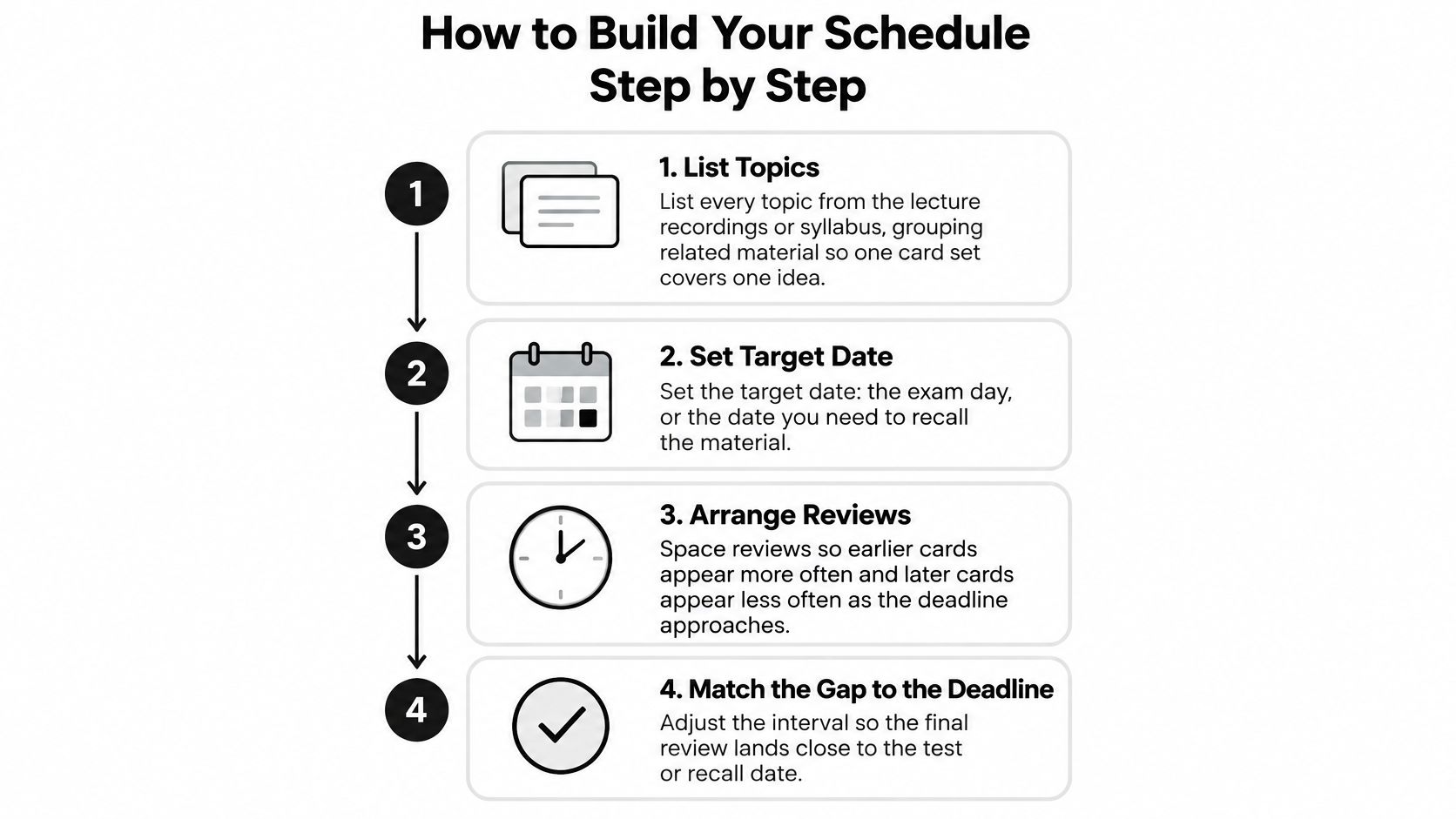
Turn the syllabus into review appointments
-
List the topics you need to retrieve. Use your syllabus, lecture titles, and learning objectives to group related material into focused sets, such as drug mechanisms or hazard identification. The common slip is making a single miscellaneous deck that hides which topics you've neglected.
-
Choose the target date. Write down the exam or retention date and identify what you'll need to do with the knowledge then. Don't substitute a vague intention to know the subject for a concrete task such as explaining a mechanism or interpreting a case.
-
Match the available window to a template. Count the time available and place review sessions around classes, work, and other assessments. Avoid booking an ideal routine that depends on having no busy days.
-
Schedule the first retrieval promptly. Close the source and attempt the main ideas while the lecture is still recent, then arrange the next return using your chosen template. Waiting until a weekly revision session can leave you discovering basic misunderstandings too late.
-
Rate the answer you produced. Use Again for failed recall, Hard for correct but difficult recall, Good for a solid answer, and Easy for confident, effortless recall. Recognizing the answer after revealing it isn't the same as retrieving it beforehand.
-
Review the due queue and repair weak items. Check wrong answers against the source, then decide whether the problem was missing knowledge, confusing wording, or a gap that was too long. Don't spend a free afternoon adding new cards while postponing the existing due queue.
Make the answer check visible
Write or say your answer before revealing the back of a card. For a nursing pharmacology concept, that might mean explaining the mechanism in your own words rather than deciding that the drug name looks familiar.
Keep the source close enough to verify your answer, but not open while you attempt it. A lecture timestamp, textbook page, or slide reference makes correction more precise than searching through an entire recording.
For an aviation example, flyCowboys' practice guidance can help you strengthen weak areas before your written. The transferable habit is to use mistakes to select the next study task, rather than treating completion as proof of readiness.
This accompanying video provides another way to engage with the study process.

A workable schedule leaves time for correction, not just card flipping. If every session overruns, reduce incoming material before sacrificing the answer check.
Fitting Reviews Into a Heavy Course Load
You can have a sensible schedule for each course and still have an impossible schedule overall. The problem appears when every lecturer expects preparation, every deck has due cards, and you treat every item as equally urgent.
A course-level meta-analysis published by Educational Psychology Review found an average 2.06% advantage for spaced retrieval over comparison conditions, with very high heterogeneity, I² = 89.2%. That variation is a reason to judge your plan by each course's demands, not assume the same routine will produce equal benefits everywhere.
Allocate time by the next meaningful deadline
Consider this hypothetical allocation for a student with a daily review budget of 75 minutes.
Daily review split for three courses
| Course | Exam in | Daily share of 75 min |
|---|---|---|
| Course A, nursing pharmacology | 3 days | 40 min |
| Course B, physiology | 10 days | 25 min |
| Course C, safety law | 25 days | 10 min |
The nearest exam gets the largest share, but the later courses don't disappear. After Course A's exam, the student could redistribute the same budget to give Course B 50 minutes and Course C 25 minutes.
Those allocations are choices, not evidence-based thresholds. Change them when a practice task reveals a major weakness, when an assessment moves, or when a course requires more application work than factual recall.
Recover without turning tomorrow into a marathon
For a hypothetical missed-week recovery plan, temporarily select Again and Hard items, cap the recovery block at 30 minutes, and pause new cards. After two manageable days, begin restoring other due items and normal study blocks.
Don't delete the omitted cards or pretend they're mastered. This is temporary triage, and you should still inspect unreviewed topics that matter for the nearest assessment.
- Check topic coverage. Track which lecture sets have had an unaided retrieval attempt, not merely which decks you've opened.
- Preserve a route to the source. Link unclear cards to the relevant lecture timestamp or document page.
- Choose useful scheduling controls. When comparing a spaced repetition app, prioritize a manageable due queue and course organization over decorative progress displays.
A completed queue can conceal an untouched lecture. Your course checklist should make that omission visible.
When to Move From Flashcards to Application Practice
A deck full of correct answers doesn't establish that you're ready for the exam. You may remember each fact when its wording supplies the cue, yet struggle to identify which fact matters in an unfamiliar problem.
A 2025 meta-analysis in Educational Psychology Review found a larger spacing effect for isolated learning, g = 0.43, than for course-embedded learning, g = 0.24. That difference doesn't make flashcards unhelpful. It means you shouldn't use card performance as your only readiness measure.
Use a practical transition check
As an illustrative coaching rule, not a validated mastery cutoff, consider moving a concept toward application when:
- Recall is consistently successful. The card has earned Good or Easy on two consecutive reviews.
- Success survives separation. You've recalled the concept across at least three spacing intervals, not through immediate repetition.
- The explanation is independent. You can state the idea without the source, hints, or the card's exact wording.
These conditions are a prompt to try harder tasks, not permission to stop checking the concept. Start application earlier whenever your course requires it, especially if cases or calculations are central to the assessment.
Change what the question asks you to do
A construction student might begin by recalling the wording of a safety rule. The application prompt asks them to examine a hypothetical site condition, identify what would justify stopping work, and explain their reasoning against the course material.
A physiology student could compare similar presentations. A nursing student could explain which information in a case is relevant to a mechanism. Use your own course's scope, and verify professional or safety-related answers against the assigned authoritative material.
Keep separate records for remembered and can apply. They describe different accomplishments.
A quiz generator for studying can help vary practice prompts, but inspect whether the question requires reasoning rather than recognition. When application fails, locate the relevant source passage and identify whether you lacked the fact, misunderstood it, or chose it in the wrong context.
Common Schedule Problems and How to Fix Them
A growing daily queue is a reason to inspect your workload, not automatically a reason to study longer. If you keep adding cards faster than you can review and correct them, tomorrow's session will remain difficult to finish.
Use the following as a troubleshooting menu. The numerical limits are example adjustments you can test, not established learning thresholds.
Schedule symptoms, causes and fixes
| Symptom | Likely cause | Fix |
|---|---|---|
| Daily queue keeps growing | Too many new cards per day | Try capping new cards at 10 to 15 a day and clear due reviews first |
| Most cards rated Again | Card covers too much material | Split the card into two smaller cards |
| Reviews feel too easy | Ratings may reflect familiarity rather than recall | Answer before revealing; let genuinely Easy cards move further out |
| Missed a week | Backlog built up | Use a temporary compressed queue focused on Again and Hard cards |
| Forgetting after the exam | No review after the exam date | Try a monthly sweep for three months, then reassess |
| Cards feel disconnected from lecture | No source reference | Open the lecture timestamp or page to check the answer |
Separate workload problems from card problems
Capping new cards changes the incoming workload immediately. It won't erase the existing backlog, but it gives you room to process it without continually adding more.
Repeated Again ratings require a different inspection. A card asking for a definition, mechanism, exceptions, and example may fail because it bundles several tasks together. Split the prompt so you can tell which part you don't know.
Easy reviews also need diagnosis. If you retrieve the answer effortlessly, accept the longer interval rather than repeatedly bringing it forward for reassurance. If you only recognize the answer after revealing it, correct the rating instead.
Test one adjustment at a time
Choose a change that matches the symptom, then watch what happens across subsequent scheduled sessions. Record whether you finish within your budget, which topics still fail, and whether you can explain corrected answers later.
- For overload, reduce new material before shortening every review interval.
- For unclear prompts, rewrite the question before assuming your memory is the problem.
- For post-exam retention, judge the plan at later retrieval checks, not immediately after adding calendar reminders.
Some fixes change today's workload; others need a later test before you can judge them. Don't expect a rewritten card to prove durable learning during the same session in which you edited it.
If you're still repeatedly failing the same material after sustained review, reconsider the card set and your understanding of the lecture. More repetitions of a confusing prompt may only give you more practice being confused.
Put Your First Review Date on the Calendar
Before today ends, choose a target date and take one lecture through a complete review cycle. Identify its main concepts, create a small set of focused cards, and attempt the answers without looking.
For an illustrative first session, make 10 to 15 cards and reserve a 20-minute daily review block. Add a calendar alert for the first return, then use the matching timeline template to book later topic checks.
Keep setup modest. You don't need to convert the whole semester before discovering whether your questions are clear and your review budget is realistic.
Start with a testable plan: A small set you retrieve and correct is more useful than an enormous deck you haven't attempted.
In our ClassLecture.ai workflow, you can record or upload a lecture, read its searchable timestamped transcript, and generate flashcards linked to exact lecture moments. FSRS scheduling uses your recall ratings to surface due cards, and the class-wide review view brings together due flashcards across lectures and documents.
The tool helps organize when to return. You still need to produce the answer, judge it fairly, and check uncertain explanations against the source.
Turn a lecture recording or class material into source-linked flashcards with ClassLecture.ai. Upload a lecture, check the timestamped transcript, and use spaced review to give your next study session a clear starting point.
The ClassLecture.ai Team
We build ClassLecture.ai, the AI study assistant that turns your recorded lectures into transcripts, summaries, flashcards, and answers cited to the exact timestamp — so you learn faster from your own professor's words.
Keep reading
How to Build an Exam Study Guide That Actually Works
Learn how to build an exam study guide that boosts recall with proven templates, active retrieval, flashcards, and a realistic study schedule.
ReadWhat Is an Objective Summary and How to Write One
What Is an Objective Summary. Learn what an objective summary is, how it differs from subjective writing, and get step-by-step tips to write one that stays
ReadThe Best Spaced Repetition App: 10 Options Compared
Compare the best spaced repetition app options by algorithm, device support, syncing, and course load. Find the right fit for your study routine.
Read