AP Euro Study Guides That Build Real Exam Skills
AP Euro study guides that turn lectures into mastery. Get unit-by-unit breakdowns, exam strategies, and a smarter way to build guides from your own notes.

“Just memorize the timeline” is poor advice for AP European History. You need chronology, but recognizing an event isn't the same as explaining why it happened or using it to support an argument. Useful AP Euro study guides help you make that jump, preferably with the lectures, documents, and notes you're already studying.
Table of Contents
- Why Most AP Euro Study Guides Miss the Point
- The Nine-Unit Structure Every Guide Should Mirror
- Anatomy of a High-Value Unit Guide
- Matching Guide Content to the Exam Tasks
- Turning Your Own Lectures Into a Personalized Guide
- Personalized Guides vs Standardized Commercial Guides
- The 2027 Exam Change and What It Means for Your Guide
- A 10-Week Study Plan Built Around Your Guide
Why Most AP Euro Study Guides Miss the Point
A polished timeline can make you feel prepared without showing whether you can answer a historical question. Reading familiar names is comfortable. Deciding which evidence supports a defensible claim takes more work.
Consider a hypothetical student who has read every assigned chapter and highlighted every review sheet. On a document-based question, that student recognizes the topic but freezes. The missing skill isn't necessarily recall. It's deciding how the documents fit together and what argument they support.
The course covers approximately 1450 to the present, including political, social, economic, cultural, and intellectual developments in Europe and their wider influence, according to the College Board's AP European History course overview. That scope calls for connected knowledge, not an expanding pile of isolated facts.
Replace recognition with explanation
When you finish reviewing a topic, close the guide and ask what you can explain without it.
- Comparison: What meaningful similarity or difference can you establish between the societies or institutions you studied?
- Causation: How did a particular condition contribute to a development?
- Continuity and change: What changed, what persisted, and how can you demonstrate both?
These questions reveal the difference between knowing a label and understanding a relationship. Your teacher's explanations, examples, and source discussions give you material for answering them.
The contrast below is the starting point for evaluating your current habits.
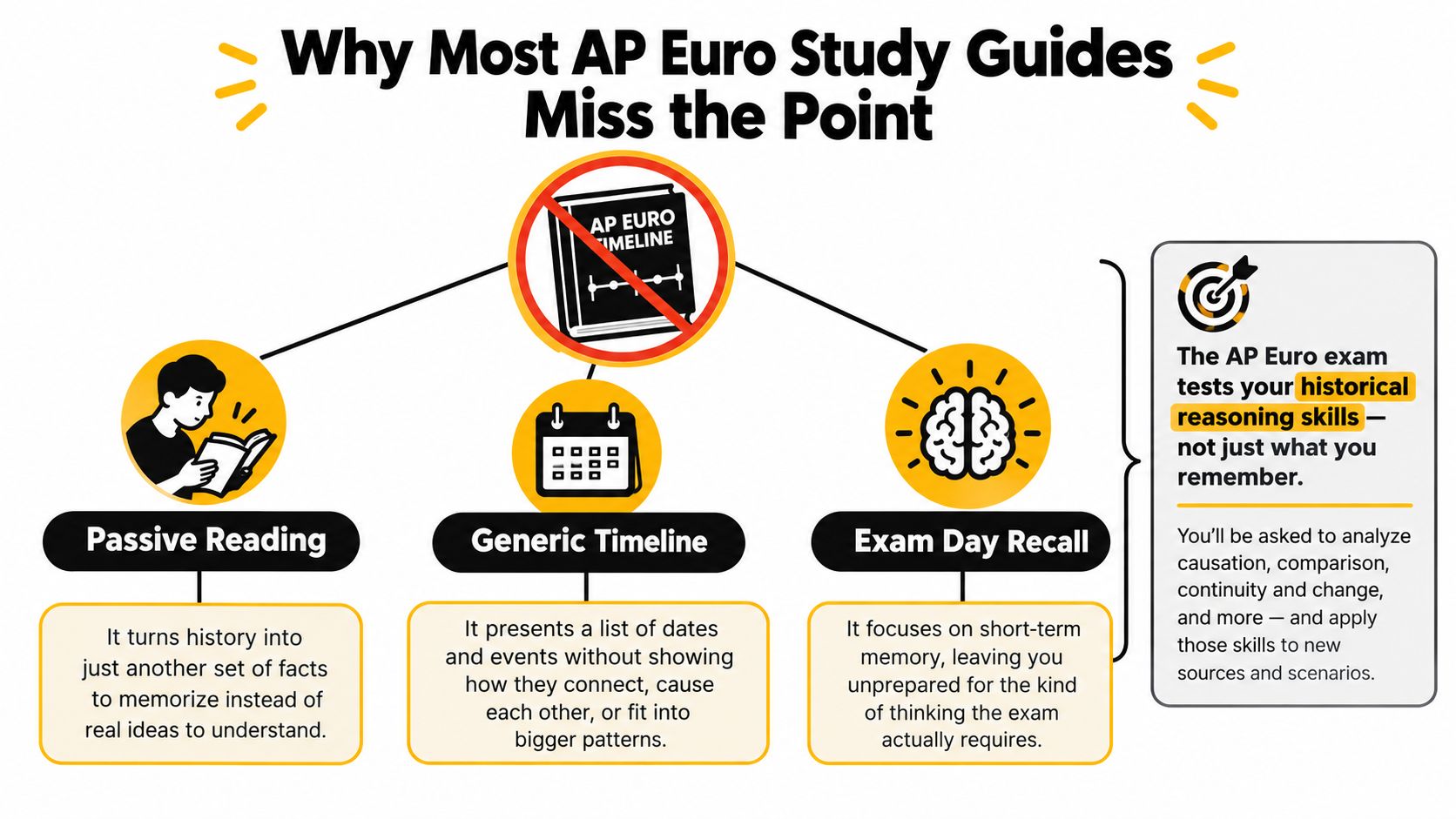
Practical rule: If you can recognize every term on a page but can't answer a question about relationships among them, you haven't finished studying that page.
Don't throw away the timeline. Give it a job. Add the question your teacher was answering, the evidence used, and the reasoning connecting them. A useful guide becomes a reasoning scaffold, something you can use to build an answer rather than merely reread a chapter.
The Nine-Unit Structure Every Guide Should Mirror
Organize your materials around the course framework, even when your textbook chapters or classroom lectures use different boundaries. Otherwise, it's easy to mistake a thick folder for complete coverage.
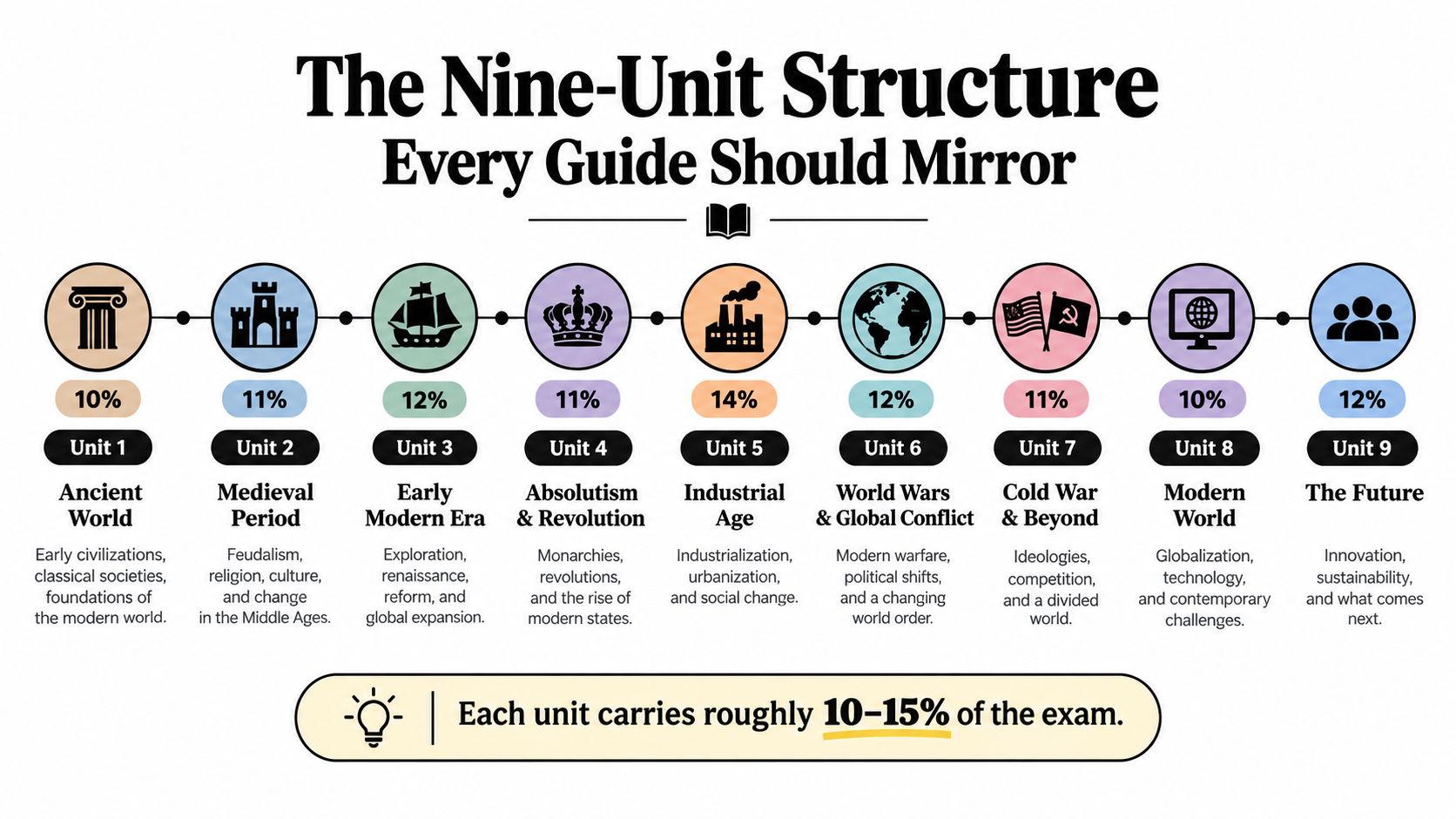
The official AP European History framework organizes the course into nine units, each carrying an estimated 10%–15% of the exam. Use that distribution as your baseline, then devote additional practice to weaknesses rather than favorite topics.
Use this overview to check your guide's coverage.
Give each unit a practice focus
The following reasoning pairings are suggested teaching choices, not official restrictions. Don't assume a particular unit belongs exclusively to a DBQ, SAQ, or multiple-choice question.
| Unit topic | Suggested reasoning emphasis | Useful starting task |
|---|---|---|
| Renaissance and Exploration | Comparison | Compare developments using class evidence |
| Age of Reformation | Causation | Explain a relationship between religion and political authority |
| Absolutism and Constitutionalism | Comparison | Build an argument about institutions of power |
| Scientific, Philosophical, and Political Developments | Continuity and change | Track changing approaches to knowledge |
| Conflict, Crisis, and Reaction in the Late Eighteenth Century | Causation | Separate underlying conditions from immediate triggers |
| Industrialization and Its Effects | Continuity and change | Explain a transformation alongside a persistence |
| Nineteenth-Century Perspectives and Political Developments | Comparison | Compare responses to a shared political problem |
| Twentieth-Century Global Conflicts | Causation | Distinguish causes, turning points, and consequences |
| Cold War and Contemporary Europe | Continuity and change | Evaluate change across political transitions |
Create a crosswalk between these topics and your actual materials. A lecture might belong in several folders because your teacher connected an intellectual movement with political institutions or economic developments.
Don't interpret extra classroom time as permission to ignore other units. Teacher emphasis helps you choose examples and understand difficult relationships. The official framework helps you notice what your classroom materials haven't yet covered.
For a supplementary review resource, keep the same unit checklist beside this video.

After using any outside explanation, return to the checklist. Add missing coverage, but don't replace your teacher's source work with another generic summary.
Anatomy of a High-Value Unit Guide
Start with a lecture topic, not a blank document titled “Everything About European History.” A manageable page answers a focused historical question and preserves enough evidence to support an answer.
Suppose your teacher asks how political authority changed during a period you're studying. Copying every slide produces a record of the lesson. Selecting relevant institutions, competing claims, and supporting examples produces a study guide.
Build a page you can actually use
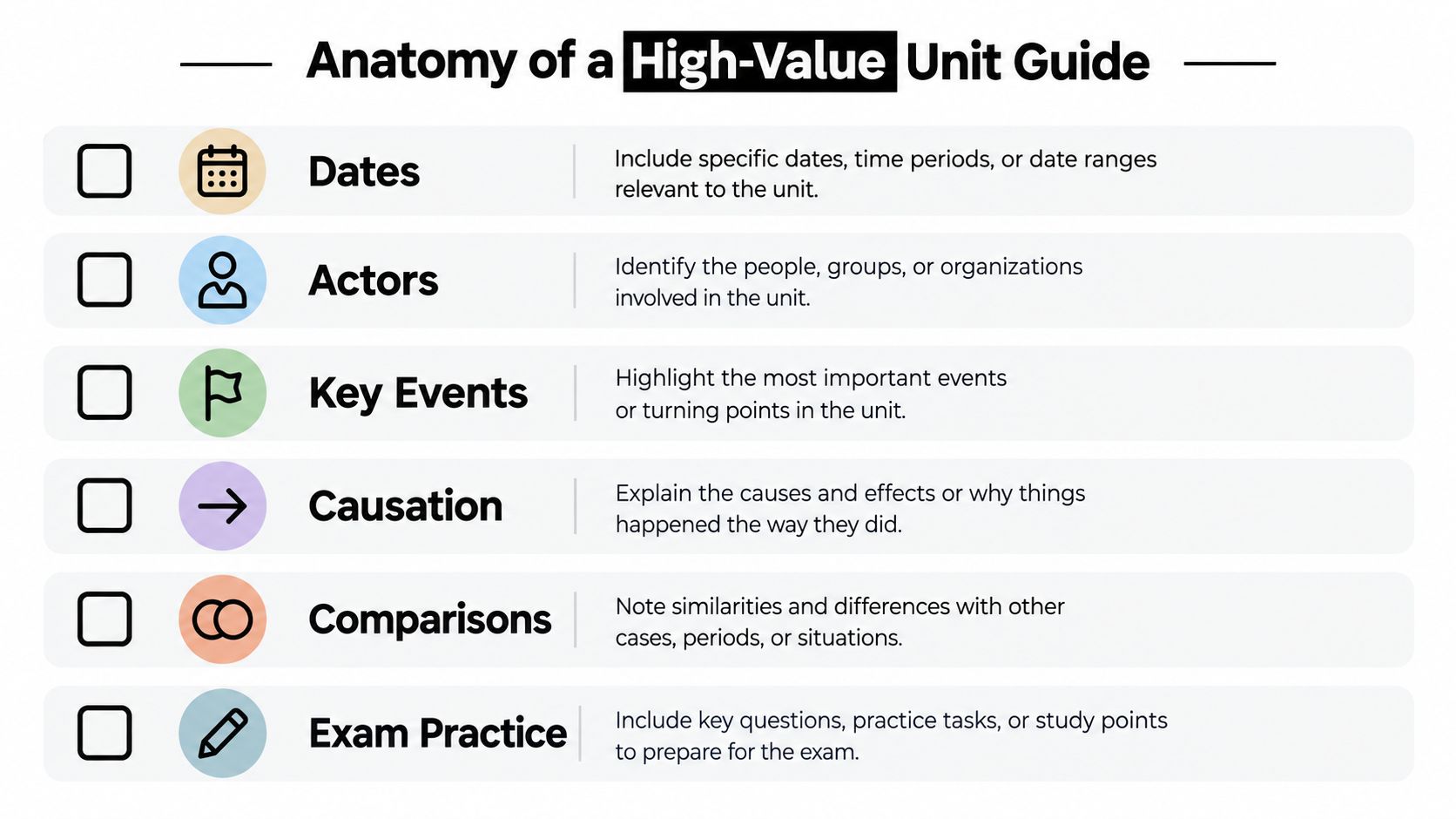
Include these fields, keeping each entry concise enough to review but specific enough to explain.
- Dates and sequence: Establish what came before, during, and after the development. Flag uncertain dates for checking.
- Actors and institutions: Identify who acted and what organization, office, or social group shaped their choices.
- Evidence: Preserve a concrete example from the lecture, textbook, or assigned document, with its location.
- Causal claim: Write a sentence explaining how a condition or action contributed to an outcome.
- Comparison hook: Identify another development you could compare with this topic.
- Thematic connection: Connect the material to political, economic, social, cultural, or intellectual change.
Use the checklist below to audit a page before calling it complete.
End with a question, not another definition
A weak final entry says, “Review political authority.” A useful prompt asks you to explain how an institution limited or expanded someone's authority, using evidence from the lesson.
Write your response before reopening the notes. Then mark the exact place where you became vague. Perhaps you named an institution without explaining its role, or described an outcome without establishing a cause.
A fact belongs in your guide because you can use it, not because you highlighted it.
Keep corrections beside the original response. Replacing a weak answer with polished notes can hide the misunderstanding you need to revisit. Your guide should preserve both the course content and a record of what you still need to learn.
Matching Guide Content to the Exam Tasks
Tag each unit page with the task you'll practice: MCQ, SAQ, DBQ, or LEQ. These tags describe practice opportunities, not predictions about which topics will appear where.
The current format includes 55 multiple-choice questions, three short-answer questions, one document-based question, and one long essay over 3 hours 15 minutes; the DBQ supplies seven documents, according to the AP European History Course and Exam Description. Check the exam-year guidance before applying those specifications to your own administration.
Match the material to the response
| Exam task | Guide material to prepare | Practice action |
|---|---|---|
| MCQ | Vocabulary, sequence, contextual clues, and source annotations | Explain why your selected answer fits the evidence |
| SAQ | Focused claims paired with specific examples | Answer the requested task without adding an unnecessary introduction |
| DBQ | Document notes, evidence groupings, and relevant outside knowledge | Organize sources around an argument |
| LEQ | Retrievable examples and cross-topic connections | Draft a timed argument outline from memory |
For multiple-choice practice, don't stop at the answer key. Record whether you missed the question because you misunderstood the source, confused the chronology, or lacked relevant knowledge. Those problems require different repairs.
For short answers, use claim, evidence, reasoning as a practice scaffold rather than a rigid script. State the answer, supply the example, and explain the connection. A paragraph full of accurate background can still fail to address the task.
Treat documents as evidence
For DBQ preparation, annotate author, audience, purpose, historical situation, point of view, and corroboration. Then ask why those features matter to your argument. Naming an author's position isn't the same as explaining how it shapes the source.
Practice building an argument supported by at least six documents, consistent with the published practice guidance in the course description cited above. Also prepare specific outside evidence, but don't assume that mentioning an extra fact automatically makes it relevant.
For the LEQ, rehearse the decisions before drafting: your position, your evidence, and the relationship each paragraph will explain. Check whether your thesis makes an argument rather than announcing a topic.
If you're creating questions from your notes, this guide to using a quiz generator for studying can help organize that work. Treat generated answers as drafts to verify, not as official scoring decisions.
Turning Your Own Lectures Into a Personalized Guide
Suppose you've finished a lecture on industrialization. Your notebook contains definitions, an unfinished diagram, and a reminder that the teacher emphasized a particular comparison. A generic review book won't tell you what you missed in that explanation.
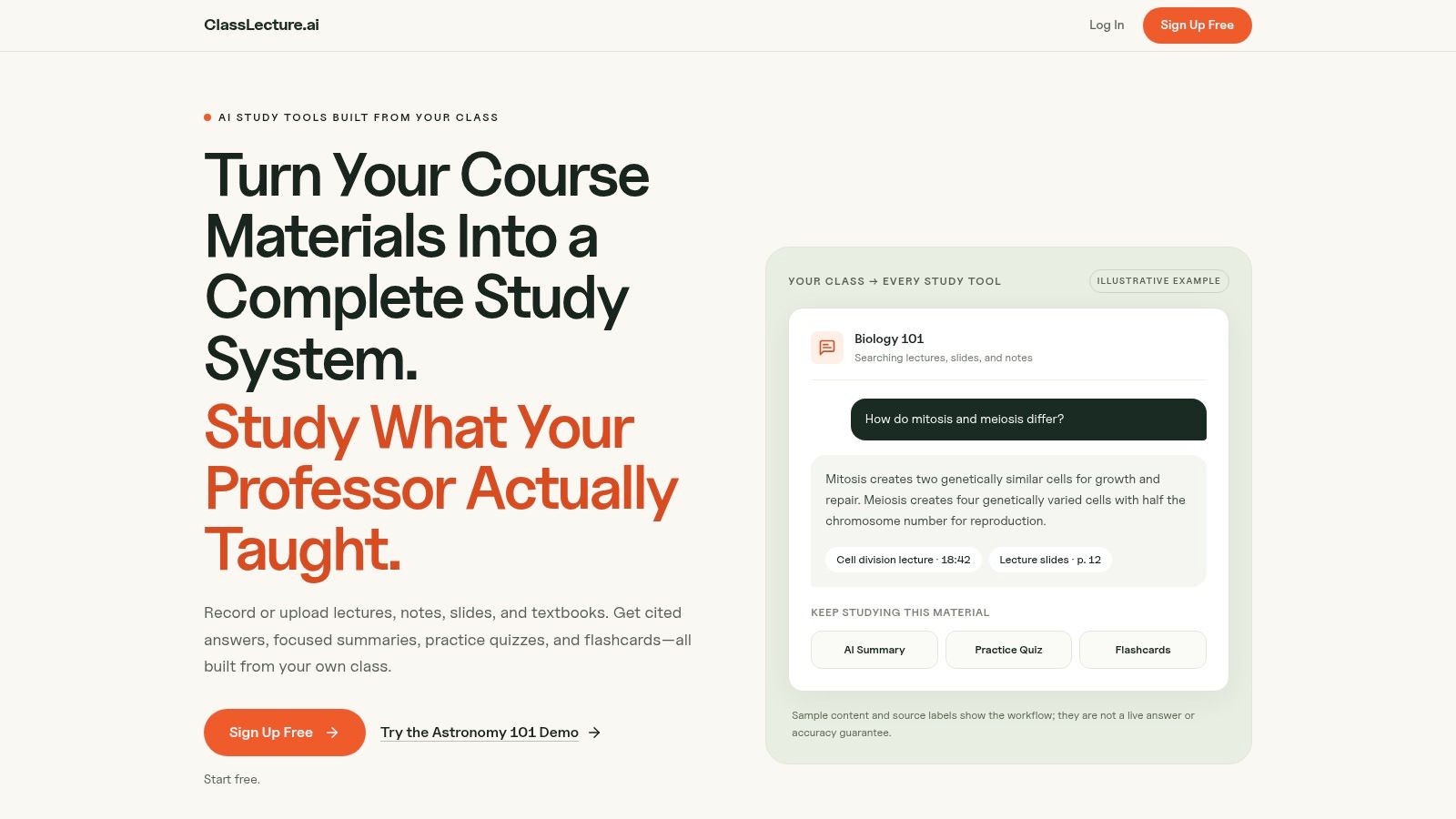
You can reconstruct the lesson manually from your notes and assigned readings, or use a source-based study assistant. The platform shown below supports uploaded or recorded lectures, transcripts, summaries, flashcards, and conversational questions over your materials.
Keep the original material available while you build the guide.
Reconstruct the explanation
Upload your permitted recording or class document, or record a session when you have permission. Supported audio and video formats include MP3, MP4, M4A, WAV, MOV, and WEBM. You can also attach an external video reference, such as a YouTube, Zoom, or Panopto URL, alongside the lecture materials.
Generate a summary, then compare its organization with the unit template. Don't accept a neat outline just because it looks finished. Check whether it preserved the teacher's central question and distinguished examples from conclusions.
Ask targeted questions rather than requesting “everything important.”
- Recover the emphasis: “Which comparison did the teacher return to, and where?”
- Clarify the reasoning: “What explanation connects the economic development with the social change?”
- Find the support: “Which passage supports this claim?”
- Identify uncertainty: “What would I need to check before using this example in an essay?”
Verify before you memorize
Conversational answers can include timestamp and document-page references. Open those references and inspect the surrounding passage, especially when a summary seems to turn a qualified statement into a universal claim.
Use the source-scope selector to distinguish transcript-based explanations from information in uploaded notes or textbooks. If those materials disagree, flag the discrepancy for your teacher rather than combining incompatible accounts into a flashcard.
Generate flashcards only after checking the underlying content. Keep straightforward recall cards, but include explanation prompts that require you to connect evidence with a claim.
The organization principles in this US history study guide offer another model for arranging lecture-heavy material. Borrow the workflow, not the historical examples. Your AP Euro guide should remain anchored in the sources you're studying.
Personalized Guides vs Standardized Commercial Guides
A commercial guide and a personalized guide solve different problems. The first can help you inspect overall coverage. The second can help you recover and practice the explanations from your own classroom.
Neither deserves automatic trust. Evaluate a particular commercial edition against the course framework, and check your personalized guide against the original materials. A beautifully organized misunderstanding is still a misunderstanding.
Commercial Guide vs Personalized Guide
| Factor | Commercial Guide | Personalized Guide |
|---|---|---|
| Coverage | Offers a fixed scope you can compare with the framework | Depends on the materials you include |
| Classroom alignment | May use different examples or emphasis | Can preserve your teacher's questions and explanations |
| Organization | Provides a ready-made sequence | Requires consistent filing and revision |
| Source checking | Depends on the publication's references | Can retain direct lecture and page locations |
| Practice | Depends on the edition and its exam-year alignment | Can target your documented mistakes |
| Maintenance | Requires checking whether the edition is current | Requires updating as the course progresses |
Choose the blend that fits your situation
For a first-time student with clear classroom instruction, I'd use the standardized guide as a coverage checklist and the personalized guide as the main practice resource. That combination keeps classroom depth without assuming the class has already addressed every topic.
A student who missed lectures needs to recover the explanation before compressing it. Obtain permitted recordings, teacher materials, or reliable class notes. A summary of incomplete notes can't restore evidence that was never included.
- Retake students: Begin with an error audit. Decide whether the problem was missing content, weak source analysis, or incomplete argumentation.
- Self-studiers: Use the official framework to establish coverage, then build a guide from selected learning materials.
- Students with scattered notes: Consolidate by unit before generating more summaries. Additional documents won't solve a filing problem.
Choose by gap: Use a broad reference to find omissions and your class materials to investigate explanations.
Don't purchase or generate another guide just because the existing one feels difficult. First identify what you need that it doesn't provide. Sometimes the missing resource is a clearer explanation. Sometimes it's just an unanswered practice prompt.
The 2027 Exam Change and What It Means for Your Guide
College Board has announced a planned update beginning with the May 2027 exam, intended to provide a more consistent exam experience and greater flexibility in demonstrating learning, as described in its clarifications effective fall 2026. Treat that announcement as a reason to check alignment, not abandon useful content.
An older exercise may still help you learn history while giving you the wrong expectations about response choices or timing. Those are separate judgments. Evaluate the historical work and the format instructions independently.
Label practice by its purpose
Use visible labels in your guide so you know what an exercise is preparing you to do.
- Current-format practice: Matches the published specifications for the administration you're preparing for.
- Transition-ready practice: Develops reasoning and evidence use without depending on a particular response format.
- Historical-content review: Checks knowledge and understanding without pretending to simulate the exam.
Don't label a practice set transition-ready merely because its publisher mentions the upcoming change. Inspect the actual directions and compare them with official guidance for your exam year.
Keep content while replacing obsolete directions
Preserve accurate evidence banks, document annotations, and explanations of historical relationships. Review separately any advice about prompt selection, timing, required responses, or scoring procedures.
A useful maintenance habit is to place the exam year beside every timed practice set. If you can't establish which specifications it follows, use it for learning rather than as a full simulation.
You don't need to predict undisclosed details. You need a guide that makes uncertainty visible and allows you to replace format-specific instructions without rebuilding your historical understanding.
A 10-Week Study Plan Built Around Your Guide
Treat this as a suggested schedule, not an official preparation requirement. It assumes you're reviewing previously taught material; if you're learning the course independently, allow more time for initial instruction.
The early weeks pair related units so the complete course receives attention before the longer writing sessions. Adjust the workload to your school calendar, but don't remove a unit when you fall behind.
Build and test the unit pages
| Week | Suggested focus | Concrete output |
|---|---|---|
| 1 | Renaissance and Exploration, then Reformation | Separate unit pages and a comparison response |
| 2 | Absolutism and Constitutionalism | An institutional comparison with checked evidence |
| 3 | Scientific, Philosophical, and Political Developments | A change-over-time explanation |
| 4 | Late-eighteenth-century conflict and crisis | A causal argument separating conditions from triggers |
| 5 | Industrialization and Its Effects | A source-supported explanation of change |
| 6 | Nineteenth-century political developments | Comparison practice and targeted short answers |
| 7 | Global Conflicts, then Cold War and Contemporary Europe | Separate guides and a cross-unit evidence check |
| 8 | DBQ practice | A complete response followed by scoring-guideline review |
| 9 | LEQ practice and cumulative recall | A timed essay and revised evidence bank |
| 10 | Full-exam rehearsal and repair | Practice attempts followed by source-based corrections |
During the unit-building weeks, follow a consistent sequence: organize the source materials, draft the guide, retrieve from memory, answer a prompt, and correct the response. Don't spend the entire week preparing to practice.
Make the final weeks diagnostic
For the DBQ rehearsal, use a complete official practice task when available. Classroom documents remain useful for drills, but a collection you assembled yourself isn't automatically an exam-equivalent document set.
During cumulative review, use the platform's FSRS flashcard scheduling to revisit due material across the class. Rate cards accurately. Recognizing an answer after revealing it isn't successful retrieval, and an exam-readiness display isn't a predicted AP score.
In the final week, reserve separate sessions for full practice and detailed correction. For every missed question, record the misunderstanding, locate the relevant source, and write the corrected reasoning. This approach to studying for AP World offers another planning reference, but keep your Euro evidence and exam-year directions distinct.
Finish with a shorter list of unresolved weaknesses, not a larger collection of unread summaries.
ClassLecture.ai offers lecture transcripts, AI-generated study guides, flashcards, and source-cited Q&A for reviewing your own course materials. Visit ClassLecture.ai, upload a permitted AP Euro lecture or set of notes, and build a unit page that ends with an argument you can defend.
The ClassLecture.ai Team
We build ClassLecture.ai, the AI study assistant that turns your recorded lectures into transcripts, summaries, flashcards, and answers cited to the exact timestamp — so you learn faster from your own professor's words.
Keep reading
Free Audio Transcription: 10 Tools Compared
Compare 10 free audio transcription tools for accuracy, limits, languages, privacy, and study workflows, including ClassLecture.ai.
Read7 Meeting Recording Software Options Compared
Compare 7 meeting recording software options for students, educators, and teams, including features, limits, pricing, capture methods, and best-fit use cases.
ReadHow to Transcribe a Lecture: A Practical 2026 Workflow
Learn how to transcribe a lecture quickly and accurately in 2026, from recording tips and AI tools to timestamping and editing for better study notes.
Read