US History Study Guide for Smarter Exam Prep
Master this US history study guide with eras, key people, essays, DBQs, and faster review using your own lectures and notes.

You're staring at a week's worth of recorded lectures, half-finished notes, and a study list that seems to grow every time you open the textbook. One lecture explains the Constitution, another jumps to Reconstruction, and your flashcards contain names without any sense of why those people mattered. Rewatching everything feels productive, but it often leaves you with less time to practice explaining causes and consequences.
A useful US history study guide should do more than collect dates. It should help you place events in sequence, connect them to recurring themes, identify what changed for different groups, and support each conclusion with evidence. The workflow below moves from a simple era map to causal reasoning, document analysis, essay practice, and a practical system for turning your own lectures into summaries, flashcards, and timelines.
Table of Contents
- Why Most US History Review Feels Overwhelming
- How to Organize US History by Era and Theme
- Key Events and People You Must Master
- How to Explain Causes Instead of Just Listing Dates
- How to Analyze Documents Maps and Photos Like a Historian
- Essay and DBQ Strategies That Earn Points
- Turn Lectures and Notes Into Summaries Flashcards and Timelines
Why Most US History Review Feels Overwhelming
Maya has three recorded lectures to review before an exam. She starts with the lecture on the early republic, pauses whenever the professor names a law or political leader, and types hurried notes into a document. After an hour, she has several pages of fragments but still can't answer a basic question: what changed, for whom, and through what mechanism?
That problem isn't a lack of effort. History courses ask you to manage several kinds of information at once. You need chronology, institutions, people, regional differences, economic pressures, social experiences, and evidence from documents. A list of isolated facts can't show how one decision altered later choices.
The pressure is visible in AP US History results. In 2025, 516,738 students took AP US History, 73.7% earned a score of 3 or higher, 26.3% scored below 3, and 14.2% earned a 5, according to the College Board's AP US History score distribution. Those results don't tell you how any individual student will perform, but they do highlight why recognition alone isn't enough. A learner may recognize a term and still struggle to explain its significance.
A better study contract
Use this guide as a contract with yourself:
- Place every topic in time. Identify what had already happened and what had not yet happened.
- Name the change. Describe the institution, policy, belief, economy, or social relationship that shifted.
- Identify affected groups. Ask who gained options, who lost power, and whose experience is missing.
- Test the explanation. Use primary sources, corroboration, and counterevidence rather than relying on one summary.
- Practice retrieval. Close your notes and explain the event in your own words.
Keep your course outline beside the era map. Mark each topic as secure, uncertain, or unexplained. “Unexplained” is the most important category. It identifies material you can name but cannot yet use in an argument.
Practical rule: If you can define a term but can't explain what it changed, you're not finished studying it.
A strong review session should therefore move through four choices: what happened, why it happened, whom it affected, and how you know. The next step is to give those questions a structure that keeps chronology and themes together.
How to Organize US History by Era and Theme
You are reviewing a lecture on westward expansion, then realize the same topic involves land, labor, Native sovereignty, migration, and federal power. A timeline alone cannot hold all those connections. Use chronology to locate each development, then use themes to explain who gained power, who lost it, and why the change mattered.
Start with six broad eras:
- Colonial Era, 1607 to 1776: settlement, Native diplomacy and conflict, labor systems, religious communities, and British rule.
- Founding Era, 1776 to 1800: independence, constitutional design, federal power, and competing ideas of citizenship.
- Expansion Era, 1800 to 1860: westward movement, market growth, slavery's expansion, reform, and sectional conflict.
- Civil War Era, 1861 to 1877: secession, emancipation, Union victory, Reconstruction, and contested freedom.
- Industrial Era, 1877 to 1945: industrialization, urbanization, immigration, labor conflict, reform, and world wars.
- Modern Era, 1945 to the present: the Cold War, civil rights, globalization, changing political coalitions, and debates over federal power.
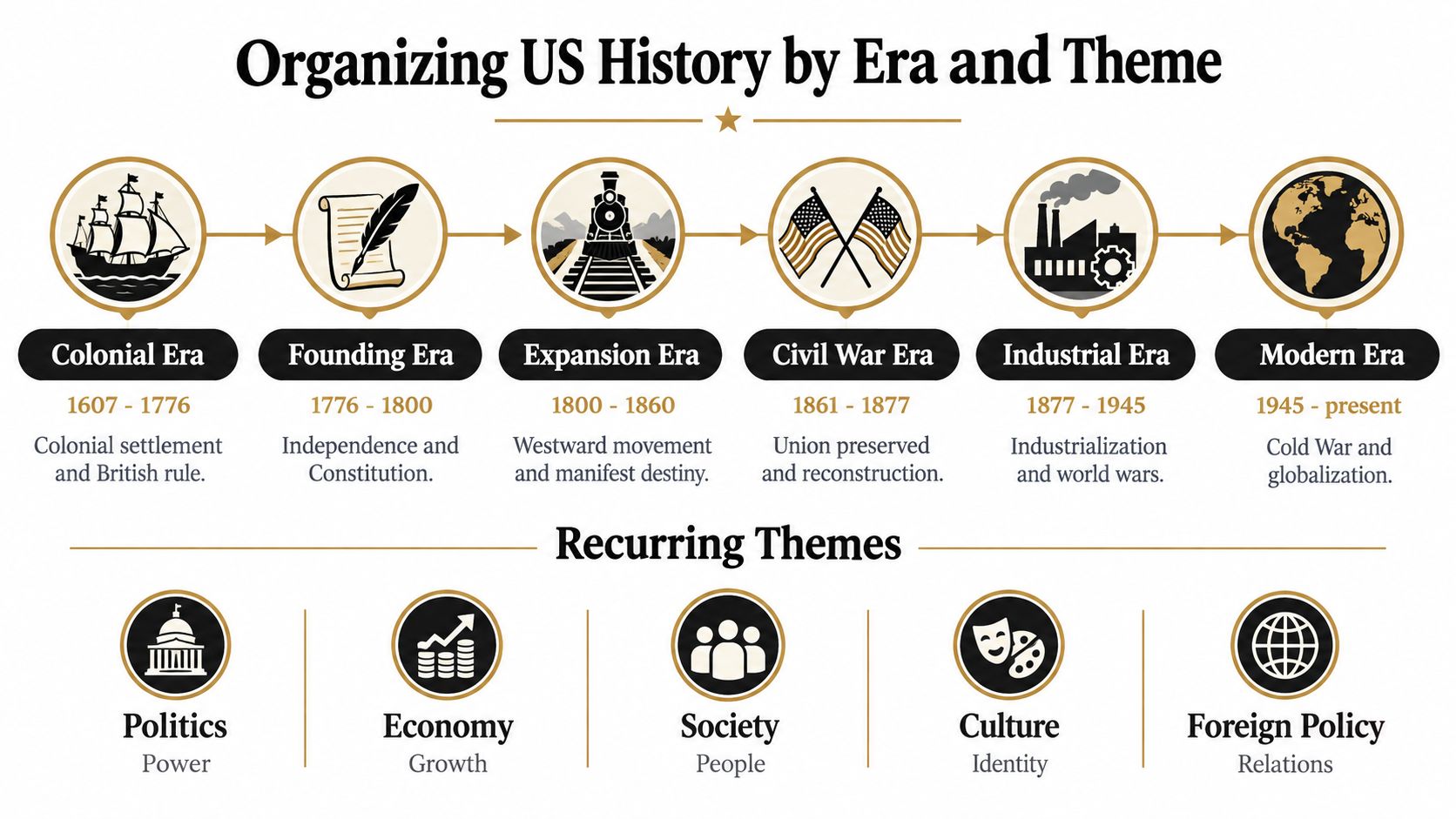
Add recurring thematic threads
Under every era, create the same thematic folders:
- Politics: constitutions, parties, elections, courts, federalism, and public policy.
- Economy: land, labor, production, trade, markets, corporations, and regulation.
- Society: race, class, gender, family, migration, citizenship, and community.
- Culture: religion, education, science, media, art, and competing national identities.
- Foreign policy: diplomacy, war, empire, alliances, and international institutions.
This arrangement turns separate lectures into one connected history. For each topic, record what changed and for whom. Population measurement, for example, belongs to politics because representation and taxation depend on it. It also belongs to society and migration because demographic records reveal changing communities. The first constitutionally required census took place in 1790, after President George Washington signed the Census Act on March 1. It recorded 3,929,214 residents, including 697,624 enslaved people, according to the U.S. Census Bureau's history of the 1790 census.
Use chronology as a guardrail
Turn each lecture recording into a compact study record. Write three lines:
- Before: What conditions made this event possible?
- During: What decision, conflict, or policy changed the situation?
- After: Which groups gained opportunities, faced restrictions, or encountered new risks?
Then convert the record into a short summary, a flashcard, and a timeline entry. Cite the source beside the fact, not at the end of a crowded page. A flashcard should ask for a relationship, such as “How did this policy change power for different groups?” rather than only asking for a date.
Population records make chronology tangible. The United States grew from roughly 3.9 million people in 1790 to more than 331.4 million in the 2020 Census, an estimated 6.9% increase over 2010, according to the Census Bureau's 2020 Census results. That arc helps explain why institutions created for a small republic faced different pressures as the country expanded.
Treat the timeline as a river with recurring threads. Constitutional systems, labor, migration, federal authority, and definitions of freedom keep changing shape, even when the vocabulary changes.
Key Events and People You Must Master
A crowded syllabus becomes manageable when you rank events by explanatory value. Begin with developments that changed institutions, reshaped daily life, or created conflicts that influenced later policy. Pair each event with the people and groups who made choices within those conditions. For every era, ask two questions: what changed, and for whom?
The Civil War deserves close study because its scale altered government and society. It lasted from 1861 to 1865. Congressional Research Service data list 2,213,363 Union service members and 364,511 Union deaths, including deaths from combat, disease, and other causes, according to the Congressional Research Service report on Civil War casualties. Traditional estimates place total American deaths above 620,000, though demographic studies suggest higher figures, as reported by the National Park Service's Civil War resources. Gettysburg, fought from July 1 to July 3, 1863, produced roughly 51,000 casualties, according to the National Park Service's Gettysburg battle page.
These figures matter because scale helps explain policy. The war pushed Union leaders to revise military aims, connect emancipation with wartime strategy, and expand military service for African American men. Enslaved people also shaped events by escaping, sharing information, seeking protection, and pressing national leaders to define freedom in practice.
Rank topics by explanatory value
| Topic example | What changed | Who was affected |
|---|---|---|
| Constitution and federalism | The national government received defined powers while states retained authority | Voters, states, taxpayers, and people excluded from political membership |
| Westward expansion | Federal policy and settlement extended US control across the continent | Indigenous nations, settlers, enslaved people, free Black communities, and Mexican residents |
| Emancipation and the Civil War | Military aims became connected to the destruction of slavery | Enslaved people, African American soldiers, Union soldiers, border-state residents, and Confederate communities |
| Reconstruction | The nation debated citizenship, civil rights, labor, and federal enforcement | Freedpeople, Southern states, white supremacist groups, and federal officials |
| Industrialization and reform | Production, urban life, labor relations, and regulation changed | Workers, immigrants, business owners, reformers, and urban families |
| Cold War policy | International rivalry influenced domestic politics and foreign intervention | Soldiers, civilians, political dissidents, allied populations, and communities in affected regions |
Study important people through decisions and consequences rather than biography alone. George Washington matters partly because he signed the Census Act and worked within the new constitutional system. Abraham Lincoln matters through the wartime policies his administration adopted. Frederick Douglass matters through his arguments about citizenship, military service, and emancipation.
A useful lecture workflow keeps each example connected to evidence. After recording a lecture, write one sentence about the conditions before an event, one about the decision or conflict during it, and one about who gained opportunities or faced restrictions afterward. Turn those lines into a summary, a timeline entry, and a relationship-focused APUSH flashcard set. Add voices that standard summaries often compress: Indigenous nations, enslaved people, women, immigrants, laborers, and regional communities. Ask what each group could do, which institutions constrained them, and which sources preserve their experiences.
How to Explain Causes Instead of Just Listing Dates
A date tells you when something happened. A causal explanation tells you why actors made choices and what those choices changed.
Consider the Emancipation Proclamation. Many students know it was important, but that recognition can hide several unanswered questions. Did it immediately abolish slavery nationwide? Did it cause the border states to leave the Union? How did it affect the war?
A 2026 South Carolina US History data review found that many students recognized the proclamation's importance but struggled to explain its effect on the Civil War, including its role in enabling African American Union regiments. Roughly one-third incorrectly believed it caused border states to secede, according to the South Carolina US History data review. The mistake comes from confusing a policy's significance with its complete consequence.
Build a mechanism chain
Use this sequence for any major event:
Conditions → decision → mechanism → immediate result → broader consequence
For the Emancipation Proclamation, your notes might read:
- Conditions: The Union faced a long war and needed to weaken the Confederacy.
- Decision: The administration framed emancipation as a wartime measure.
- Mechanism: Enslaved people in areas under rebellion were declared free, and the policy helped open expanded military service to African American men.
- Immediate result: The Union connected military victory to the destruction of Confederate slavery.
- Limits: The proclamation did not immediately abolish slavery everywhere, and border states remained in the Union.
That last line matters. A policy can be transformative and limited at the same time. Good historical writing names both.
Use counterfactual questions carefully
Counterfactuals expose weak reasoning:
- If the proclamation caused border states to secede, what evidence should appear in the timeline?
- If emancipation was immediate everywhere, why would later constitutional and military developments matter?
- If Cold War involvement was only about ideology, why examine power vacuums, alliances, resources, and regional politics?
Write a thesis that includes a mechanism:
The proclamation changed the Civil War by linking Union victory to emancipation and expanding the Union's military resources, although its immediate legal reach remained limited.
Then test that thesis against two contrasting documents. Record what each source shows, what it omits, and whether it supports the argument directly or only through context.
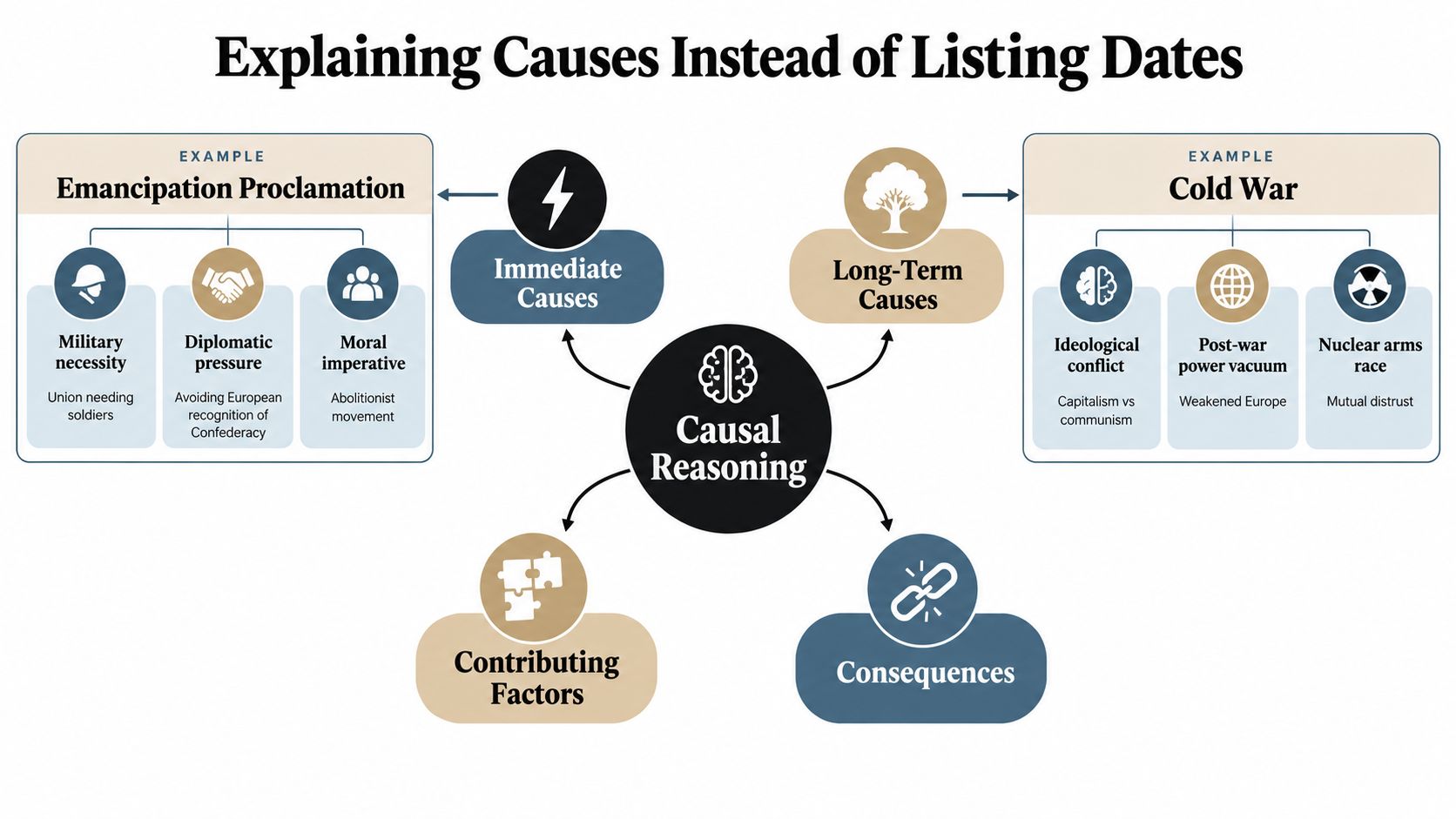
The same approach works for the Cold War. Don't stop at “the United States opposed communism.” Ask how ideological conflict, postwar power shifts, domestic politics, military strategy, and regional interests combined to produce a particular action. A strong answer explains why one factor mattered more in that context and identifies evidence that complicates the conclusion.
How to Analyze Documents Maps and Photos Like a Historian
A photograph of a crowded factory, a speech about war, or a map of changing borders can make an era feel real. It cannot, by itself, explain what changed, for whom, or why. Judge each source by whether it supports the specific claim you're making.
Start with sourcing. Record:
- Creator and date: Who made it, and when?
- Audience: Who was expected to read, hear, or view it?
- Purpose: Was the creator persuading, reporting, documenting, defending, criticizing, or mobilizing?
- Context: What events shaped the source?
- Claims and omissions: What does it say, and what does it leave out?
- Position and bias: What interests or assumptions might shape the presentation?
The National Archives primary-source analysis framework organizes the work around document analysis, context, relevant information, and evidence-based judgment. Apply those steps to your lecture recording: mark the era, identify what changed for which groups, then attach each claim to a source. Turn the result into a short summary, a citation-backed flashcard, and a timeline entry.

Match the method to the medium
A speech shows public language and persuasion. A newspaper shows framing and audience. A map can reveal boundaries, movement, or spatial claims. A photograph may document a moment while also reflecting selection, staging, and omission. A political cartoon condenses an argument through symbols, labels, and exaggeration.
Ask what each medium can reveal and what it cannot establish alone. For example, a map may show territorial change, but another source is needed to explain how that change affected residents.
Create an evidence matrix
Use a small table in your notes:
| Evidence | Category | What it shows | Limitation | Use in argument |
|---|---|---|---|---|
| A policy document | Direct observation | The policy's stated language | It may hide enforcement or resistance | Establishes official intent |
| A population record | Contextual fact | Demographic or institutional conditions | It may classify people imperfectly | Supports scale and setting |
| Your conclusion | Inference | Why the evidence supports a claim | It remains open to challenge | Forms the argument |
Label each row as direct observation, contextual fact, or inference. That separation keeps an author's interpretation from becoming your established fact.
Build each study unit around a timeline of prerequisite events, central historical question, source set, evidence matrix, and an argument paragraph. The University of North Carolina guide to using primary sources supports this structured approach. Compare important claims with contrasting evidence, record whose voice is absent, and cite the source beside each summary, flashcard, and timeline entry.
Essay and DBQ Strategies That Earn Points
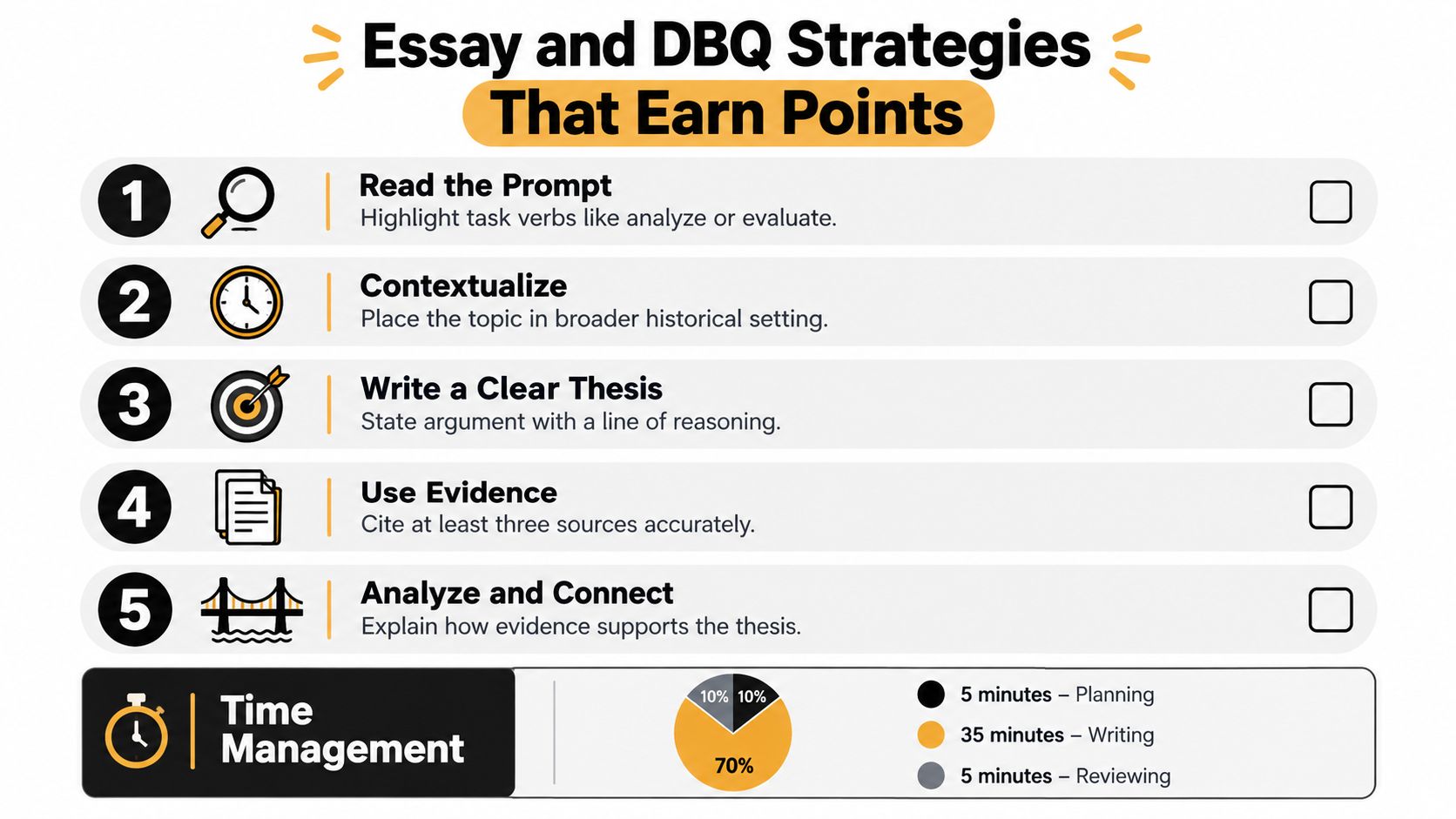
Picture the exam clock moving while a DBQ prompt asks whether a policy changed American society. A strong response begins by turning that question into four parts: the task, the period, the historical actors, and the standard for judgment. That framework keeps chronology connected to a causal question: what changed, for whom, and why?
Build the response in deliberate passes
- Read the prompt. Circle verbs such as analyze, evaluate, compare, or explain. Underline the time period and subject.
- Draft context. Write the conditions that shaped the issue before its central development. Link that background to the groups affected.
- Write a qualified thesis. State a defensible position and the main reasons supporting it.
- Group evidence. Arrange documents by causes or effects, such as political power, economic incentives, military necessity, or social change.
- Source strategically. Explain how a creator's audience, purpose, position, or historical situation shapes the document's meaning.
- Add outside knowledge. Include a relevant fact beyond the documents, then show how it strengthens your argument.
- Address tension. Identify a contradiction, limitation, or alternative interpretation, and explain why your conclusion still fits the evidence.
The College Board's APUSH DBQ scoring rubric awards the sourcing point only when you connect a document's purpose, audience, position, or situation to your argument. Naming a HIPP element without explaining that connection does not earn the point.
A useful body paragraph has four moves: claim, evidence, sourcing, and connection. The connection explains what the source reveals about an actor's incentives, the institution's limits, or the consequences for a particular group. Write that explanation beside each lecture summary or flashcard while the reasoning is fresh, then reuse it in a timeline entry with its citation.
A document belongs in your essay only when you can explain what it contributes to your reasoning.
Use your study matrix as a compressed outline. One paragraph might compare an official statement with a personal account. Another could connect a law to effects on labor or citizenship. Those contrasts create analysis because they require an explanation of why the sources differ and whose interests each reflects.

For a related method of organizing historical review, see how to study for AP World. Adapt the workflow to your course. A strong essay needs a defensible claim, accurate evidence, clear causation, and attention to limits.
Turn Lectures and Notes Into Summaries Flashcards and Timelines
Your recorded lectures already contain the raw material for a personalized study guide. The challenge is converting speech and scattered documents into study objects you can retrieve, question, and verify.
Start with capture. Save lecture recordings, slides, textbook excerpts, and handwritten notes in one course folder. ClassLecture.ai can process uploaded or recorded course content, create transcripts, generate summaries and structured study guides, and support questions tied to timestamps or document pages. It accepts common audio and video formats, along with files such as PDF and DOCX.
Use a repeatable weekly rhythm
After class: Upload or record the lecture. Skim the transcript and mark unclear terms, missing transitions, and claims that need checking.
The next day: Generate a concise summary, then rewrite it into the era and theme system. Add a “what changed for whom?” sentence under each major event.
Later in the week: Ask source-specific questions. For example, ask what evidence supports a lecture's explanation of Reconstruction, then compare the answer with your textbook or assigned primary sources.
Before the exam: Turn the summary into retrieval prompts and flashcards. Good cards ask for mechanisms: "Why did this policy matter?" "Which group gained advantage?" "What evidence challenges this interpretation?"
Use flashcards for study notes as a model for converting passive notes into active recall. Keep separate cards for chronology, definitions, comparisons, causes, consequences, and source analysis. A timeline card might ask what happened before a policy. An argument card might ask why two sources interpret the same event differently.
Finish with a readiness check
At the end of each study cycle, close the materials and produce five things from memory:
- a short era timeline
- one causal chain
- one comparison between groups or policies
- one source analysis
- one paragraph answering a historical question
If you can't complete one item, that weakness becomes your next review target. Don't respond by rewatching every lecture. Return to the exact timestamp, page, or source that addresses the gap, then test yourself again.
That rhythm turns fragmented material into an auditable record: record, summarize, question, retrieve, corroborate, and revise. It helps you prepare for an exam without confusing familiarity with mastery.
ClassLecture.ai can turn your US history lectures, notes, slides, and textbooks into searchable transcripts, summaries, cited answers, flashcards, and study guides. Upload your course materials at ClassLecture.ai and use the resulting timeline and questions to practice explaining what changed, for whom, and why.
The ClassLecture.ai Team
We build ClassLecture.ai, the AI study assistant that turns your recorded lectures into transcripts, summaries, flashcards, and answers cited to the exact timestamp — so you learn faster from your own professor's words.
Keep reading
10 Best AP Government Flashcards for 2026 Exam Prep
Explore 10 AP Government flashcards from top study platforms, with import tips, usage guidance, and spaced-repetition practice for 2026 exam review.
ReadFlashcards for Study Notes That Actually Stick
Learn how to turn class notes and recordings into flashcards for study notes that boost recall with manual and AI workflows, spacing, and review tips.
Read10 Notes for Social Studies Resources
Find the best notes for social studies, from timelines and textbooks to flashcards and AI study systems for faster, organized exam preparation.
Read