Flashcards for Study Notes That Actually Stick
Learn how to turn class notes and recordings into flashcards for study notes that boost recall with manual and AI workflows, spacing, and review tips.
You've probably had this happen this week. You leave class with pages of notes, a slide deck, maybe a recording, and the comforting feeling that you “have the material.” Then later that night you try to answer a review question without looking. The page feels familiar, but the answer doesn't come.
That gap is why so many students get stuck with flashcards for study notes. They aren't short on information. They're short on retrieval practice. Notes collect ideas. Exams ask you to produce them.
I've seen the same pattern over and over in lecture-heavy courses. Students spend hours rewriting, highlighting, and reorganizing notes into prettier notes. It feels responsible. It rarely feels good on test day unless those notes get turned into something you can recall from memory.
Table of Contents
- Why Flashcards for Study Notes Beat Rereading
- Prepare Your Notes and Recordings for Card Creation
- How to Turn Notes Into High Quality Flashcards by Hand
- Speed Up Creation With AI Assisted Workflows
- Review Smarter With Spaced Repetition and Proven Tips
- Your Next Study Session Made Simple
Why Flashcards for Study Notes Beat Rereading
Rereading helps you recognize. Flashcards help you retrieve.
That difference matters more than most students realize. A major review of spaced-repetition research summarized evidence from thousands of participants across retention intervals ranging from seconds to weeks or longer, and it found clear benefits for spaced retrieval practice over massed study. That same review notes that the principle behind review timing goes back to Hermann Ebbinghaus in 1885, which puts flashcards inside a learning tradition with more than 140 years of empirical history. It also cites a landmark 2006 meta-analysis by Cepeda and colleagues covering 254 studies and more than 14,000 participants, confirming that spaced review beats cramming for long-term retention even when total study time is held constant (review of spaced-repetition and spacing research).
What usually goes wrong after class
A student in biology might reread a paragraph on cellular respiration three times and feel solid. Then the quiz asks, “Why does the electron transport chain need oxygen?” Recognition vanishes because the task has changed. The exam doesn't ask, “Have you seen these words before?” It asks, “Can you produce the idea under pressure?”
Practical rule: If your study method lets you keep the answer in view, it's training familiarity more than recall.
Flashcards for study notes fix that when they're written well. Not as trivia cards. Not as copied lecture bullets. As prompts that make you explain causes, steps, relationships, and differences.
A study-note flashcard isn't the same as a vocab card
A weak card asks:
- Term match: “Mitochondria = ?”
- Copied line: “Photosynthesis is the process by which...”
A stronger card asks:
- Mechanism: “Why does the mitochondrion need a membrane gradient to produce ATP?”
- Contrast: “How is photosynthesis different from cellular respiration in the way energy is stored?”
That's the shift. Your notes are raw material, not the finished study tool.
When flashcards are the right tool
Flashcards work especially well for:
- Definitions you must state precisely
- Processes with ordered steps
- Cause and effect relationships
- Comparisons between similar ideas
- Exceptions, conditions, and triggers
They're less useful when you still don't understand the topic at all, or when the course depends heavily on full worked problems and extended reasoning. In those cases, flashcards should support the work, not replace it.
Prepare Your Notes and Recordings for Card Creation
Students often make bad cards because they start too early. They open a flashcard app while their notes are still messy, incomplete, and out of order. Then every later review session feels bloated.
Clean source material saves time.
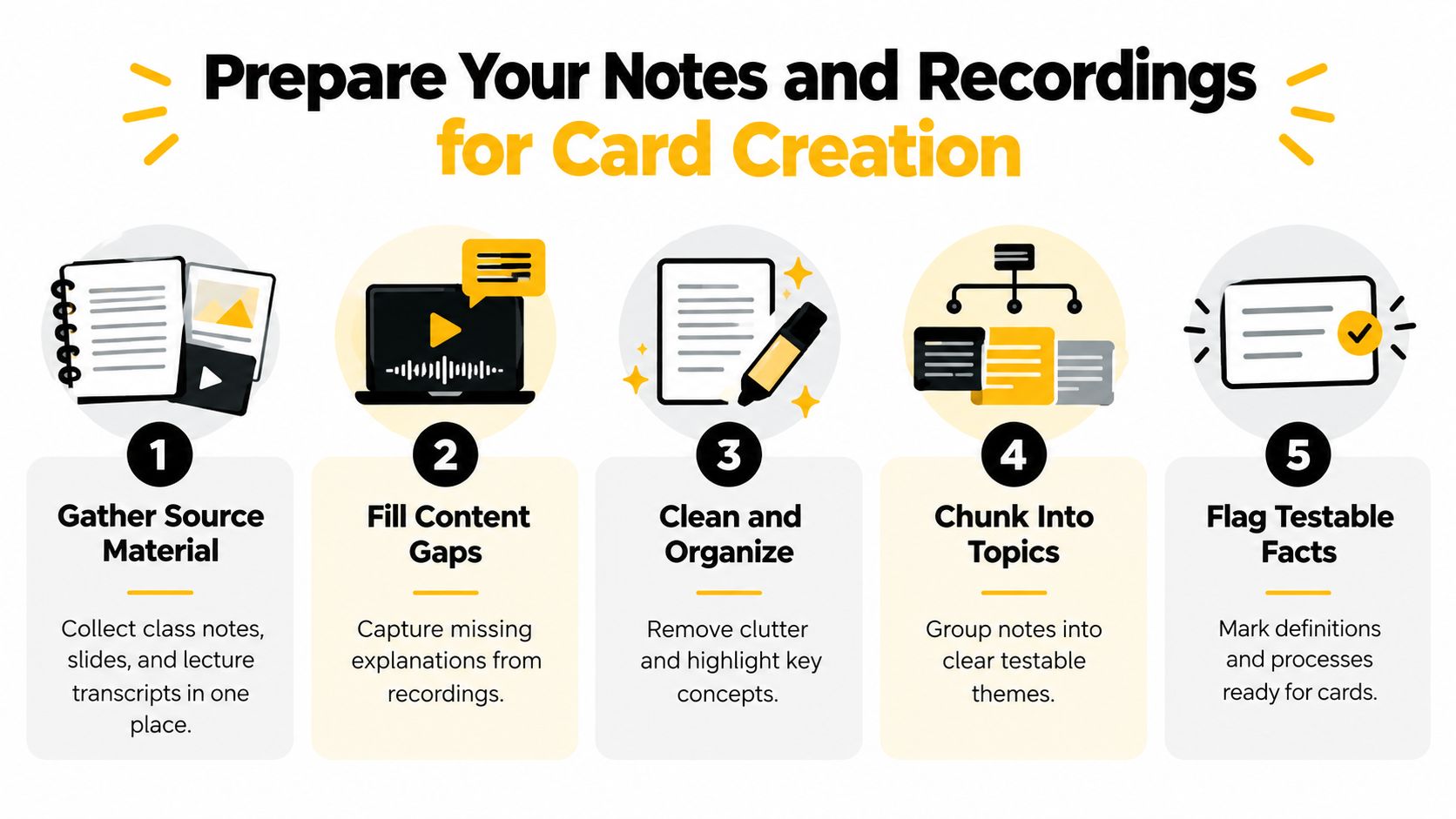
Gather everything into one source pack
Pull together your:
- Class notes
- Lecture slides
- Assigned reading notes
- Lecture transcript or recording
- Any review sheet from the instructor
If your notes are thin because class moved fast, use the recording to fill in missing explanations before you make cards. A practical workflow for turning audio into usable notes is described in this guide on converting lecture recordings into notes.
Don't keep switching between six tabs and two notebooks while writing cards. Put the relevant material for one lecture or one topic in one place first.
Clean the notes before you chunk them
Most raw notes contain clutter that should never become a flashcard. Delete repeated examples, reminders to yourself like “check this later,” and partial phrases that only made sense in the room.
Then mark the material by function, not by page order:
- Definitions for terms you must state clearly
- Mechanisms for how something works
- Relationships for comparisons, causes, inputs and outputs
- Examples that help you remember or apply the concept
- Gaps where your notes are too vague to trust
A transcript is helpful, but a transcript is not automatically a study guide. Spoken explanations need trimming before they become testable.
Chunk by concept, not by lecture timeline
Many decks go off the rails. Students often build cards in the exact order the professor talked. That keeps the lecture sequence, but it doesn't create clean recall targets.
Instead, break the material into small concept blocks. For example, a psychology lecture on conditioning might split into:
- Classical conditioning
- Operant conditioning
- Positive vs negative reinforcement
- Punishment vs extinction
- Common examples and confusions
Each chunk should answer one question: “What is the idea I need to remember or explain?”
Flag what needs verification
If your note says “enzyme activated in acidic part?” don't guess. Mark it and verify from the slide, textbook, or recording. The fastest way to poison a flashcard deck is to memorize your own rough draft.
A good source pack is short, organized, and slightly boring. That's perfect. It means you've removed the noise before work begins.
How to Turn Notes Into High Quality Flashcards by Hand
Writing cards by hand is slower. It also teaches you where your thinking is fuzzy. That's why I still recommend a manual pass for difficult topics, especially in science, law, and any class where the professor writes exam questions in unusual wording.
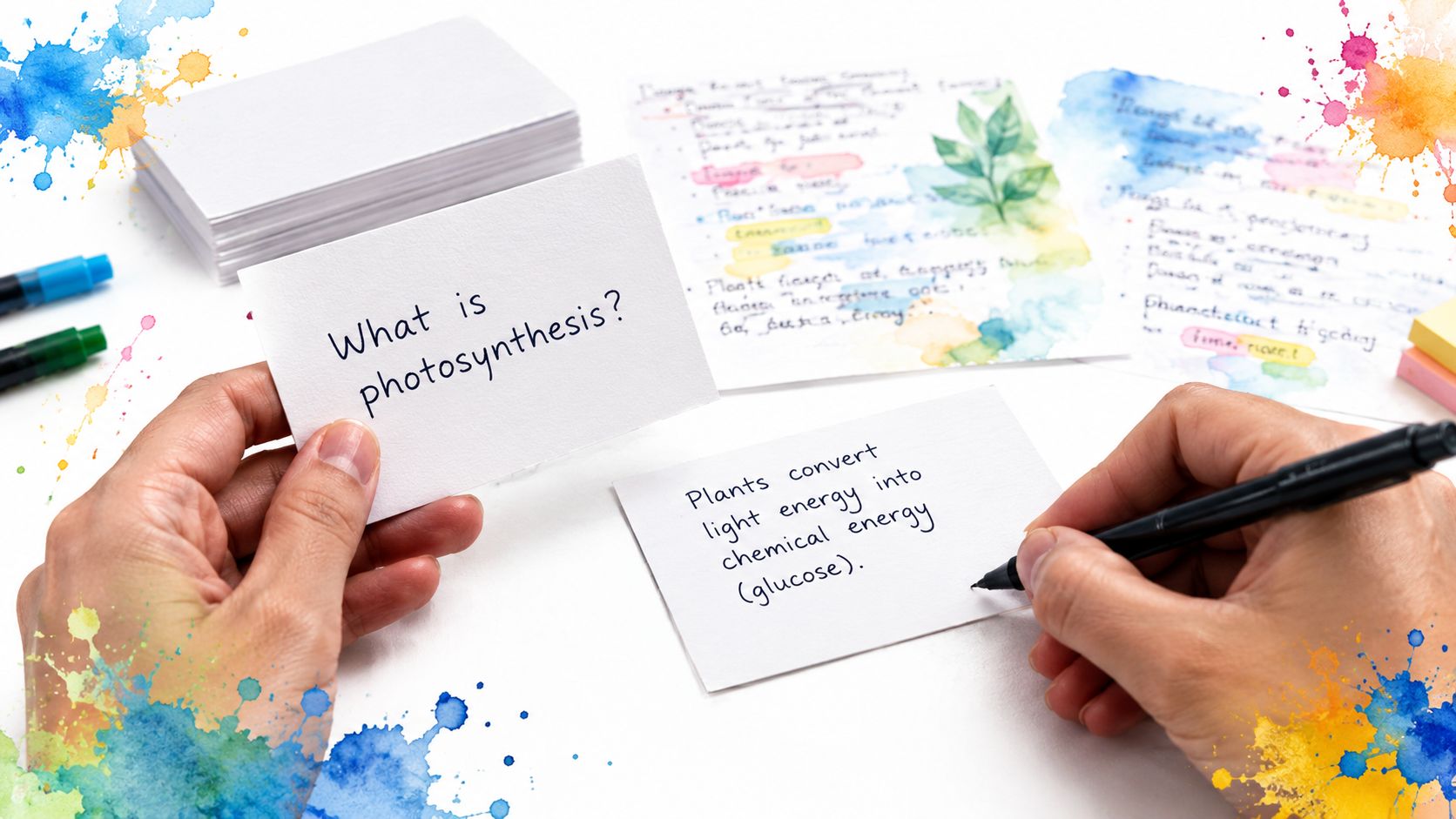
Start with one idea per card
A card should test one retrieval target. Not a whole paragraph. Not an entire slide.
If your notes say:
“Neurons maintain resting potential through selective membrane permeability and the sodium-potassium pump, which moves sodium out and potassium in.”
Don't turn that into one oversized card like:
“What should you know about resting potential?”
Split it.
- Concept card: What creates resting potential in a neuron?
- Mechanism card: What does the sodium-potassium pump move, and in which direction?
- Why card: Why does selective permeability matter for resting potential?
Each card now has a clear job.
Use prompts that force explanation
The Learning Scientists have pointed out an important gap in common flashcard advice. Many students are taught to memorize terms, but conceptual flashcards are better for short-answer performance and deeper understanding (Learning Scientists guidance on conceptual flashcards).
That means your best prompts often begin with:
- Why does...
- How does...
- What is the difference between...
- When would...
- What happens if...
- Which condition leads to...
These question stems make you think through relationships instead of matching labels.
Four card formats worth using
-
Direct question and answer
Best for precise definitions and distinctions.
Example: “What is opportunity cost?” -
Fill in the blank
Best for formulas, pathways, and exact wording.
Example: “In classical conditioning, the ______ stimulus naturally produces a response.” -
Compare and contrast
Best when students confuse similar terms.
Example: “How is mitosis different from meiosis in outcome?” -
Application prompt
Best for exam-style transfer.
Example: “A patient can't absorb vitamin B12. Which body system is most directly affected first, and why?”
Good flashcards don't ask, “Did you read this?” They ask, “Can you produce the answer cleanly?”
Turn one messy note into better cards
Suppose your history notes say:
“Industrialization changed urban life through factory labor, migration to cities, overcrowding, sanitation problems, and new labor movements.”
A poor card would copy the line.
Better options:
- What drew people into cities during industrialization?
- What urban problem grew as migration increased?
- Why did labor movements gain momentum during industrialization?
That gives you three clean retrieval tasks instead of one baggy summary sentence.
A short demo can help if you want to see card writing in action:
Common mistakes that waste review time
| Mistake | Why it fails | Fix |
|---|---|---|
| Copying the textbook sentence | You memorize wording, not meaning | Rewrite in plain language |
| Asking broad questions | You can't grade yourself quickly | Narrow to one answer target |
| Packing many facts into one card | One missed piece forces full relearning | Split into atomic cards |
| Making only term-definition cards | You train recognition more than explanation | Add why, how, and contrast prompts |
Manual card writing takes judgment. That's the point. When you can write a sharp card, you usually understand the idea better already.
Speed Up Creation With AI Assisted Workflows
AI can save a lot of time when your notes, transcripts, and readings are already organized. It can also flood you with shallow cards if you dump in everything and accept the output without checking it.
The right use of AI is drafting at scale, then editing with a teacher's eye.
Where AI helps most
AI-assisted flashcards work well when you have:
- Typed lecture notes with complete ideas
- Transcripts that already reflect the full explanation
- Slide decks with clear topic boundaries
- Textbook excerpts for definition-heavy units
Tools like Anki add-ons, Quizlet import workflows, and platforms that generate cards from source documents become useful here. One example is ClassLecture.ai, which can generate flashcards from lecture recordings, notes, PDFs, and transcripts, with both question-and-answer and fill-in-the-blank formats. If you want a walkthrough of that kind of workflow, this guide on making flashcards online shows the basic process.
Where AI needs supervision
AI tends to make three predictable mistakes:
- It overproduces obvious cards
- It merges multiple ideas into one vague prompt
- It stays too close to summary language
That's why source scope matters. If you feed an entire unit with slides, transcript, reading, and random notes all at once, you'll get quantity. You may not get a usable deck.
A better workflow is to upload one lecture or one chapter at a time, then review the output for accuracy, depth, and coverage.
Manual vs AI Assisted Flashcard Workflows
| Workflow | Best For | Trade Off | Quality Check |
|---|---|---|---|
| Manual only | Hard subjects, tricky concepts, professor-specific wording | Slower creation | Ask whether each card matches likely exam wording |
| AI assisted only | First-pass draft generation from clean sources | More weak or shallow cards | Delete obvious cards and split broad ones |
| Blended workflow | Most college courses with heavy reading or recorded lectures | Requires an edit pass | Keep AI for extraction, keep your judgment for final wording |
A practical blended routine
Here's the version I recommend most often:
- Clean the source material first
- Generate a draft deck from one topic
- Delete low-value cards immediately
- Rewrite broad cards into conceptual prompts
- Add a few manual cards for likely exam traps
- Tag or group cards by class and unit
Keep timestamps or source references where possible. That makes it easier to verify cards later when one answer looks suspicious or incomplete.
AI is fastest at extraction. You're still better at deciding what deserves to stay in the deck.
Review Smarter With Spaced Repetition and Proven Tips
Making flashcards is only half the job. The deck has to be reviewed in a way that matches how memory works.
A medical education trial on electronic flashcards found that repetitive testing produced better recall than repetitive studying after one week, with the difference reported as statistically significant at p < 0.001. The same review also reported retention differences across spacing schedules, including about 86% recall with a 1-day spacing interval versus about 62% with a 10-day interval, and 83.1% retention with a 3-day interval versus 80.9% with a 14-day interval after multiple relearning sessions (flashcard and spacing findings in educational review).
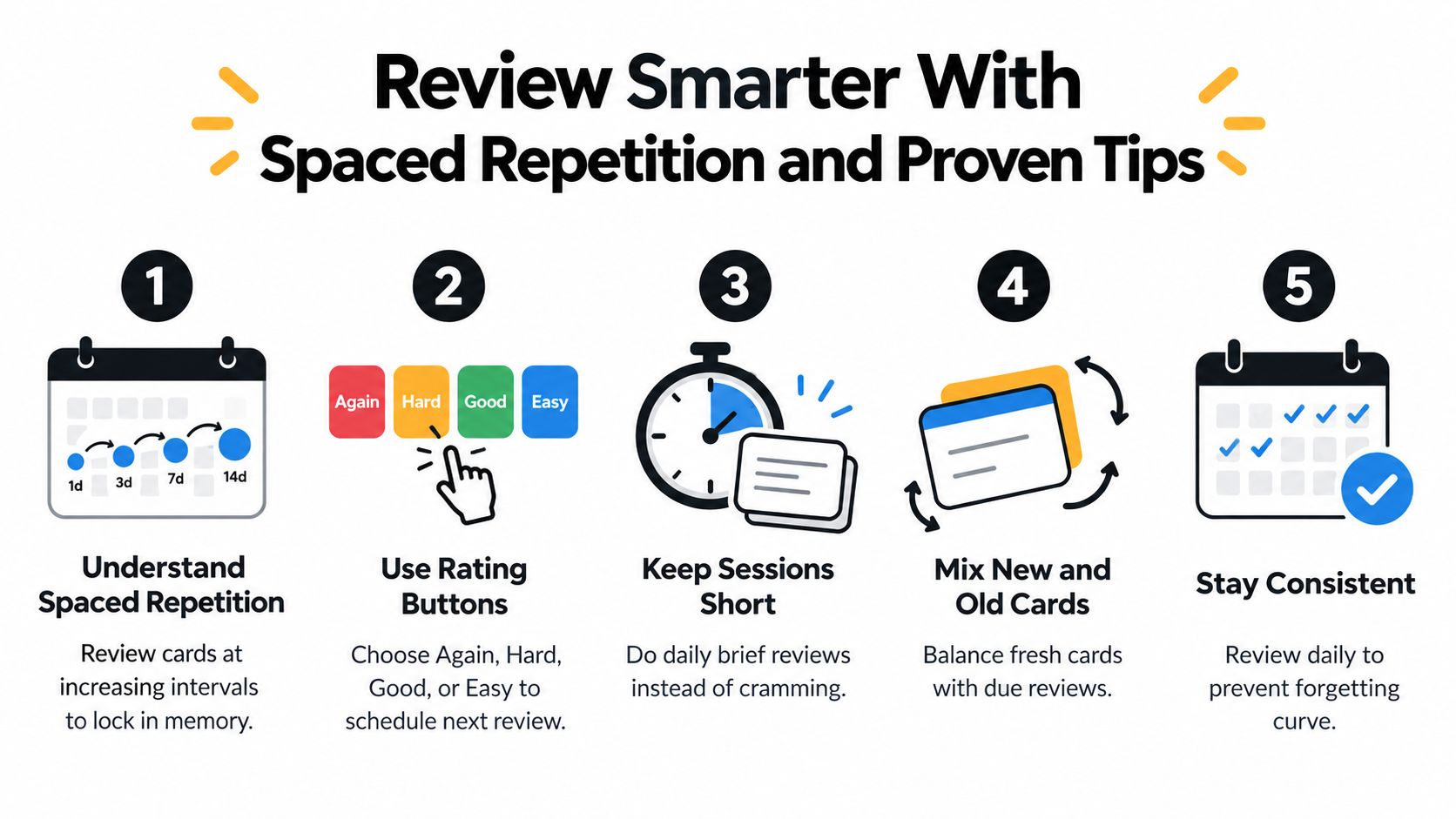
Use the scheduler honestly
If your flashcard app uses ratings like Again, Hard, Good, and Easy, don't game them. If the answer felt shaky, mark it that way. Spaced repetition only works when the schedule reflects actual recall, not optimism.
Short daily reviews usually beat heroic catch-up sessions. A few minutes of due cards keeps the deck alive. Skipping days turns the deck into a guilt pile.
Mix cards instead of cramming mini-decks
A controlled experiment found that studying one large, spaced stack beat studying four smaller stacks separately. Final test accuracy was 65% versus 34%, with a large effect size (d = 1.11, p < .0001) (controlled spacing experiment on flashcard stack structure).
That matters because many students create tiny chapter decks and drill each one in isolation. It feels organized. It often produces the illusion of mastery.
Mix new and old cards. Mix nearby topics. Force your brain to tell similar ideas apart.
Know when flashcards aren't enough
Recent work on retrieval practice points to an important limit. Flashcards often beat restudying, but the best results come when they're combined with other review modes instead of treated as a total replacement for notes, quizzes, or problem-solving (retrieval practice review on combining study modes).
For practical use, that means:
- Math and physics still need worked problems
- Chemistry needs mechanism practice and reaction application
- Essay-based classes need outline recall and short written responses
- Case-based courses need scenario practice, not just fact recall
If you want a broader study routine around this, these effective learning techniques pair well with a flashcard habit.
Your Next Study Session Made Simple
Students usually don't need more advice. They need a cleaner next step.
If your notes feel messy right now, don't try to turn everything into cards tonight. Pick one lecture. Clean the notes. Pull missing points from the recording. Group the material into concepts. Then make a small deck that tests explanation, not just recognition.
A simple 30-minute reset
Try this:
- First 10 minutes clean one lecture's notes and remove clutter
- Next 10 minutes mark definitions, mechanisms, and comparisons
- Final 10 minutes write or generate a short deck, then cut weak cards fast
That's enough to restart momentum without building a giant system you won't maintain.
What progress should look like
You're on the right track when:
- you can answer cards before flipping them
- your deck gets smaller because you delete weak cards
- more prompts ask why, how, and when
- your due reviews stay manageable
- you notice what you don't know before the exam does
The goal isn't the biggest deck. It's the cleanest deck you'll actually review.
Flashcards for study notes work when you treat notes as source material, cards as retrieval tools, and review as a daily habit. Keep the deck lean. Add conceptual cards as the course gets harder. Pair them with problem sets, practice questions, or brief written recall when the class demands more than memorized fragments.
If you want one place to turn lecture recordings, notes, textbooks, and transcripts into study materials you can review, ClassLecture.ai lets you upload or record content, generate flashcards and study guides, and review them with spaced repetition. It's useful when you need to move from messy source material to an organized deck without losing the ability to check answers against the original lecture.
The ClassLecture.ai Team
We build ClassLecture.ai, the AI study assistant that turns your recorded lectures into transcripts, summaries, flashcards, and answers cited to the exact timestamp — so you learn faster from your own professor's words.
Keep reading
10 Notes for Social Studies Resources
Find the best notes for social studies, from timelines and textbooks to flashcards and AI study systems for faster, organized exam preparation.
Read10 Study Flashcards Apps for Lecture-Based Learning
Compare 10 study flashcards app options for lecture-based learning, including features, pricing considerations, limitations, and transcript-to-card workflows.
ReadAI Meeting Notes Explained and How to Use Them
Learn what AI meeting notes are, how they work, and how to turn transcripts into searchable summaries, Q&A and flashcards with AI meeting notes.
Read