English 101 and 102: Key Differences, Goals, and Tips
Compare English 101 and 102 to understand their goals, assignments, and how to study effectively for both courses.
The most popular advice about English 101 and 102 is also the advice most likely to mislead you: English 101 teaches essays, and English 102 teaches research papers. That progression is common, but it isn't universal. Course numbers are labels, not a promise about what you'll read, write, or be graded on. Before you plan your semester around generic advice, inspect the catalog description, syllabus, and first major assignment for your own course.
| Dimension | English 101 | English 102 |
|---|---|---|
| Typical focus | Rhetorical foundations, audience, purpose, claims | Extended analysis, inquiry, and evidence use |
| Common assignments | Essays, rhetorical analysis, revisions | Research writing, source synthesis, or literary analysis |
| Primary skills | Thesis, organization, paragraph coherence, revision | Source evaluation, synthesis, documentation, sustained argument |
| Citation expectations | May be limited or assignment-specific | Often more prominent, but depends on the course |
| Assessment mix | Drafts, essays, feedback, reflection | Research or analytical projects, source work, revision |
| Signature deliverable | A clear, well-organized argument or analysis | A sustained argument or analysis shaped by the course's actual focus |
Use that table as a starting point, not a substitute for your instructor's requirements. The course you're enrolled in matters more than the number in its title.
Table of Contents
- Why English 101 and 102 Are Not One Course
- What Each Course Is Actually Building
- Side by Side at a Glance
- How Placement and Access Work
- Why English 102 Feels Like a Different Class
- Study Strategies That Match Each Course
- Using ClassLecture.ai as a Study Assistant
- Diagnose Your Course Before You Plan Your Semester
Why English 101 and 102 Are Not One Course
Anyone who tells you English 102 is "the research paper course" is describing their campus, not yours. The sequence has a real history, though: Harvard made first-year composition a formal requirement in 1875, and its English A course was established as a first-year requirement by 1885. By 1900, freshman composition had spread to most American colleges. A national survey of U.S. institutions, summarized in research on the history of composition requirements, found that 97% of institutions included a writing requirement and 85% fulfilled it through the English department. That pattern is broad. It still tells you nothing about what your 102 will assign.
The variation is the point students miss. One college's English 102 builds a multi-source argument across the semester; another spends the term on literary analysis. One syllabus requires MLA documentation, while the instructor down the hall uses APA or a disciplinary format. Even whether 102 is required at all can differ by program.
What to inspect before trusting generic advice
The documents worth reading are your catalog description, the syllabus, and the first major assignment. The skill is decoding them. Outcomes that mention rhetoric, audience, and argument signal one kind of course. Outcomes built around inquiry, information literacy, and source synthesis signal another. A course subtitled "Introduction to Literature" is a different animal entirely, and a themed section (say, writing about food or urban policy) changes what you'll read even when the skills stay the same. Check the prerequisite line too: some programs treat 101 and 102 as a designed pair, while others let you enter 102 through placement or credit, which usually means the instructor assumes less shared preparation.
The history does give you one fair expectation. Introductory composition has long trained students to make claims, organize writing, use evidence, revise, and write for a reader. The enrollment figures above describe a U.S. pattern, not a global rule or a promise about your campus.
Diagnose the course you're in. If the syllabus isn't posted yet, ask the department for a recent one. That single page will tell you more than any ranking of "what English 102 covers."
What Each Course Is Actually Building
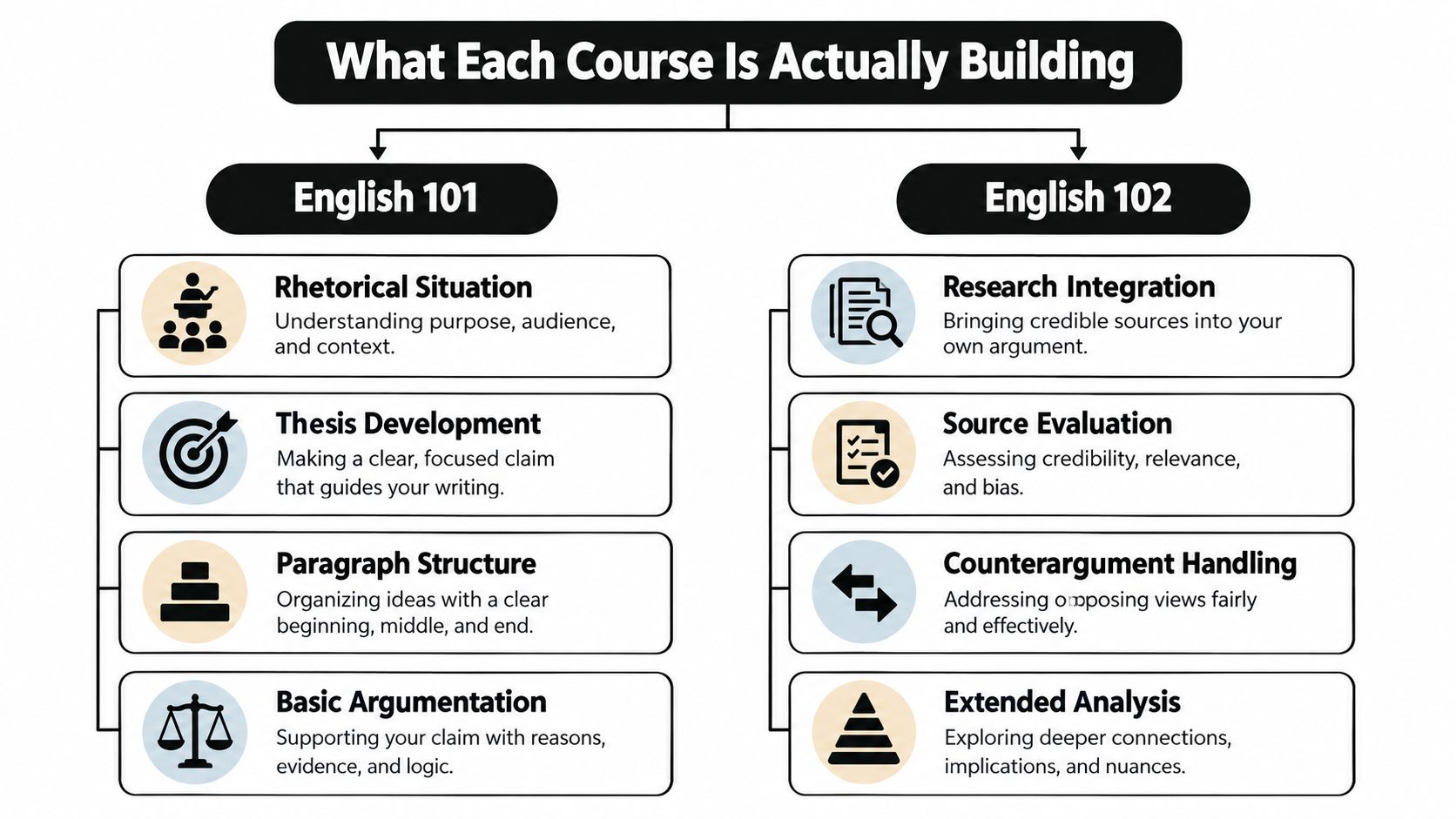
The typical progression is from learning to make deliberate writing choices toward using research and analysis to build a more sustained argument. English 101 often teaches students to identify a rhetorical situation: who is writing, for whom, for what purpose, and in what context. Students practice developing a thesis, organizing paragraphs around that claim, revising after feedback, and making choices for an audience.
That foundation isn't “write an essay.” A rhetorical analysis, for example, asks you to explain how a text persuades its audience, not just whether you agree with it. A personal or explanatory essay may also ask you to shape a clear claim, select relevant details, and guide a reader through the reasoning. The transferable skill is intentional composition: knowing why each part of the draft belongs.
From rhetorical foundations to research decisions
English 102 often assumes that students can already form a claim and organize an essay. It raises the demands by asking them to investigate a question, understand the conversation around it, assess source credibility, and combine ideas from multiple texts. The shift isn't merely adding citations. You have to explain how evidence supports your argument, where sources agree or disagree, and what your own analysis contributes.
Course outcomes published by the University of Massachusetts Boston's composition program illustrate this broader progression through rhetorical and composing skills that may extend into inquiry, genre, and discourse communities. But even that kind of outline shouldn't be treated as a universal template.
Some 102 courses aren't research-paper courses at all. College of the Canyons describes its English 102 around analytical writing about literary works, while other programs focus on multi-source argument. That difference changes what you should study: research-question practice and source evaluation are essential when the syllabus requires inquiry, but close reading and literary analysis may matter more in a literature-centered class.
If you want a concrete starting point for English 101 review, ClassLecture.ai's English 101 free course preview offers foundational-course flashcards. Use it to practise relevant concepts, then match your review to your instructor's actual assignments.
Side by Side at a Glance
The table below gives you a useful first comparison, but don't read it as a universal checklist. English 101 usually builds the core skills for composing and revising; English 102 often asks you to extend those skills through research or deeper analysis. The syllabus decides which version applies.
| Dimension | English 101 | English 102 |
|---|---|---|
| Typical focus | Rhetorical situation, audience, purpose, clear claims | Sustained inquiry, research, synthesis, or literary analysis |
| Common assignments | Essays, rhetorical analysis, drafts, revision exercises | Research arguments, source-based analysis, or literary essays |
| Primary skills | Thesis development, paragraph coherence, organization, revision | Source evaluation, synthesis, documentation, argument development |
| Citation expectations | May vary by assignment and instructor | Often more involved in research-focused classes |
| Assessment mix | Writing assignments, drafts, peer or instructor feedback | Research or analytical projects, source work, revised writing |
| Signature deliverable | A focused essay shaped for a reader and purpose | A longer analysis or argument that fits the course's design |
| Important variation | May include research, but usually establishes foundations | May be research-driven, literature-centered, or themed |
Pay special attention to the “signature deliverable” and “important variation” rows. If the first major 102 assignment is a literary analysis, prepare for close reading and interpretation. If it asks you to investigate a question with outside sources, expect to spend time finding, evaluating, and connecting evidence. Don't let a generic 101-versus-102 guide persuade you that one format is inevitable.
Use the table as a syllabus-reading tool
Compare each row with your instructor's documents. Look for what students submit, how the instructor describes success, and what the grading criteria reward. A syllabus that emphasizes source credibility and documented argument calls for different preparation from one that emphasizes analysis of literary texts.
Also check the citation style directly. Don't assume MLA because the course is called English, and don't assume citation rules are the main difference between the classes. A citation system is one part of the work; the more important question is what the assignment expects you to do with the texts and evidence.
Advisor's rule: Prepare for the assignment your instructor assigned, not the assignment you think English 102 is supposed to have.
How Placement and Access Work
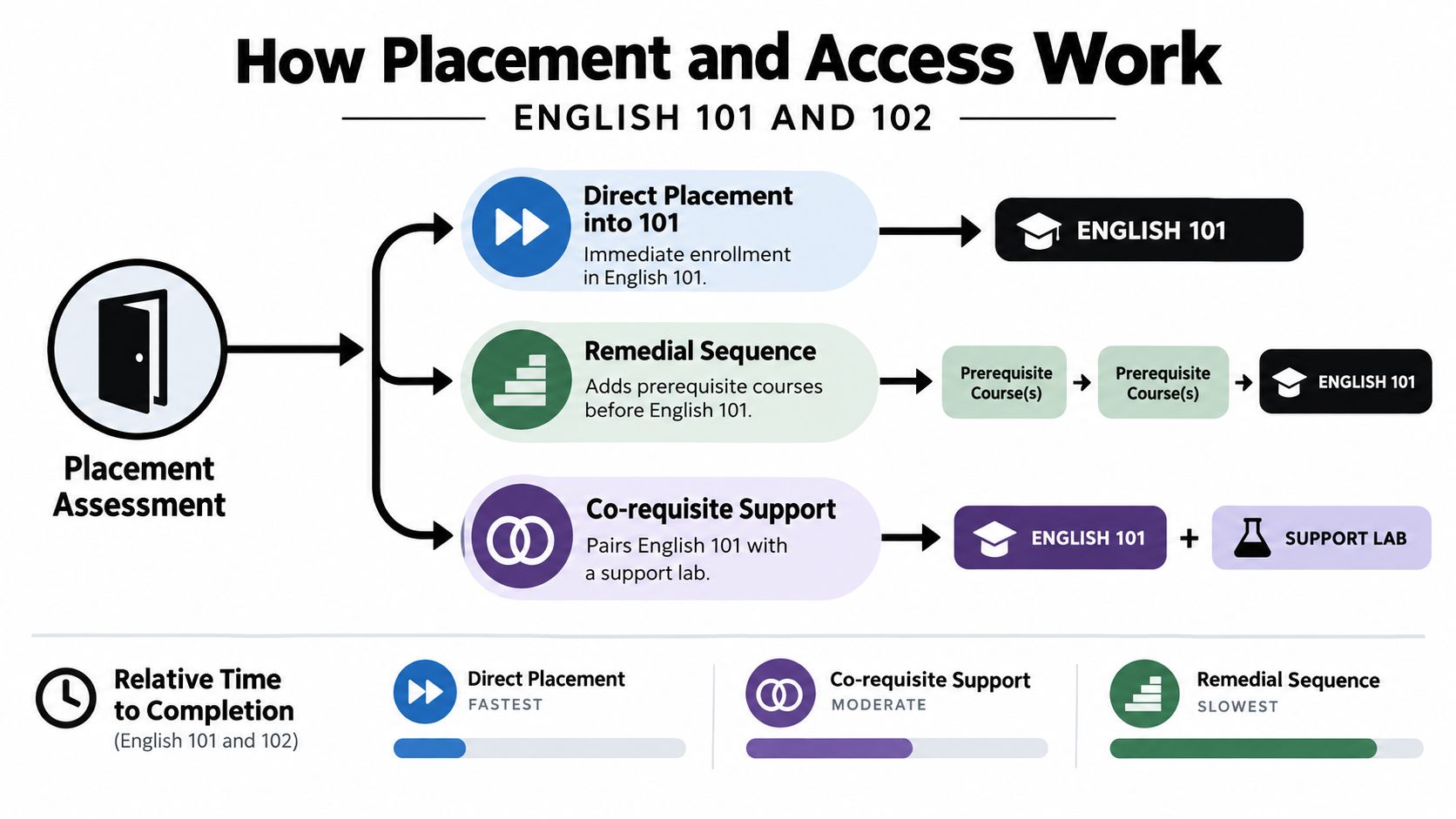
Not every student begins English 101 in the same way. Colleges use different placement practices, and some students may be directed into prerequisite remedial courses or offered extra support alongside college composition. That matters because a student who has to complete a separate remedial sequence may take longer to reach the first transfer-level writing course, and therefore may not be able to move on to a follow-on course as quickly.
California community colleges offer a clear example of how placement policies can shape access. In fall 2015, only just over one-third of first-time English students began directly in college composition. After Assembly Bill 705 required colleges to maximize students' chances of entering and completing transfer-level English within a year, and to use high-school records more heavily for placement, 96% of first-time English students enrolled in college composition as their first English course in fall 2019. That was an increase of roughly 58 percentage points in direct access, described in the California community-college access report.
Ask what support comes with your placement
The same report notes that more than 57,000 additional students earned a C or better in college composition in fall 2019 than in fall 2015. It also summarizes research finding that students in corequisite models, where college composition is paired with extra academic support, were about 30 percentage points more likely to complete the gateway course in one term than students who began in remedial education were to complete it within one year.
Those figures are about a specific system and policy change, not a promise about every college. For an individual student, the takeaway is practical: ask an advisor what course you've been placed in, whether it counts as transfer-level composition, what support is available, and which course you can take next. If you're already in English 101, find out what the prerequisites are for your campus's version of 102.
Placement is not a measure of your potential. It determines the route you're offered, and support can make that route more workable. Ask about tutoring, writing-center appointments, office hours, and corequisite support before you fall behind.
Why English 102 Feels Like a Different Class
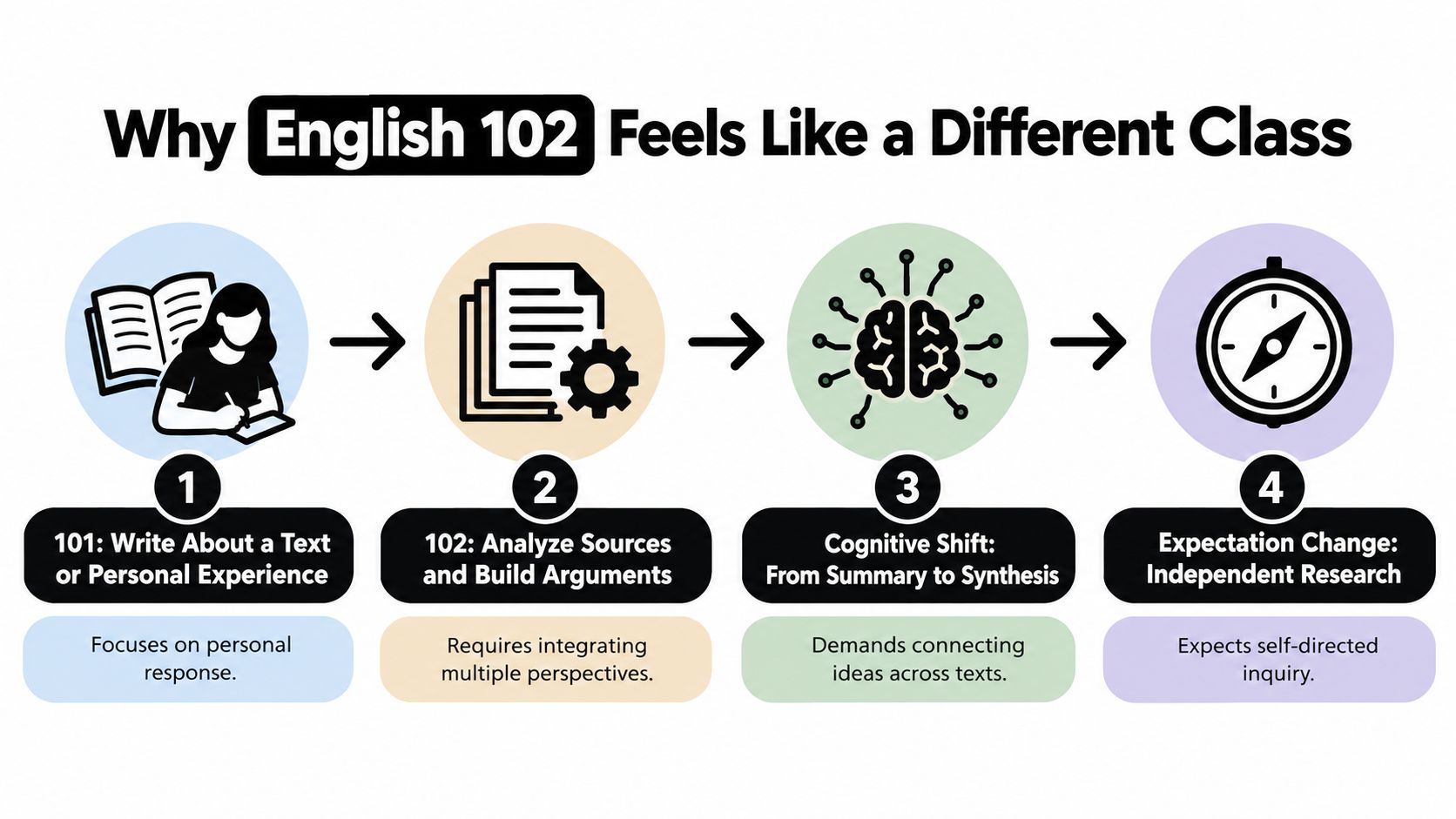
Students often enter English 102 expecting a harder version of the same essay. The bigger change is usually the kind of thinking the work demands. English 101 may ask you to analyze a text or develop an idea from experience; research-focused 102 asks you to join a conversation by examining evidence from multiple sources.
That means you must narrow a research question before you can answer it, decide which sources deserve trust, and make quotations serve your reasoning rather than replace it. Then you have to connect sources that may disagree, explain the significance of that disagreement, and revise your claim when the evidence complicates your first idea.
The hard part is synthesis, not finding a quote
Seattle Central's published English 102 standards require students to evaluate scholarly and popular sources, distinguish summaries from paraphrases, use MLA documentation, and avoid plagiarism through attribution. The standards also describe an approximately 15-page documented research paper with a supportable thesis, organized argument, integrated sources, and a conclusion, as set out in Seattle Central's English 102 performance standards. That's a specific program's benchmark, not a standard length for every English 102 paper.
The useful lesson is the workflow. Start with a focused question, search strategically, evaluate credibility, take notes that preserve where ideas came from, and group sources by their contributions to the issue. Drafting becomes easier when you know which sources support, challenge, or qualify your claim. For help keeping summary separate from analysis, review what makes an objective summary, then check your instructor's directions before applying any general guidance.
AI adds another pressure point, but it doesn't change the core responsibility. A 2025 College Board research brief surveyed college faculty in June and August 2025 about their perceptions of generative AI. For your own work, the useful question is not whether a tool can produce fluent sentences; it's whether you can verify claims against assigned sources, keep track of those sources, and explain your own reasoning. You may use AI to brainstorm research questions or practise counterarguments if your instructor permits it. Don't outsource source judgment or present generated material as evidence you haven't checked.
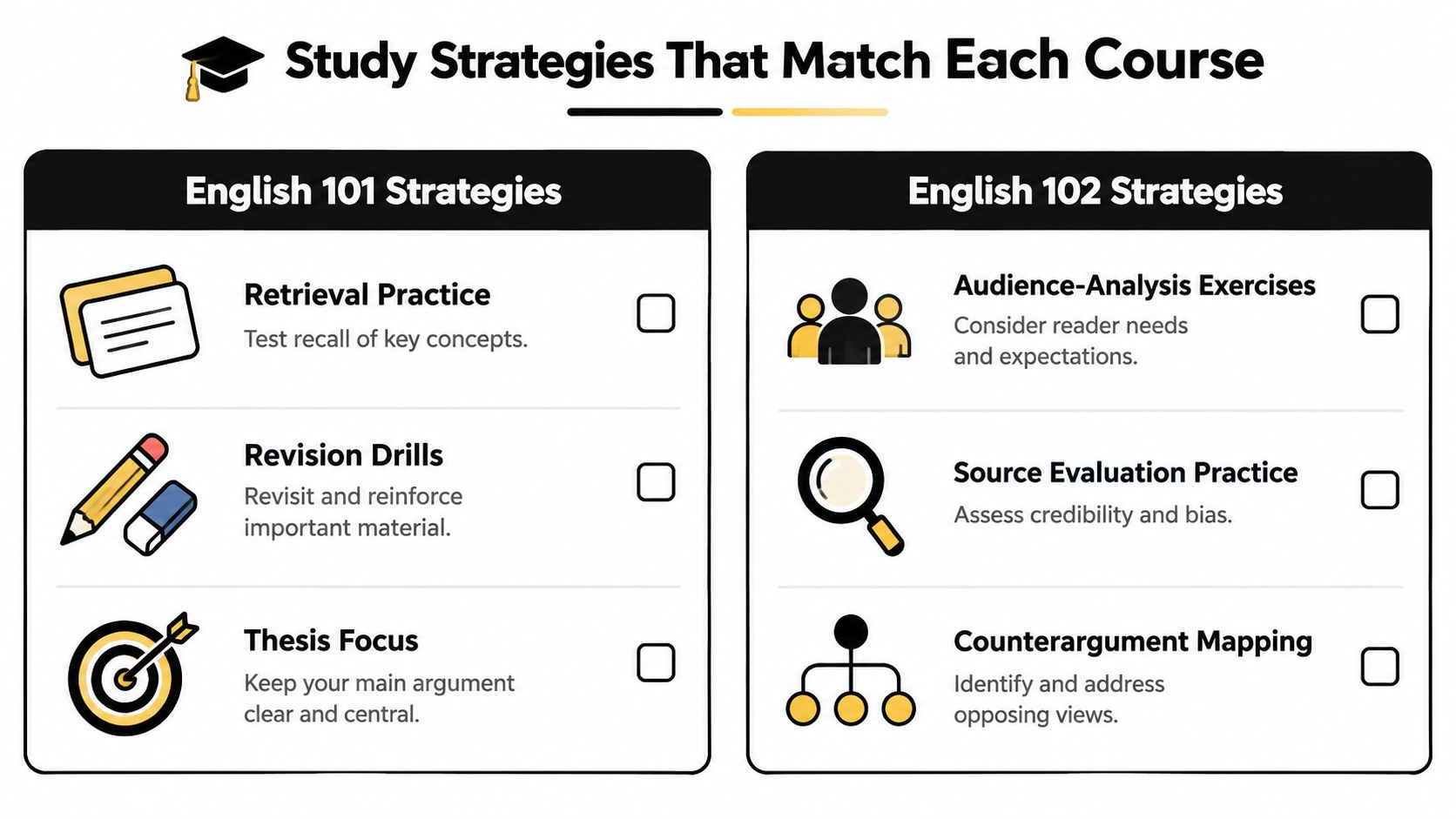
Study Strategies That Match Each Course
Study the skill your assignment will test. For English 101, that usually means practising the moves that make an essay clear: identifying audience and purpose, stating a specific thesis, building coherent paragraphs, and revising for meaning before polishing sentences.
Try these routines:
- Retrieve before rereading: Close your notes and explain the difference between a claim, evidence, and analysis from memory.
- Revise one paragraph: Rewrite a paragraph to improve its focus and transitions, then compare the versions.
- Test the thesis: Ask whether a reader could disagree with your claim and whether the essay supports it.
- Practise audience shifts: Explain the same idea to a peer and to a reader unfamiliar with the topic. Notice what context each needs.
English 102 study should track the source work your course requires. Make flashcards for distinctions such as scholarly versus popular evidence, summary versus paraphrase, and quotation versus paraphrase. Practise writing a short synthesis that explains how two sources relate rather than listing what each says.
Keep your review tied to course materials
When you have lecture notes or assigned texts, ask questions that point back to a page or timestamp. “What did the instructor say about paraphrasing?” is more useful when you can check the relevant class material than when an answer gives generic writing advice. For more ways to make review active, see these study strategies for college students.
The right study plan follows the course's actual demands. Don't spend all your time correcting grammar if the assignment is testing synthesis, and don't drill source evaluation for a literature-focused course that asks you to closely analyze assigned texts.
Using ClassLecture.ai as a Study Assistant
A study assistant earns its place when it sends you back to your own course materials. If it hands you polished paragraphs detached from your syllabus, it is doing the wrong job.
ClassLecture.ai lets students upload lectures, notes, and textbooks, then review them through transcripts, conversational Q&A, flashcards, summaries, and study guides. Its Q&A cites timestamps and document pages, so you can check where an answer comes from rather than trusting a general chatbot to guess at a syllabus it has never seen.
The product includes a free preview flashcard set for English 101 and supports transcription of up to 30 hours of audio or video per user. Its free tier offers up to 3 hours of monthly transcription, 10 questions, and 100 MB of text uploads, as described on ClassLecture.ai.
Match the tool to the course in front of you
Because 102 is not standardized, the right workflow depends on your syllabus. In a 101 course built on rhetorical analysis, turn lectures into retrieval practice: explain a concept from memory, then check the transcript for what you missed. In a research-heavy 102, load your assigned sources and quiz yourself on how they relate. In a literature-focused 102, upload the assigned texts and test your interpretation instead.
Keep one firm boundary. Use the tool to generate questions, clarify class content, or rehearse a counterargument, then verify every claim against the assigned material and follow your instructor's rules about AI. Your judgment and final synthesis stay yours.
Open ClassLecture.ai with material from your own course, then shape your review around the syllabus and assignments in front of you.
Diagnose Your Course Before You Plan Your Semester
Before choosing study tactics, make a quick course diagnosis. Read the catalog description and syllabus, then inspect the first major assignment. Check whether it asks for rhetorical analysis, literary close reading, research, or a themed project. Note the expected source types, documentation style, and whether your instructor grades drafts, revision, analysis, or a finished argument.
Then match your preparation to those demands. If the course focuses on rhetorical writing, practise thesis development, paragraph structure, audience awareness, and revision. If it requires research, work on narrowing questions, evaluating sources, paraphrasing accurately, and synthesizing ideas. If it centers on literature, prioritize close reading and interpretation rather than assuming outside research will dominate.
Passing English 101 doesn't guarantee readiness for every English 102. The right study system matches the course you actually have.
Use AI only as a verification aid: it can help generate questions or possible counterarguments, but check every claim against assigned sources and preserve your own reasoning. If the syllabus remains unclear, ask your instructor or writing-program advisor what the first major assignment requires before you build your study plan.
ClassLecture.ai offers transcripts, source-grounded Q&A, summaries, and flashcards for reviewing lectures and course materials, including a free English 101 preview set. Try ClassLecture.ai with material from your actual course, then shape your review around the syllabus and assignments in front of you.
The ClassLecture.ai Team
We build ClassLecture.ai, the AI study assistant that turns your recorded lectures into transcripts, summaries, flashcards, and answers cited to the exact timestamp — so you learn faster from your own professor's words.
Keep reading
How to Take Lecture Notes That Actually Stick (2026)
Learn how to take lecture notes using proven methods, digital tools, and review strategies that turn passive listening into long-term retention.
Read10 Flashcards for Psychology: Best Study Resources
Compare 10 flashcards for psychology resources, from Quizlet and Anki to lecture-based tools, with reviews, limitations, and study strategies.
ReadAP Art History Notes: 10 Resources for Better Study
Find AP Art History notes, flashcards, timelines, and study guides for the AP 250, plus ways to turn lectures and readings into better revision materials.
Read