How to Study Flashcards the Smart Way
Learn how to study flashcards with spaced repetition, active recall, and better card design. A practical guide to faster, longer-lasting learning.

The most popular flashcard advice is incomplete: making cards isn't studying. You can spend an evening copying definitions into a beautiful deck, flip through every card, and still struggle to produce the answer under exam pressure.
The useful work starts after you see the card. You need to attempt recall before revealing the answer, judge the quality of that attempt, and let the result determine when the card returns. Flashcards work best as repeated retrieval practice, not passive rereading, because the learning gain comes from pulling information from memory over time. The retrieval practice guidance on flashcards recommends answering before flipping, shuffling cards, and keeping cards in circulation until you've retrieved them correctly multiple times.
Table of Contents
- The Recognition Trap: Why Flipping Feels Like Studying
- Designing Cards That Actually Stick
- Spaced Repetition and the Right Review Rhythm
- A Weekly Practice Schedule You Can Copy
- Turning Your Own Lectures Into Flashcards With AI
- Common Mistakes That Undo Your Progress
- Your Five-Move Flashcard Checklist
The Recognition Trap: Why Flipping Feels Like Studying
Flipping through a deck can create a convincing illusion of progress. You see the front, reveal the back, and think, “I knew that.” What you practiced was recognition, like recognizing a face in a crowd. An exam usually requires recall: producing the answer without a visible cue.
Recall is less comfortable than rereading, and that discomfort is useful. Before flipping, pause and attempt the answer. Say it, write a few words, or explain it in your own language. An effortful correct answer strengthens memory more than a quick glance that merely creates familiarity.
A card is only the prompt. The learning loop is your attempt, your rating, and the date the card returns.
Three choices shape that loop. Write prompts that demand a specific answer rather than display a block of information. Review across expanding intervals instead of exhausting the deck in one sitting. Rate each attempt truthfully, so difficult cards return sooner while secure cards wait longer.
One correct response does not prove that a fact is stable. Retrieval-practice guidance recommends aiming for three correct retrievals before considering a term learned. The flashcard evidence summary also reports higher exam performance with self-testing than with studying without testing. It reports that even modest spacing can improve retention by at least 20% after short and 1-week delays.
Use the deck as a testing system, not reading material. After every reveal, ask two questions: Was my answer accurate, and how hard was it to retrieve? Let those answers determine whether the card needs another appearance soon or can move farther into the future. That rating and repetition loop is what turns a familiar-looking fact into information you can produce under pressure.
Designing Cards That Actually Stick
Good card design reduces the amount of work each review requires while making recall precise. Start with one idea per card. A prompt such as “What are the causes, symptoms, diagnosis, and treatment of condition X?” creates several tests at once. Split it into separate prompts so you can identify exactly what you know and what needs repair.
Use a question instead of a label. “Glycolysis” invites recognition of a topic, while “What are the net inputs and outputs of glycolysis?” demands a response. Keep the answer short enough to check quickly, but include context when context prevents confusion.
Build the prompt around retrieval
Avoid yes-or-no questions because they let you guess without producing the fact. Replace “Is the sinoatrial node the heart's natural pacemaker?” with “What structure acts as the heart's natural pacemaker?” The second card requires the term, not just a judgment.
For definitions, processes, and formulas, cloze deletion works well. Instead of writing “The nephron is the functional unit of the kidney,” write “The {{c1::nephron}} is the functional unit of the kidney.” For a formula, hide the part you need to retrieve, then add a second card if you also need to recall how the formula is applied.
| Rule | Bad Card | Better Card |
|---|---|---|
| One idea | “Describe the stages and regulation of glycolysis.” | “What are the net inputs and outputs of glycolysis?” |
| Specific cue | “Glycolysis” | “Where does glycolysis occur in the cell?” |
| No recognition shortcut | “Is insulin released when blood glucose rises?” | “What happens to insulin release when blood glucose rises?” |
| Short answer | “Explain everything about the cranial nerves.” | “Which cranial nerve controls most tongue movement?” |
| Useful context | “What is it?” | “In renal physiology, what is the main role of the loop of Henle?” |
| Cloze format | “The cardiac cycle has phases.” | “The cardiac cycle includes {{c1::diastole}} and {{c2::systole}}.” |
Text is appropriate when the fact is verbal and compact. Use an image when spatial relationships matter, such as an anatomy diagram, a pathway, or a labeled instrument. Hide the label or key region so the image becomes a prompt, not decoration.
If you keep missing different parts of one card, split it. A card that asks for several items may appear “mostly right” while hiding a gap. Smaller cards let your rating and schedule respond to the actual weakness.
Spaced Repetition and the Right Review Rhythm
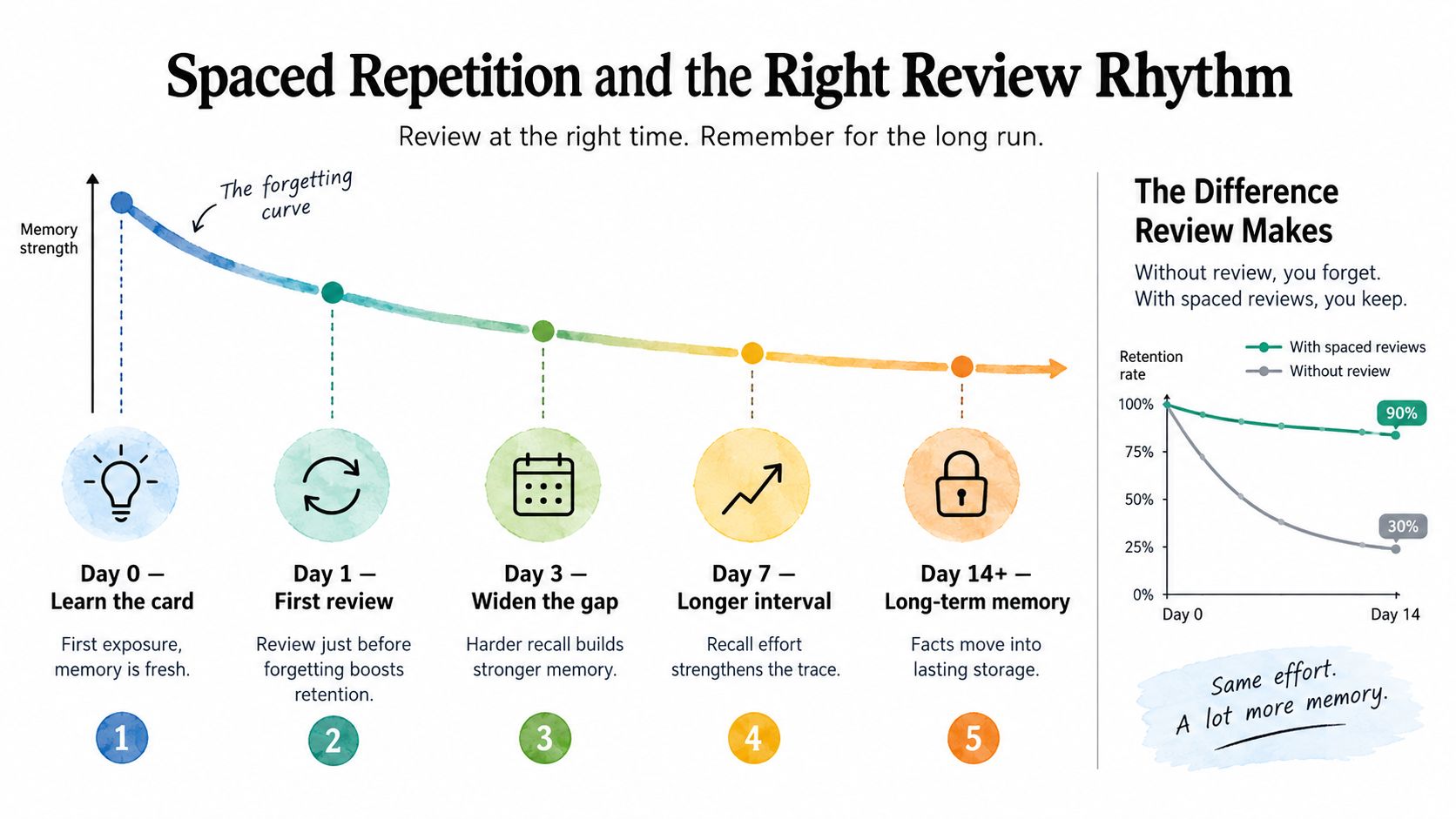
Cramming can make answers feel familiar without making them durable. Spaced repetition places a review after some forgetting has occurred, so you must reconstruct the answer instead of repeating a recent impression. Each accurate retrieval can earn a longer interval. A lapse should send that card back sooner, while the rating determines what happens next.
A practical sequence looks like this:
- Learn the card today.
- Review it after 1 day.
- If recall is solid, review it after 3 days.
- Continue with wider gaps such as 7, 14, and 28 days, adjusting for difficulty.
These intervals are common examples described in the Frontiers spaced-repetition review, which also notes that difficult cards should return sooner, while easy cards can wait longer. Longer retrieval intervals may support stronger delayed recall than shorter ones. Treat the sequence as a starting rhythm, not a rigid timetable.
Let the rating change the rhythm
Digital schedulers often use four practical ratings:
- Again: You could not recall the answer or gave a materially wrong response. Relearn it soon.
- Hard: You recalled it slowly, incompletely, or with serious uncertainty. Keep the next gap modest.
- Good: You recalled it accurately with normal effort. Allow the interval to expand.
- Easy: You produced it immediately and confidently. Send it farther out.
Rate retrieval, not recognition. Choose Good only when you answered before revealing the back. A schedule can respond only to the judgment you give it.
Mix subjects in one large deck rather than hiding each topic in a separate mini-stack. Interleaving makes you distinguish similar concepts, so the order of a small pile cannot provide the answer. A controlled flashcard study in the Frontiers review found that spacing one large stack was more effective than studying four smaller stacks separately and more effective than last-day cramming.
For a digital walkthrough of this review workflow, see how to use a flashcards app for study.

A Weekly Practice Schedule You Can Copy
A review algorithm works best when you give it dependable study windows. You don't need identical sessions every day, but you do need a routine that catches new cards, due cards, and lapses before they disappear.
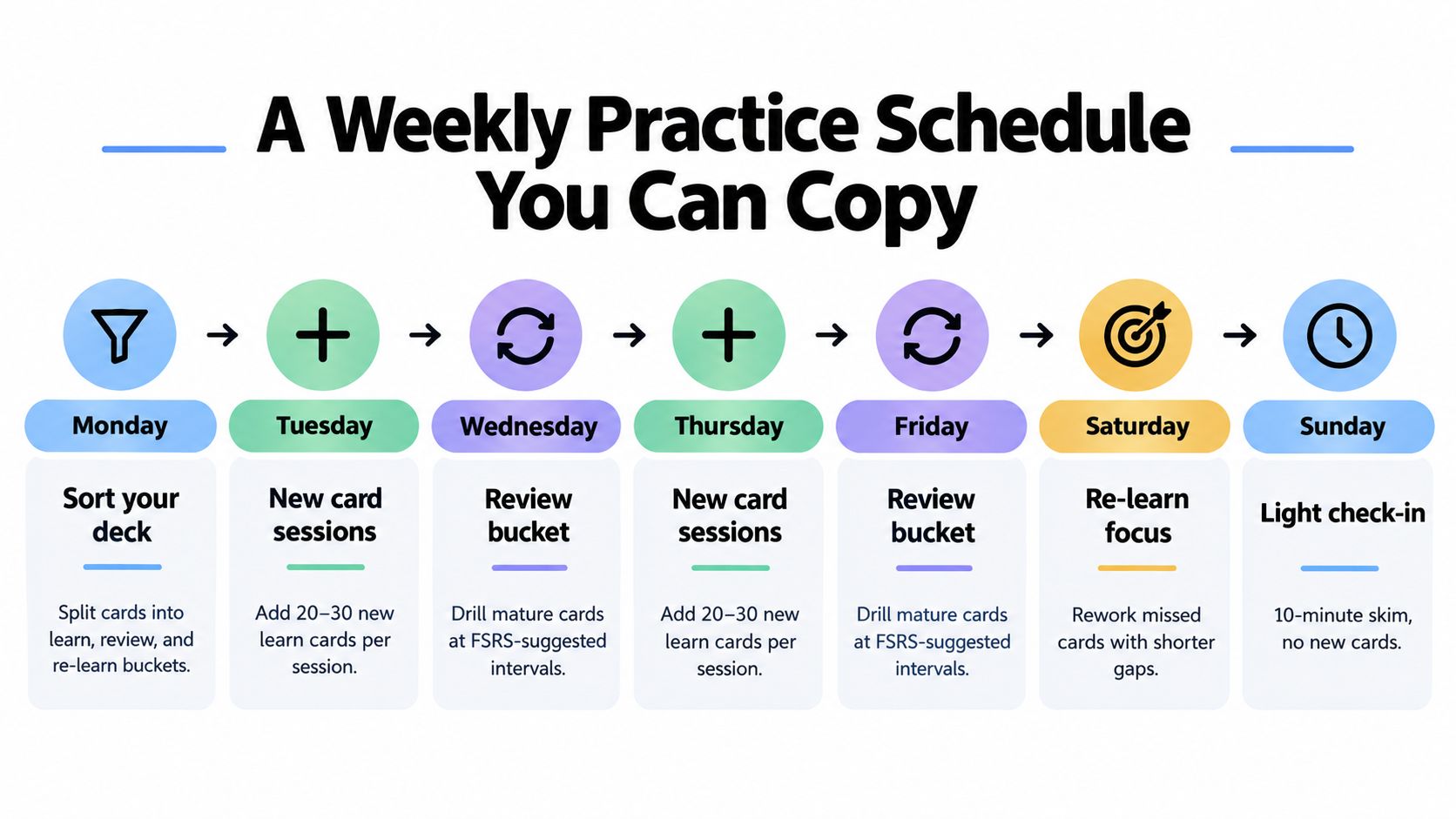
Use this weekly pattern and adjust the session length to your calendar:
- Monday, sort and learn: Clear due reviews first, then introduce a small batch of new cards. Mark cards you couldn't answer as re-learn items.
- Tuesday, short-interval review: Review cards due from Monday and revisit the re-learn bucket. Don't add new material until the due queue is under control.
- Wednesday, mixed review: Work through a shuffled selection from the full deck. Include older cards, not only the topic you studied most recently.
- Thursday, learn and review: Add another small batch only after completing due cards. Cards answered well can move toward a wider interval.
- Friday, longer-interval review: Review cards returning from earlier sessions, including material from different courses or units.
- Saturday, re-learn focus: Isolate missed or hesitant cards. Rewrite unclear prompts, add a cue, and schedule them for a shorter return.
- Sunday, catch-up: Complete overdue cards and check the deck lightly. Avoid creating a large new queue before the week begins.
This cadence mirrors expanding intervals such as 1, 3, 7, and 14 days, while keeping the deck active. If you miss a block, don't skip the cards. Move them into re-learn, answer them again, and let the scheduler rebuild the interval.
When the queue grows beyond a manageable session, stop adding new cards. Work from oldest due cards to newest, suspend duplicates, and split cards that take too long to answer. During exam crunch, prioritize due and failed cards over fresh content. A short, focused review is more useful than a marathon that leaves you too tired to make honest ratings.
Turning Your Own Lectures Into Flashcards With AI
Manual card writing can become the bottleneck when your course materials include long lecture recordings, dense slide decks, and scattered notes. An AI study tool can turn those materials into a starting deck, but you still need to act as the editor and evaluator.
The workflow is straightforward:
- Upload a lecture recording, transcript, PDF, or notes.
- Let the tool extract terms, definitions, processes, and likely question prompts.
- Review every generated card against the original material.
- Correct inaccurate wording and remove cards that test trivia you don't need.
- Add course-specific cues, examples, diagrams, or the wording your instructor uses.
- Merge the approved cards into your existing spaced-repetition deck.
The editing step protects you from generic prompts. A card that says “What is inflammation?” may be too broad for your course. Rewrite it around the actual lecture, such as “Which vascular changes did the lecture associate with acute inflammation?” The narrower question gives you a meaningful retrieval target and helps you connect the answer to its source.
ClassLecture.ai can generate question-and-answer and fill-in-the-blank flashcards from uploaded lectures and class materials, then support review with FSRS scheduling and Again, Hard, Good, and Easy ratings. Its materials also describe source-linked study features, so you can check a generated card against the relevant lecture context rather than trusting an isolated answer.

AI generation is most useful when you have a large lecture dump and need a workable first pass quickly. Writing your own cards remains valuable for personal diagrams, unusual mnemonics, and concepts you've misunderstood. For more ideas on converting notes into retrieval prompts, see how to make flashcards from study notes.
Common Mistakes That Undo Your Progress
A busy flashcard session can still produce weak learning. The difference lies in what happens after each prompt: attempt the answer, judge the attempt fairly, and let the next interval reflect that judgment.
The habits to replace
Flipping too fast: Revealing the answer before making a real attempt trains recognition. Fix: Pause for several seconds, then say or write your best answer before checking the back.
Studying only easy cards: Familiar prompts make the session feel smooth while difficult material receives no practice. Fix: Keep challenging cards in the main queue and return to them sooner instead of hiding them in a separate pile.
Cramming a huge batch: A large group can feel efficient during one sitting, yet it gives you little evidence about recall after a gap. Fix: Add a controlled number of new cards and reserve time for scheduled reviews.
Rereading notes through cards: A long answer turns a prompt into a portable textbook and makes retrieval harder to judge. Fix: Keep the answer compact. Open your lecture notes or textbook separately when you need the explanation.
Skipping the rating: “I knew it” is too vague to guide scheduling. Fix: Choose Again, Hard, Good, or Easy immediately after each attempt, based on how well you answered before the reveal.
Following the same order: Repeated sequence can become a cue, so you recall what comes next rather than the fact itself. Fix: Shuffle the deck and interleave related topics.
A correct answer once is only one data point. Keep a card in circulation until you have retrieved it correctly several times across separate sessions. Repeated retrieval over time builds stronger evidence than one-pass recognition.
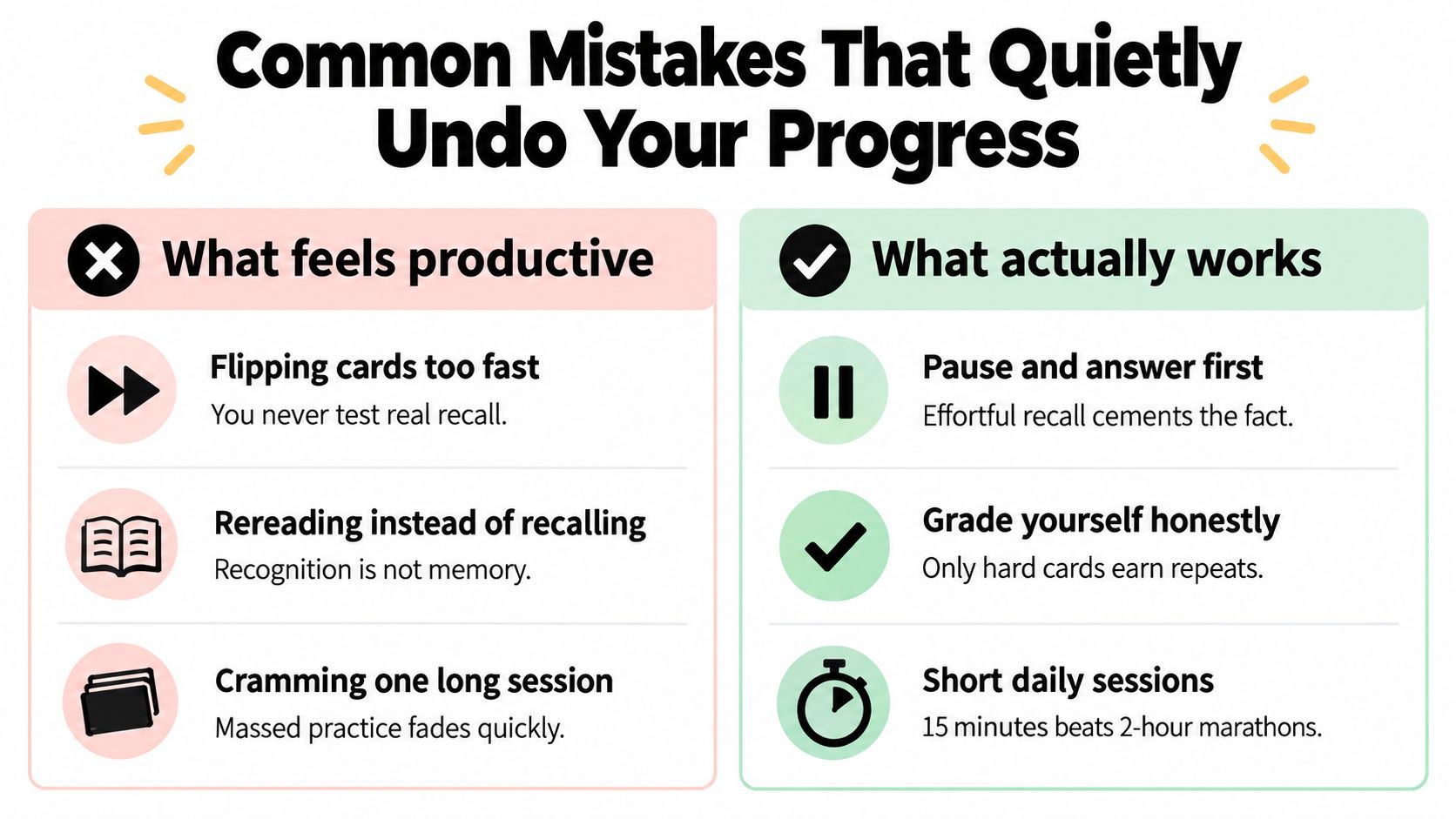
Measure progress by delayed recall, not by the number of cards touched in one sitting. A smaller deck reviewed consistently can teach more than a massive deck you recognize only during the first pass. The rating, spacing, and repetition loop turn each review into feedback about what to study next.
Your Five-Move Flashcard Checklist
Five disciplined moves will outperform hours of casual flipping.
- Write the back first. State the correct answer in a short form, then reduce the front to one clear cue. This keeps the prompt focused on the response you need.
- Answer aloud before flipping. Don't settle for a vague feeling of familiarity. Produce the answer, even if it's incomplete, then compare it with the back.
- Rate the attempt accurately. Use Again, Hard, Good, or Easy based on what happened before the reveal. Your rating tells the scheduler how soon the card deserves another test.
- Clear the due queue before adding new cards. Keep overdue reviews from accumulating. If the queue starts to exceed two days of work, pause new material and rebuild consistency.
- Tag the three cards that caused hesitation. After the session, add an image, example, contrast, or more precise cue to those cards. Then return them through a shorter interval rather than hoping the problem resolves itself.
This process works because it connects card design, active recall, honest grading, and spaced review in one loop. Pick your next study block, open your deck, and run these five moves once. You'll quickly notice which cards test memory and which ones only invite recognition.
ClassLecture.ai can turn your own lecture recordings, notes, and PDFs into editable question-and-answer or fill-in-the-blank flashcards, with study support built around spaced review. Upload your next course file, check the generated cards against the source, and begin your review at ClassLecture.ai.
The ClassLecture.ai Team
We build ClassLecture.ai, the AI study assistant that turns your recorded lectures into transcripts, summaries, flashcards, and answers cited to the exact timestamp — so you learn faster from your own professor's words.
Keep reading
How to Take Lecture Notes That Actually Stick (2026)
Learn how to take lecture notes using proven methods, digital tools, and review strategies that turn passive listening into long-term retention.
Read10 Trig Identities Flashcards Resources for 2026
Compare 10 trig identities flashcards resources, including interactive decks, printable aids, spaced repetition, study tips, and sample cards.
ReadFlashcards for Study Notes That Actually Stick
Learn how to turn class notes and recordings into flashcards for study notes that boost recall with manual and AI workflows, spacing, and review tips.
Read