Best Way to Make Flashcards: Active Recall That Sticks
Learn the best way to make flashcards: write active-recall questions, use cloze cards, source them from lectures, and review with FSRS scheduling.
You've just left a lecture with a full page of notes and a growing sense that you should turn them into flashcards. You start copying definitions and slide headings, and soon the deck looks substantial. But when you cover the answers, the cards mostly ask you to recognize familiar words, not retrieve what you've learned.
The best way to make flashcards is to build each one around a question you must answer from memory. Start with the kind of knowledge you're learning, phrase a clear prompt, and check every answer against the lecture or course material it came from.
Table of Contents
- Pick the Card Format Before You Write
- Choose the Medium First
- How to Turn a Lecture Into Flashcards, Step by Step
- Rewrite Weak Cards Into Ones That Force Recall
- Build Flashcards From Lecture Transcripts
- Schedule Reviews With FSRS Ratings
- Fix the Problems That Stall Your Review
- Start Your First Deck Tonight
Pick the Card Format Before You Write
| Format | Best for | Example front | Watch for |
|---|---|---|---|
| Question and answer | Definitions, causes, dates | What causes the Krebs cycle to stall without oxygen? | Questions that have several correct answers |
| Cloze deletion | Terms inside a sentence, formulas, process steps | The {{c1::ribosome}} translates mRNA into protein. | Too many blanks in one sentence |
| Reversed pair | Vocabulary, symbols, labelled diagrams | ATP (front) and adenosine triphosphate (back), tested both ways | Doubling cards you never actually recall |
| Explanation card | Why and how questions, comparisons | Why does insulin lower blood glucose? | Answers longer than a few sentences |
Choose the format to fit the material, not because you happen to prefer one card type. A plain question-and-answer card works well when the goal is to retrieve a definition, cause, or date. Keep the answer focused: if the front asks what osmosis is, the back should give a concise definition, not a paragraph about cell membranes.
Cloze deletions work when a term belongs inside a sentence or a step in a process. The surrounding sentence supplies context, but you still have to recall the missing piece. Hide one meaningful item at a time. Several blanks can turn a single prompt into a guessing game, especially if you don't remember which gap you're meant to fill.
Use reversed pairs when knowing both directions matters. You might need to identify a symbol from its name and recall the symbol when given the name. The same logic can apply to vocabulary or labelled diagrams. Don't create a reverse card automatically; add it only if you'll practice that direction.
Explanation cards test reasoning rather than a label. Ask why insulin lowers blood glucose, or how two theories differ. Keep the answer short enough to explain aloud in a few sentences. For your first pass through lecture material, sort each idea by format before writing. A useful deck often mixes formats instead of forcing every topic into the same template.
Choose the Medium First
Decide where the cards will live before drafting them. Paper slows you down in a useful way: handwriting encourages concise answers, and you can sketch a formula or redraw a diagram without fiddling with an interface. It works well for a limited course deck, especially when drawing is central to the material.
Digital cards make it easier to review over time because a scheduler can use your review history to decide when each card should return. That only helps if you complete the reviews. Cloze cards and reverse versions are also quick to make in an app, and you can revise wording without rewriting a stack of cards.
A hybrid approach is practical: jot key terms during class, then make finished cards later while checking them against the lecture. For longer-term review, digital is usually easier to manage. If you'll redraw most of your study material, paper may be the better starting point. For ideas about turning course content into revision material, AI flashcards for treaty revision offers a relevant example of how flashcards can be built around subject-specific material.
Whichever medium you choose, keep each card focused on one idea, with a clear answer and a source you can check.
How to Turn a Lecture Into Flashcards, Step by Step
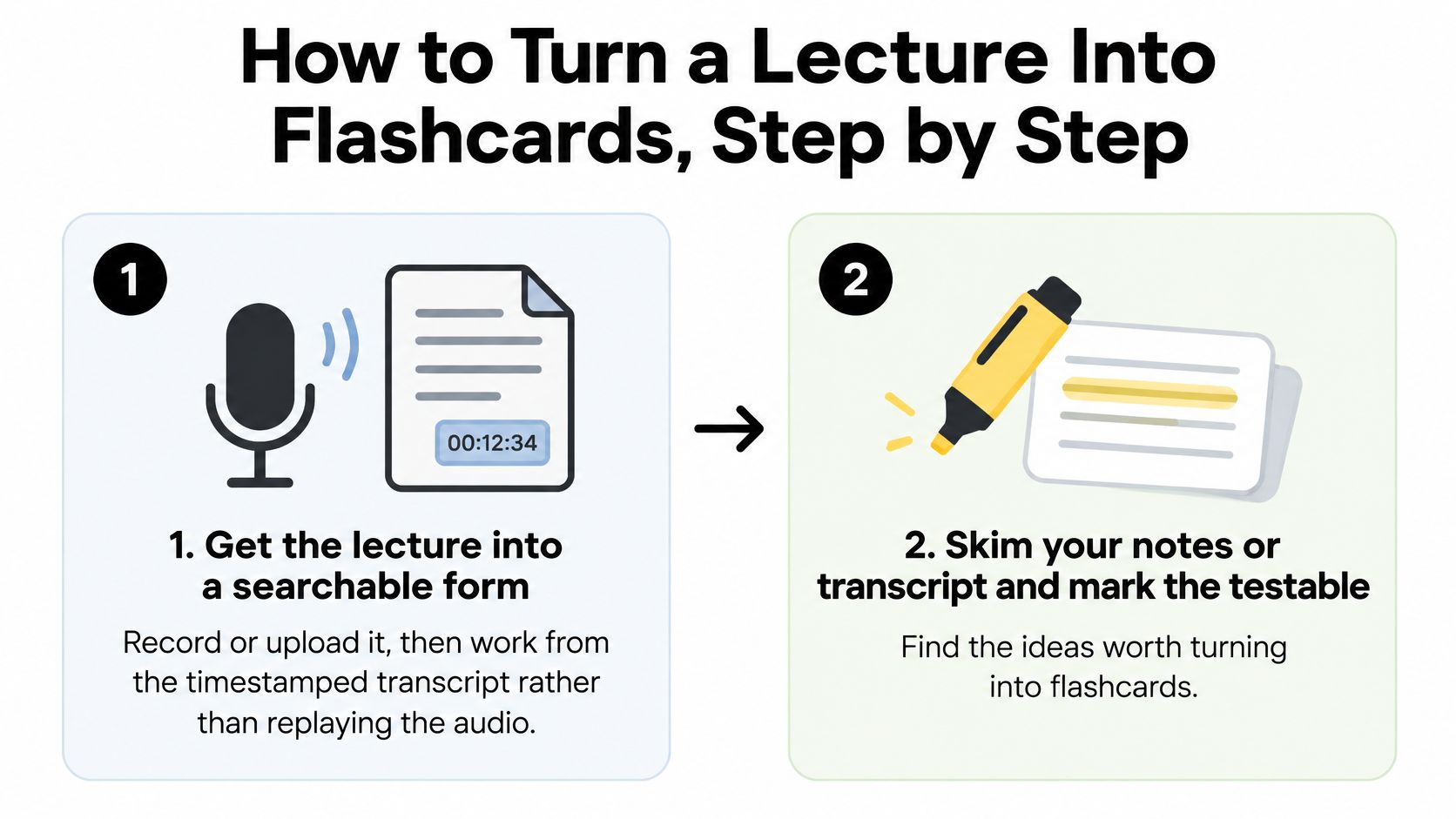
Start with the lecture itself, not a pile of copied slides. A workable process takes you from searchable material to a small deck you can test without notes.
-
Make the lecture searchable. Record or upload it and work from a timestamped transcript rather than replaying the audio to find each point. A searchable transcript helps you locate the exact moment when a definition or explanation comes up.
-
Mark the testable ideas. Skim your notes or transcript for headings, bold terms, repeated points, and anything the professor flagged as important. A topic appearing on a slide isn't automatically worth a card; prioritize material you'll need to explain, distinguish, or recall.
-
Separate ideas. Write one idea per card. If a prompt asks for two unrelated answers, you can know one and miss the other without knowing what the rating should be.
-
Match the format to the idea. Use a direct question for a definition or cause, a cloze for a term within a process, and an explanation prompt for a mechanism or comparison. The prompt should make clear what kind of answer you're expected to retrieve.
-
Rewrite the front. Put the prompt in your own words instead of copying slide text. Familiar phrasing can make the card feel easy because you recognize the sentence, even when you can't explain the idea.
-
Add a source marker. Attach a lecture timestamp or page number to each card. When an answer seems wrong or unclear, you can return to the relevant course material without searching from scratch.
-
Verify the answer. Check each card against the original recording, textbook, or class notes. Catching an error now is easier than trying to unlearn an answer you've already memorized.
-
File and review. Keep the deck under the right course and unit, then try it the same day. A sound deck is a short run of focused cards you can answer without opening your notes.
Building a study routine around these cards can help keep review from becoming another last-minute task; the Boss as a Service study guide offers useful context on organizing study at home.
Rewrite Weak Cards Into Ones That Force Recall
A card isn't strong just because its answer looks familiar. Cover the back and ask whether the front makes you retrieve an answer from memory, rather than spot a word you've already seen.
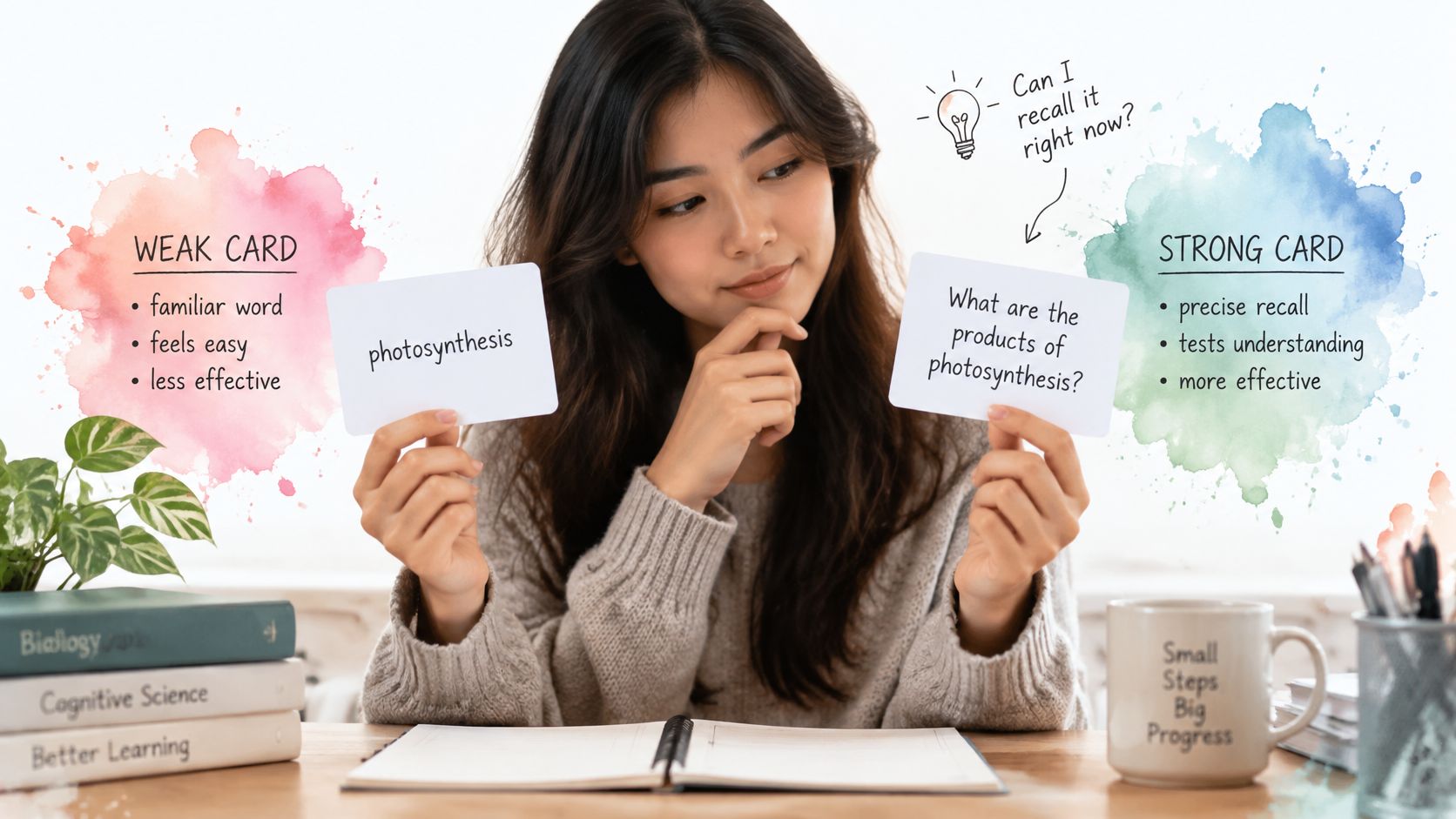
| Weak card | Stronger card | Why it works |
|---|---|---|
| Photosynthesis | Where in the chloroplast does the light-dependent reaction take place? | Forces a specific location instead of a familiar word |
| Define homeostasis | What mechanism brings blood glucose back to its set point after a meal? | Uses a concrete scenario, so the answer must be built, not recognised |
| Inflation causes | When demand outpaces supply, what happens to prices, and why? | Asks for the chain of cause and effect in one answer |
| Mitochondria are the powerhouse of the cell | Which organelle makes most of a cell's ATP, and through which process? | Asks for the name and the process, so one answer is not enough |
The last example needs a judgment call: it asks for both an organelle and a process, so it may be better split into two cards if you want to rate each fact separately. The point isn't to make every prompt difficult. It's to make the expected answer clear and require you to produce it.
A useful check is to answer each front aloud before turning the card over. If you can't say the answer in a sentence, the prompt may be vague, overly broad, or testing multiple things at once. For more practice shaping focused prompts, see this guide to structured questions. Students studying for A-Level exams can also use this active recall guidance for A-Level students to think through how prompts can test retrieval rather than recognition.
Try rewriting a handful of existing cards before adding more. Stronger wording often improves a deck faster than making it longer.
This video gives another look at how to put active recall into practice.
Build Flashcards From Lecture Transcripts
A transcript helps you search for the lecturer's emphasis instead of relying only on what happened to make it onto a slide. Search for phrases such as “remember that,” “the key idea,” or “this will be on the test,” and notice terms the lecturer returns to. Treat those as leads, not automatic instructions to make a card.
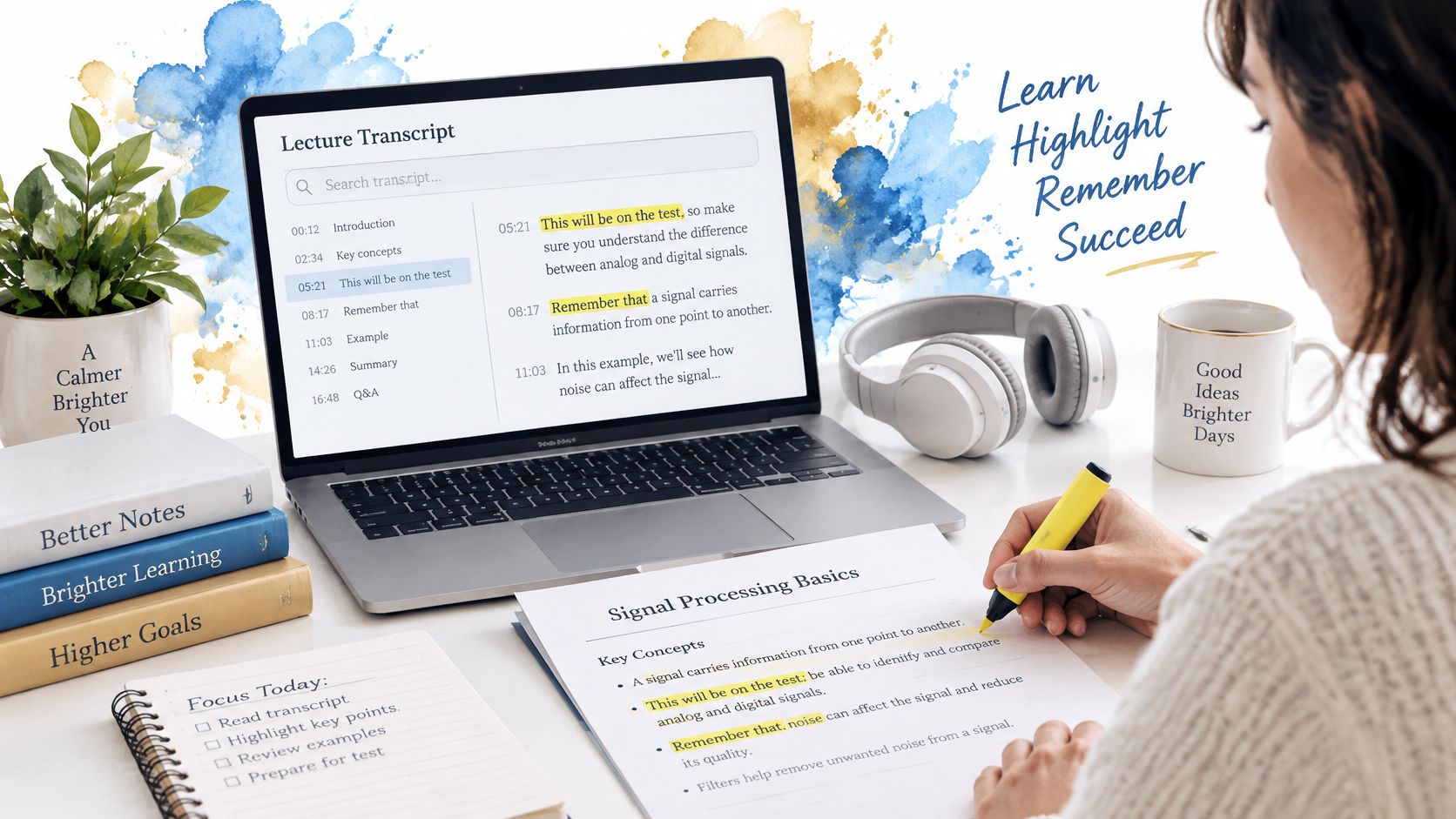
Compare the transcript with the slides and your own notes. The lecturer may explain a mechanism, give a qualification, or describe an example that the slide leaves out. Add a card for a missing idea when it matters to the course, and leave out details that don't help you answer a likely question.
ClassLecture.ai turns lecture recordings and class materials into flashcards linked to the exact lecture moment. Its searchable transcripts have timestamps, so you can open the original audio at the point a card came from if the answer is unclear. If you're preparing your own transcript first, this guide to making transcripts explains why searchable text can make course material easier to work with.
Treat generated cards as a draft, not a finished deck. Rewrite prompts that copy the transcript word for word, remove trivia, and add important gaps you noticed while comparing sources. If a card includes two ideas, split it; if its wording gives away the answer, make the cue more specific.
Check every answer against the recording or course materials before studying it. AI transcripts, summaries, flashcards, answers, and citations can be inaccurate or incomplete, so verify anything important against the original. A timestamp makes that check quicker, but it doesn't replace your judgment about what the course expects you to know.
Schedule Reviews With FSRS Ratings
Spacing reviews helps you revisit material over time instead of cramming every card into one sitting. FSRS uses your rating after each attempt to decide when a card should return. Rate what happened during recall, not how confident you want to feel about the topic.
| Rating | Choose it when | What the scheduler does |
|---|---|---|
| Again | You could not recall the answer, or recalled the wrong one | Brings the card back soon and shortens its interval |
| Hard | You recalled it, but only with real effort or a long pause | Grows the interval slowly |
| Good | You recalled it correctly after a brief think | Grows the interval at a normal pace |
| Easy | You recalled it instantly and with certainty | Grows the interval fastest, so the card appears less often |
A correct guess isn't the same as a confident answer. If you hesitated or pieced the answer together with effort, choose Hard rather than Good. Choosing Easy for a card you only guessed can push it too far into the future, when you may not be ready to retrieve it.
Set a review routine you can repeat: work through due cards, pay attention to those you struggled with, and finish the queue before adding a large batch of new material. When your cards come from different lectures, reviewing across the course can make it easier to see what needs attention. Class-wide review and an exam readiness widget can help you check how the deck stands for a class, rather than relying on a general feeling of confidence.
For a closer look at planning recurring practice, see this guide to a spaced repetition schedule. The most useful rating is the honest one. The scheduler can only respond to the feedback you give it.
Fix the Problems That Stall Your Review
The daily review pile keeps growing? Don't assume the solution is to study faster. That symptom often means you're adding new cards faster than you can clear due reviews.
| Symptom | Likely cause | Fix |
|---|---|---|
| Cards feel easy but you fail the exam | Cards test recognition, not recall | Rewrite the front with no visible cue, such as a blank to fill |
| The daily review pile keeps growing | Too many new cards added at once | Cap new cards per day and clear due reviews first |
| The same card keeps coming back as Again | The card holds two facts or ambiguous wording | Split the card or rewrite the prompt so one answer fits |
| Ratings no longer change your schedule much | Pressing Good by habit | Choose Hard whenever you hesitated, even if you got it right |
| Deck does not match the exam | Built from slides alone | Add cards from the transcript sections the professor stressed |
Use the symptom to decide what to change, rather than repeating the same review. A card you keep failing may need a clearer front or a narrower answer, not more time staring at it. If the deck feels disconnected from the exam, compare it with the lecturer's spoken explanations as well as the slides.
Start Your First Deck Tonight
Choose one lecture from this week instead of trying to rebuild an entire semester. Record or upload it, get the timestamped transcript, and make a starter deck from ideas you can verify in the class material.
- Upload or record the lecture.
- Open each generated card and rewrite prompts that only test recognition.
- Delete trivia and add any important gaps you spotted.
- Check each answer against its lecture moment or course source.
- Review the finished deck today and rate each attempt.
ClassLecture.ai's Free plan includes three AI summaries, three quizzes, three flashcard decks, and three questions per month. Keep the first session short enough to fit into a busy day, then give yourself a clear time to review again.
ClassLecture.ai turns your lectures and class materials into searchable transcripts, timestamp-linked flashcards, and scheduled review. Try it with one lecture and build a deck you can check against the original. Visit ClassLecture.ai to get started.
The ClassLecture.ai Team
We build ClassLecture.ai, the AI study assistant that turns your recorded lectures into transcripts, summaries, flashcards, and answers cited to the exact timestamp — so you learn faster from your own professor's words.
Keep reading
How to Make Flashcards Online the Smart Way
Learn how to make flashcards online with proven design rules, spaced repetition setup, and how to auto-generate cards straight from lecture recordings.
ReadHow to Study Flashcards the Smart Way
Learn how to study flashcards with spaced repetition, active recall, and better card design. A practical guide to faster, longer-lasting learning.
ReadSpaced Repetition Schedule: How to Build One That Works
Build a spaced repetition schedule for any exam date or course load, with sample plans, FSRS basics and fixes for missed reviews.
Read