What Are Structured Questions and How to Use Them
What are structured questions? Learn the definition, three layers, templates, lecture examples, and study tips.
A structured question is a preplanned prompt with fixed wording, response rules, and a known cognitive job, so answers can be compared and checked against a source.
The popular advice to turn everything into multiple-choice questions misses the point. A selected answer can check recognition, but an open explanation can be just as structured when you specify what the student must explain and how you'll judge it.
That distinction matters when your notes look familiar but you can't reconstruct the lecturer's reasoning with the recording closed. Good study questions expose that gap instead of helping you rehearse the feeling of knowing.
Table of Contents
- What Structured Questions Actually Mean
- Format, Function, Sequence and Trade-offs
- Cognitive Levels That Change the Prompt
- How to Write a Reusable Question Schema
- Structured Questions Drawn From a Lecture
- Turn Your Next Lecture Into a Question Set
What Structured Questions Actually Mean
A structured question is a standardized prompt whose wording, response options, and often presentation order are fixed before anyone answers. The Springer encyclopedia entry on structured questionnaires explains that these shared conditions make responses comparable and describes formats including category selection, numerical entry, and five-point scales.
Compare these study prompts:
- Improvised prompt: Explain this concept.
- Structured prompt: Define the concept using the lecturer's terminology, distinguish it from the related concept in your notes, and identify the supporting passage.
With the improvised version, you might accept a definition today and expect a causal explanation tomorrow. The structured version keeps the task stable. You know what to produce before you begin, and someone checking your answer knows what to look for.
Structured response formats students actually use
| Format | What the answerer does | Best study job | Main weakness |
|---|---|---|---|
| Single choice | Selects one preset category | Classification and definitions | Misses partial knowledge |
| Five-point scale | Rates agreement or confidence from lowest to highest | Confidence checks and attitudes | A number can look more precise than the judgment |
| Select all that apply | Marks every option that fits | Causes, features, or symptoms | Easy to over-select and hard to score fairly |
| Numerical entry | Supplies a count or calculated value | Quantities and formulas | A wrong unit still looks neatly structured |
| Bounded constructed response | Writes a short answer under stated rules | Explanation and transfer | Slower to check than a selected option |
For lecture study, these become practical tasks: identify the correct definition, rate your confidence before answering, mark every cause the lecturer named, calculate a quantity using the formula in your notes, or explain a relationship within a stated boundary.
Notice that rating confidence isn't the same as testing knowledge. It's useful when you compare your initial judgment with the answer you produced. Feeling certain and giving a complete explanation are different outcomes.
What standardization gives you
Consistency lets researchers group answers, compare respondents, and repeat a measurement. For students, it also makes later attempts meaningful: you can see whether your explanation improved rather than whether you happened to ask yourself an easier question.
But predetermined options can exclude an explanation the question writer didn't anticipate. Keep open prompts available, especially when you're exploring ambiguity or trying to diagnose why an answer went wrong.
A response format is a container, not a learning objective. Choose it for the thinking you want to observe.
So, what are structured questions in everyday study? They're tasks with enough advance definition that you can tell whether you've completed them. Use the table as a format menu, not as a rule that every concept must become a selected answer.
Format, Function, Sequence and Trade-offs
Structured doesn't mean closed, and open doesn't mean unstructured. A long written response can follow precise requirements, while a multiple-choice item can be vague, misleading, or poorly aligned with the lecture.
To design useful questions, separate how students answer from what they must think about and how the prompts connect.
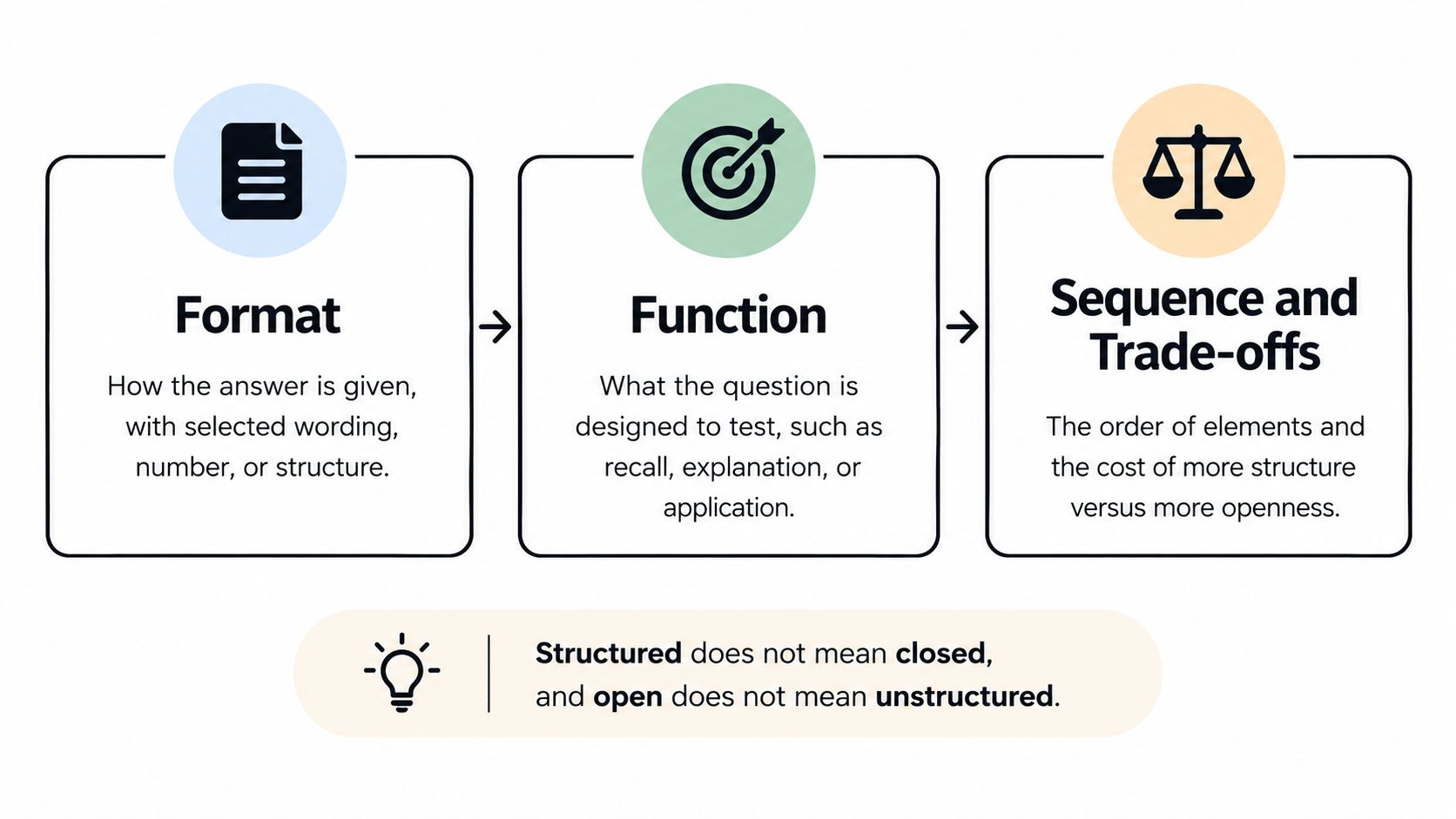
Separate the design decisions
Format is how the answer is given: a selected option, a short constructed response, or a longer explanation. It determines what you'll collect, not automatically how demanding the thinking will be.
Function is the cognitive job: recall, explain, apply, critique, or transfer. Selecting a diagnosis from a carefully written scenario can require application; writing a memorized definition remains recall even when the answer fills a paragraph.
Sequence is the order and dependency among prompts. In a connected chain, the student uses an established definition to explain a mechanism, then uses that mechanism to reason through a new situation.
For a lecture concept, try this progression:
- What is the concept?
- How does the lecturer explain it?
- What evidence supports it?
- Where would it fail?
- Can you apply it to a new case?
The prompts shouldn't merely change the wording of the same question. Each should require something the preceding answer didn't establish.
What the evidence does and doesn't establish
A quasi-experimental study published in the International Journal of Educational Technology in Higher Education involving 83 undergraduates found that students using progressive or divergent question chains showed more learning-strategy use and monitoring, stronger metacognitive awareness, and higher course achievement than students using free-form questioning.
That doesn't establish that sequencing alone caused the gains. Students received prescribed question packages, and researchers didn't measure adherence to each sequence.
The Revista de Investigación Educativa paper on questioning and learning discusses mixed findings across response formats and the potential of open constructed responses to reveal deeper learning approaches, while also acknowledging grading demands and limitations of question-chain comparisons involving intact classes. A tidy sequence isn't proof of an effective intervention, and a polished response isn't proof of understanding.
Choose the structure according to the outcome:
- For facts: Use short checks that require a specific term, feature, or relationship.
- For concepts: Open the response gradually so students must explain connections rather than select familiar wording.
- For transfer and uncertainty: Add a scenario or ask what evidence would change the answer.
Keep verification inside the task
Require learners to identify the supporting timestamp or page, flag claims absent from the material, and compare competing interpretations. If an answer sounds convincing, ask what passage would let another student verify it.
This matters particularly in medical, nursing, construction, and safety study. Naming a principle doesn't demonstrate that a learner can recognize when it applies, notice an exception, or identify missing information in a scenario.
Don't force every topic through an elaborate chain. If you're checking terminology, a direct retrieval item may be enough; if you're preparing to explain a decision, stopping at terminology leaves the important work untested.
Practical rule: Prefer a short chain with distinct thinking jobs to a long conversation full of near-duplicate prompts.
Cognitive Levels That Change the Prompt
A lecturer's slide on memory can support very different exam questions. Naming a term, explaining a distinction, and judging a study plan all concern the same topic, but they don't measure the same skill.
Benjamin Bloom and colleagues' original 1956 taxonomy established six cognitive categories, presented in Clemson University's Bloom's taxonomy document. The framework helped educators construct examinations around identifiable intellectual skills rather than a vague expectation that students should understand the material.
Bloom levels as structured study prompts
| Level | Cognitive job | Lecture prompt stem |
|---|---|---|
| Knowledge | Name or define from memory | What term does the lecturer use for this idea? |
| Comprehension | Restate or interpret | In your own words, what does the lecturer mean by it? |
| Application | Use a rule in a new situation | Apply this rule to a case the lecture did not show |
| Analysis | Separate components and relationships | Which parts of the explanation depend on each other? |
| Synthesis | Produce an original plan or product | Design a short procedure that uses these ideas together |
| Evaluation | Judge against standards or evidence | Which interpretation is best supported by the lecture? |
These are the historical categories, not a claim that every study session must climb a rigid ladder. Sometimes you'll discover during application that you need to return to a definition. That's useful feedback, not a failed sequence.
The label should describe the actual task, not just the verb at its beginning. An item that says analyze but only asks you to reproduce a list still tests recall.
Label the skill before writing the stem
Suppose your learning outcome is to distinguish recognition from recall. A knowledge item might ask you to define each term; an application item might ask which process a student uses when identifying a familiar answer among alternatives.
An analysis item could ask you to separate the demands of an open response from those of a selected response. An evaluation item could ask which assessment better supports a particular conclusion about a learner, using criteria from the lecture.
Before writing, finish this sentence: A successful answer will demonstrate that the student can… If your ending is only discuss memory, narrow it until you can identify a visible performance.
- Begin with retrieval: Ask for essential terms and relationships without showing the notes.
- Add explanation: Include comparison and mechanism prompts that require connected reasoning.
- Test use and judgment: Introduce an unfamiliar case, then require evidence for the student's conclusion.
A bank made entirely of recognition items won't show whether you can generate an explanation independently. Conversely, asking for elaborate critiques before you've learned the underlying terms can make practice unnecessarily confusing.
For help turning those learning outcomes into clear stems, use this guide to making quiz questions. Keep the target skill visible while you edit the wording.
A transcript can support a deliberate progression: identify the concept, use it in a new case, and judge which interpretation the source supports. The important change is in the student's work, not the length of the answer.
How to Write a Reusable Question Schema
Explain preload is a weak study stem because it leaves the scope and scoring decision to whoever reads it. A student might give a definition while the tutor expects a mechanism.
A more auditable version is: Using only the lecture transcript, define preload, identify the timestamp where it is introduced, and explain one consequence of excessive preload. Now the checker can distinguish a correct definition from an accurate location and a supported causal explanation.
Reduce discretion before polishing wording
Structure means controlling the task, not making the language sound formal. Keep the target concept stable, give learners comparable conditions, and specify what another person should be able to score.
The U.S. Office of Personnel Management's structured interview guide summarizes associations between greater interview structure and higher validity, rater reliability, and rater agreement, alongside reduced adverse impact. That evidence concerns personnel assessment, not a direct test of lecture flashcards, but it illustrates why explicit criteria matter when people judge responses.
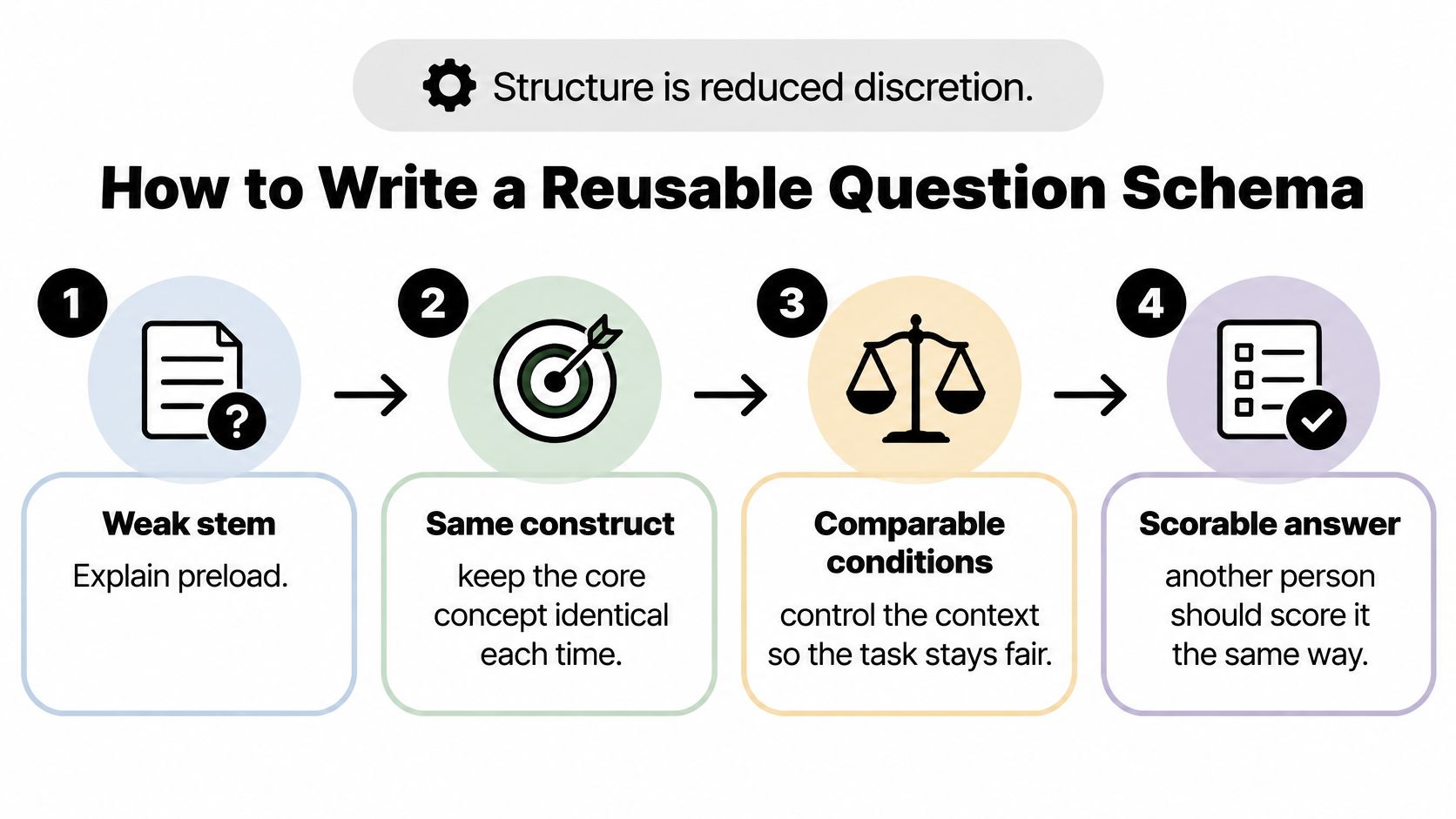
Build the reusable fields
- Source scope. Specify transcript only, or notes plus transcript. Don't add textbook knowledge when the task tests the lecturer's explanation.
- Topic. Choose a narrow concept such as preload, not an entire cardiovascular lecture. Attach a learning outcome, such as explaining a source-supported consequence.
- Question type. Name the cognitive operation. If the item combines definition and explanation, identify both rather than labeling it general understanding.
- Difficulty. Use a practical label such as recall, mixed, or transfer. Make the label reflect the demands, including whether the case is unfamiliar.
- Answer format. State whether you expect a selected option, calculation with units, or bounded explanation. For the preload example, use separate labeled parts.
- Citation requirement. Require a timestamp or page that supports the relevant claim, not merely a passage containing the topic word.
- Rubric. Define the checkable dimensions before seeing the answer: accurate definition, correct source location, and a causal explanation supported by that location.
For the rubric, say what counts as sufficient. A definition should include the lecturer's essential meaning; the location should lead to the relevant explanation; the consequence should follow from the source rather than from an unsupported assumption.
Quality gate: Reject an item when its expected answer is absent from the selected material or its citation doesn't support the claim.
If the transcript is ambiguous, mark the item for clarification instead of inventing a clean answer key. This is especially important when a transcription error changes a technical term or reverses a relationship.
Save the fields alongside the stem. Metadata, rather than prettier wording, makes the pattern repeatable across lectures and makes later revisions easier to audit.
Structured Questions Drawn From a Lecture
Say you're reviewing a hypothetical psychology lecture segment about familiarity and recall. For this worked example, the segment distinguishes recognizing previously encountered material from producing an answer without the material visible, and cautions that fluent rewatching doesn't establish independent recall.
Treat that as the example's content boundary, not as a quotation from an actual recording. In your own set, replace the descriptive evidence anchors below with the timestamps or pages.
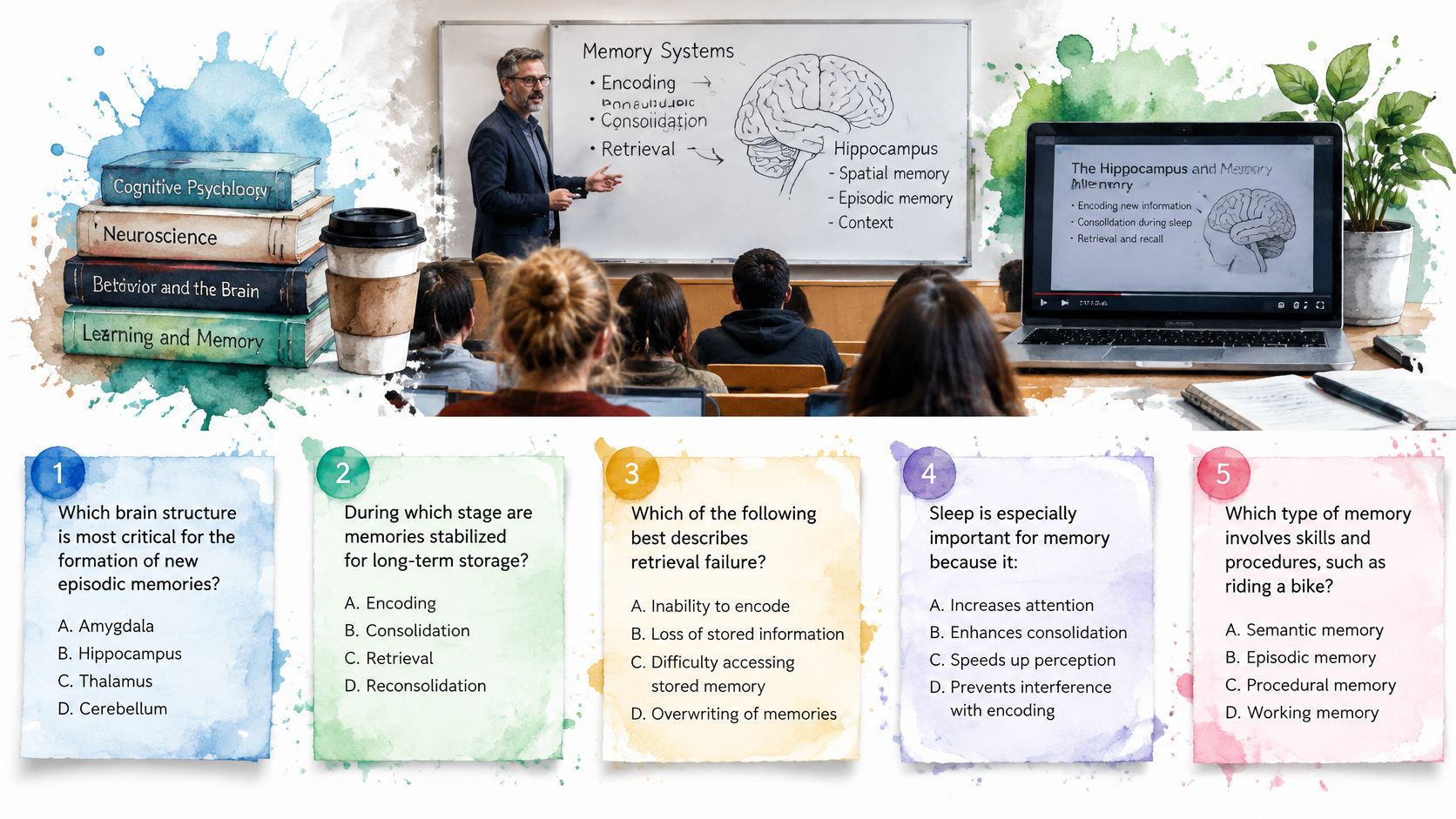
A set with distinct jobs
| Item and prompt | Expected response | Difficulty | Evidence anchor and corrective feedback |
|---|---|---|---|
| Definition Describe recall as used in this segment. | Producing the relevant answer without viewing the material. | Recall | Attach the definition passage. Correct the idea that recognizing wording is equivalent to generating it. |
| Comparison Which task directly requires recall: selecting a familiar definition, recognizing a slide, explaining with notes closed, or following a replay? | Explaining with notes closed. | Mixed | Attach the distinction passage. Explain why familiar cues aren't the same as independent production. |
| Mechanism Why can rewatching feel successful without establishing recall? | The material remains available, so following it doesn't demonstrate that the student can produce the answer independently. | Mixed | Attach the lecturer's explanation. Correct the assumption that ease of following proves readiness. |
| Application A student follows a replay but can't explain the concept afterward. What should the student test next? | Attempt an explanation without the recording, then compare it with the lecture. | Transfer | Attach the relevant principle and label the scenario as an application. Don't describe it as a case the lecturer actually discussed. |
| Source verification Locate the passage supporting the distinction and identify any stronger claim it doesn't establish. | Provide the actual source location and flag unsupported additions. | Mixed | Attach the supporting span. Correct the belief that a relevant citation validates every sentence. |
Only the comparison item uses multiple choice. Its wrong options represent specific mix-ups: selecting familiar wording, recognizing visual material, and following an explanation while it remains available. They aren't joke alternatives that let students answer without understanding the distinction.
Convert selected items into cards
Turn the definition item into a question-and-answer card. Turn its key sentence into a fill-in-the-blank card by removing recall, while retaining enough context to make the intended term clear.
Flashcard templates for lecture items
| Card type | Front | Back and attached evidence | Best use |
|---|---|---|---|
| Question and answer | Question tied to one concept | Answer plus timestamp or page | Definitions and mechanisms |
| Fill-in-the-blank | Sentence with one blank | Term plus evidence span | Terms in context |
| Multiple choice | Stem with four options | Key plus distractor logic from lecture mix-ups | Classification and comparisons |
Keep the evidence span attached, not just the front and back. This guide to working with lecture notes can help you organize the material you'll check against.
Question-generation findings discussed in Applied Cognitive Psychology report medium-to-large effects on comprehension, recall, and problem solving compared with restudying; the evidence also cautions that retrieval practice alone didn't outperform restudying for producing create-level research questions. Don't turn the whole segment into near-identical definition cards.
Answer from memory, inspect the evidence, and mark unsupported additions. If you're studying in a second language or using a rough recording, treat fluent wording as unverified until you've checked the underlying passage.
Turn Your Next Lecture Into a Question Set
Use your next session to build a small, checkable set rather than a large question bank. Keep a visible record of what you couldn't yet answer.
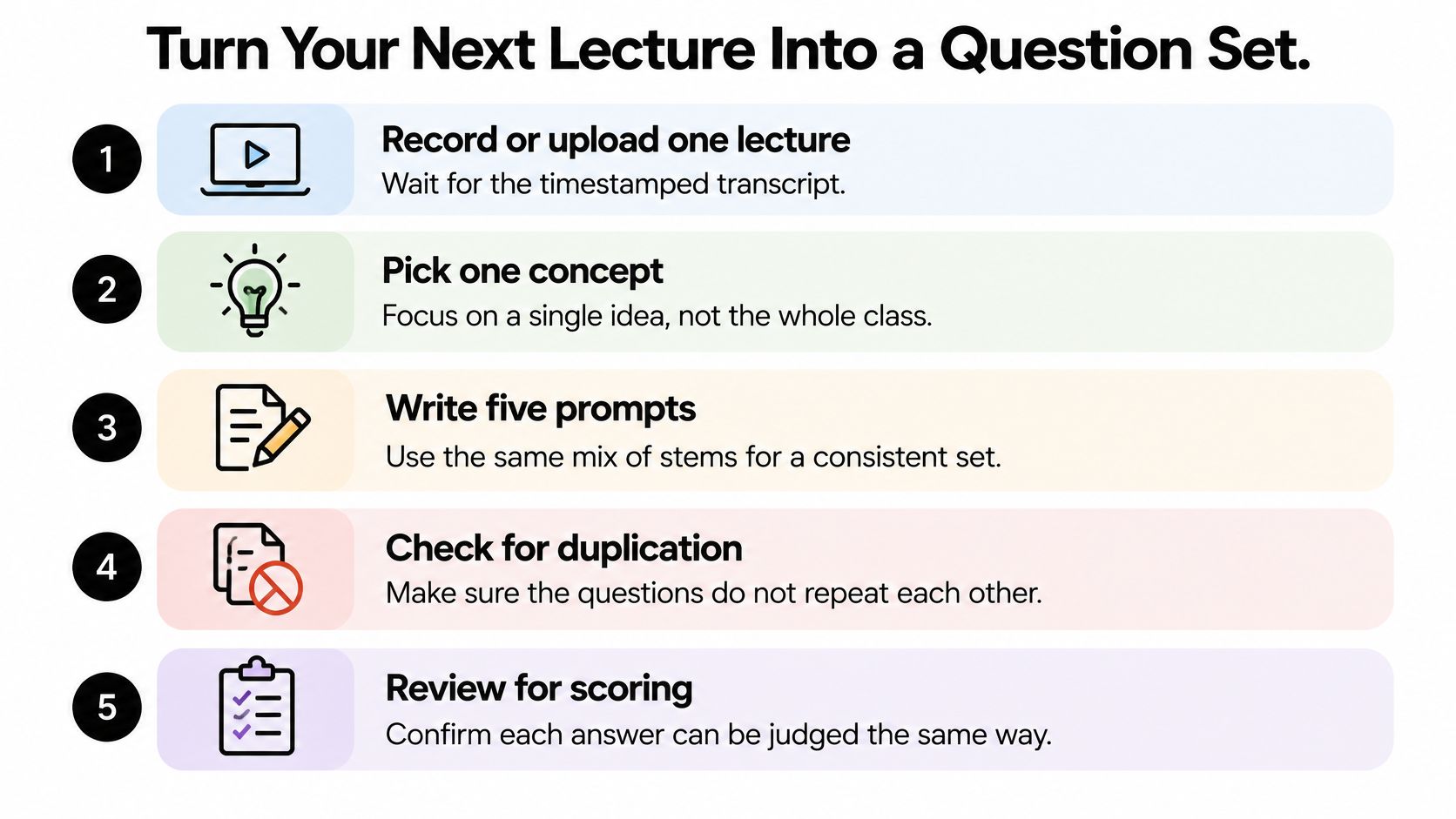
- Capture the lecture. Record or upload it and wait for the timestamped transcript.
- Narrow the topic. Pick a concept you need to explain, not the whole class.
- Draft the set. Include definition, comparison, mechanism, application, and citation-check prompts. Remove duplicates.
- Attempt before checking. Answer with the source closed, including the reasoning you're unsure about.
- Audit the answers. Keep items whose citations support the key, and note where the material is silent.
- Schedule review. Convert the keepers into source-linked flashcards and revisit them on a spaced schedule.
At ClassLecture.ai, we follow that capture-to-study path: once the transcript is ready, you can ask questions and generate summaries, study guides, and flashcards, with course answers cited to the exact lecture moment or document page. You can also create a scored multiple-choice quiz with immediate feedback after every answer; this guide to using a quiz generator for studying explains the study workflow.
Verify generated transcripts, summaries, and answers before relying on them. If a prompt has no cognitive job and no source span, it isn't ready to study from.
ClassLecture.ai helps you turn your own lecture recordings and documents into cited answers, flashcards, study guides, and practice quizzes. Visit ClassLecture.ai to build a focused question set from your next lecture, then check each answer against the material before you review it.
The ClassLecture.ai Team
We build ClassLecture.ai, the AI study assistant that turns your recorded lectures into transcripts, summaries, flashcards, and answers cited to the exact timestamp — so you learn faster from your own professor's words.
Keep reading
AI Meeting Notes Explained and How to Use Them
Learn what AI meeting notes are, how they work, and how to turn transcripts into searchable summaries, Q&A and flashcards with AI meeting notes.
ReadFlashcards Questions Answers: 8 Proven Examples
Explore 8 proven flashcards questions answers examples—from Leitner boxes to AI-generated Q&A cards made from your own lecture transcripts.
ReadStudy Flashcards Online: How to Build a Review Routine
Learn how to study flashcards online with spaced repetition, source-checked cards from your lectures, and a review schedule you can follow.
Read