How to Summarize a Research Paper: Step-by-Step Guide 2026
Learn how to summarize a research paper step by step: pull out the question, methods and results, avoid overstated claims, and cite the exact pages.
You're staring at a 14-page PDF the night before a seminar, highlighter in hand, and everything looks important. The introduction runs for three pages. The results table has six columns. By page four, you've highlighted whole paragraphs and you still can't say, in plain words, what the authors found.
That feeling isn't a reading problem. It's a selection problem. Learning how to summarize a research paper means deciding what to keep, what to leave out, and how strong each claim really is. A good summary doesn't shrink every section a little. It keeps the paper's logic intact, drops the background noise, and leaves you with something you can test yourself on later.
Start from the finished shape, then work backward to the reading. Once you know the five parts you're hunting for, the paper gets much easier to read.
Table of Contents
- The Parts Every Research Paper Summary Needs
- How to Summarize a Research Paper Step by Step
- Keep Findings Accurate Without Overstating Them
- Turn the Summary Into Questions You Can Answer
- Build a Page-Cited Summary and Verify It
The Parts Every Research Paper Summary Needs
Use this template before you write a word. If a box stays empty, you haven't read that part closely enough yet.
| Summary part | What to capture | Length guide |
|---|---|---|
| Research question | The problem or objective in one sentence | 1 sentence |
| Study design and sample | Method, data source, participant or sample size | 2-3 sentences |
| Main results | Key numbers with units, effect size and confidence interval where given | 2-4 sentences |
| Limitations | The limits the authors themselves state | 1-2 sentences |
| Conclusion | What the authors claim, kept separate from your own opinion | 1-2 sentences |
Why These Five Parts Work
A reliable summary mirrors the paper's central logic rather than its wording. That logic follows the IMRaD order, Introduction, Methods, Results, and Discussion, which the U.S. National Library of Medicine structured abstracts policy describes as a de facto standard for scientific abstracts. Structured abstracts were developed in the late 1980s and early 1990s to help readers assess relevance and methodological validity quickly.
For you, that history is practical. Preserve the question, design, evidence, and interpretation in that order, and leave out minor background and unsupported implications. For a standard empirical article, roughly 150 to 250 words usually covers all five parts without padding.
Some parts shift by paper type. A clinical trial needs participants, intervention, primary outcome, and harms where reported. A review article needs search scope and inclusion criteria instead of a single sample. If you're also learning how abstracts differ from summaries, Thesis Book Project's abstract writing guide is a useful companion for seeing how authors compress their own work.
Every sentence in your summary should be traceable to a page, table, or figure in the paper.
Here's the shape in miniature. "In a single-hospital study of 80 nurses, a training program was associated with a 12% drop in medication errors. The authors note that the single site limits generalization." Question, sample, result, and limitation are all present. Nothing is claimed beyond the study.
How to Summarize a Research Paper Step by Step
Your notes are full, the word budget is tight, and the results section is the part you are tempted to smooth into one confident sentence. A usable summary does the opposite. It keeps the question, the evidence, and the limits small enough to reread, then turns those lines into something you can recall without the paper open.
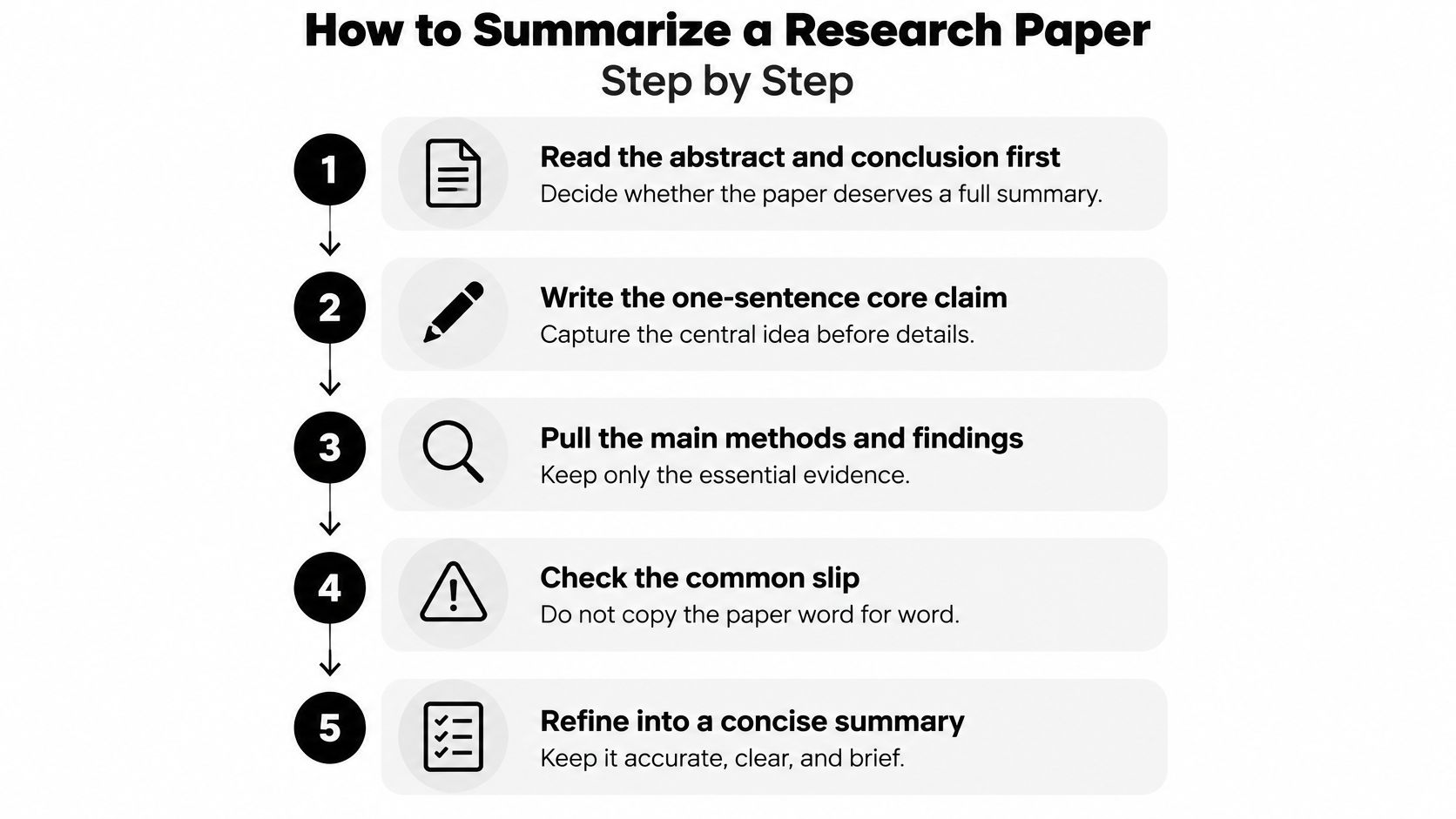
1. Read the abstract and conclusion first. Decide whether this paper deserves a full summary for the assignment or exam. Then write the one-sentence research question in your own words. If you cannot write it yet, reread the last paragraph of the introduction. Authors usually state the question there in plain language.
2. Map the argument section by section. The introduction tells you why the question matters. Methods tell you who or what was studied and how. Results give the specific findings. Discussion gives what the authors make of those findings. Methods work like a recipe card: drop the quantities and steps, and a neat result no longer shows whether the conclusion is earned. That is why skipping methods, because they feel technical, is the common slip.
3. Extract only claims the paper directly supports. Label each note as a finding, an author interpretation, or your own inference. Leave those labels visible while you draft. A finding belongs with results. An interpretation belongs in the conclusion, attributed to the authors. Your inference stays out of a neutral summary.
Keep the Qualifiers Attached
4. Preserve sample size, confidence intervals, significance levels, and limitations. Summaries usually fail here, not in the opening sentence. "In this sample" is the fence around the result. Remove it, and a bounded finding starts to sound like a claim about everyone. A confidence interval is the width of the estimate. Remove it, and the number looks sharper than the paper allows. If a limitation changes who the result applies to, it stays in the summary, not in a footnote you never reread.
5. Draft in your own words inside the word budget. Close the paper and write from your labeled notes so you are not copying phrasing line by line. If you're building broader habits around source work, you can explore writing research techniques alongside this workflow to strengthen how you handle evidence in longer assignments. When a sentence has no note behind it, cut it. Padding is how a short summary starts inventing importance the authors did not claim.
6. Check every sentence against its source page. Set each line beside the page, table, or figure it came from and correct any number that does not match. Shared vocabulary is a weak quality check. In SummEval, ROUGE-1 correlations with human judgments were only 0.250 for coherence and 0.412 for relevance, according to the SummEval re-evaluation in Transactions of the Association for Computational Linguistics. Two texts can share words the way two recipes share "salt" and "oven" while one of them burns the dish. After the check, cover the summary and try to state the question, method, main result, and limitation from memory. Any item you cannot retrieve is either missing or buried in wording you do not yet own.
Final test: A classmate who hasn't read the paper should be able to state the question, method, main result, and limitation after about two minutes with your summary.
Keep Findings Accurate Without Overstating Them
"The training program proves hospitals can eliminate medication errors." That sentence sounds clear, confident, and finished. It's also wrong if the paper studied 80 nurses at one hospital and found an association, not proof.
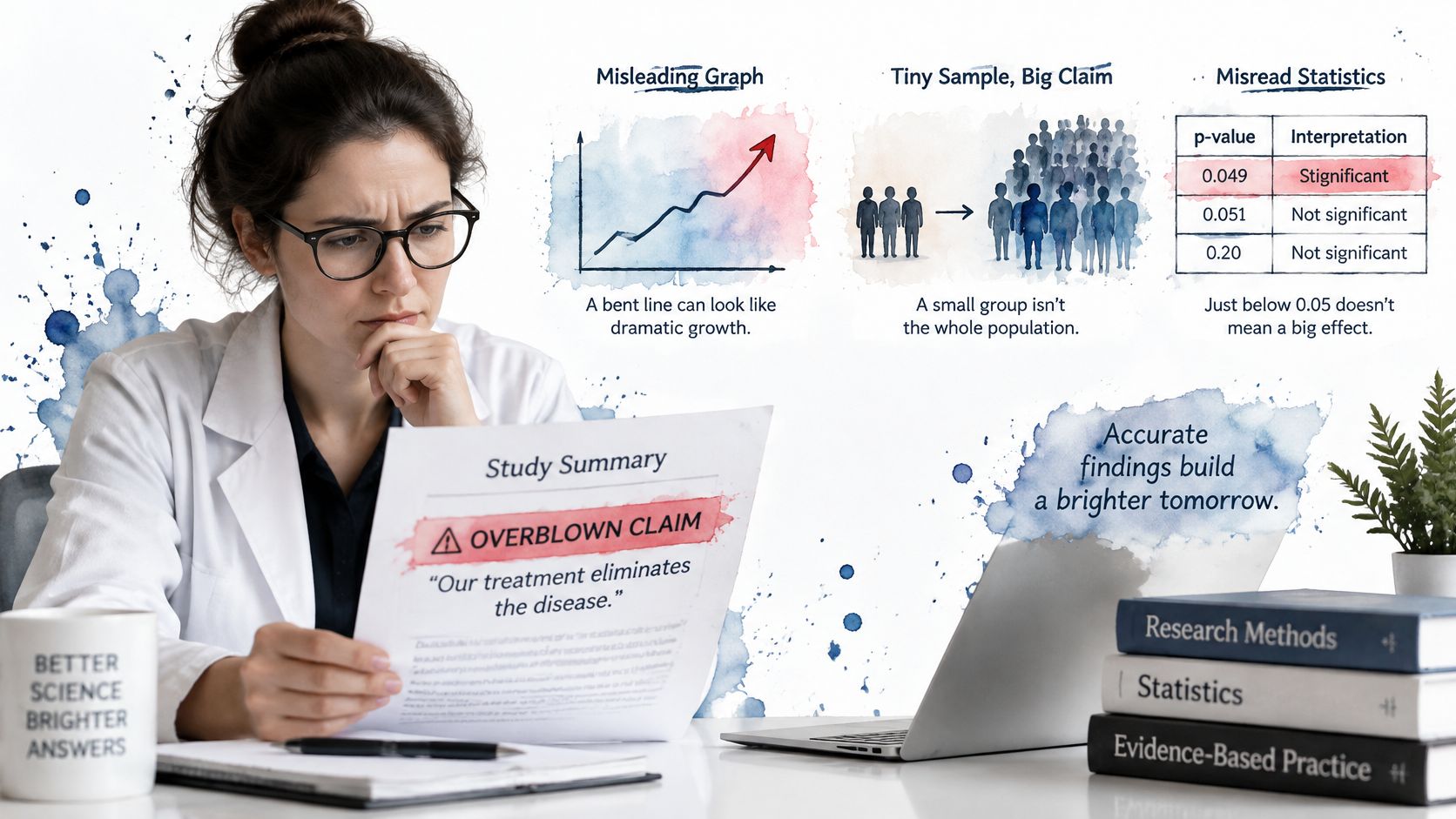
That pattern is result inflation. It shows up in three familiar ways. A correlational finding gets written as a cause. A small or selective sample gets presented as representative. Statistical significance gets treated as practical importance, even when the effect itself is tiny.
Run a Claim and Evidence Check
For each major claim, answer three things. Who was studied? Does the design show association or an intervention effect? What outcome was measured? Trent University guidance on writing article summaries asks students to identify participants, sampling, variables, controls, predictions, results, and limitations. The check goes one step further by tying each conclusion to the design feature that supports it.
| Draft phrase | Problem | Accurate version |
|---|---|---|
| The new method causes faster learning | Correlational study written as a causal claim | The method was associated with faster learning in this sample |
| Results prove the program works for everyone | Narrow sample presented as representative | The program improved outcomes for participants in this sample |
| The difference was significant, so it matters | Statistical significance treated as practical importance | The difference was statistically significant; the effect size was small |
| The study shows students will pass the exam | Outcome not measured in the paper | The study measured quiz scores, not exam results |
| The authors recommend a national policy | Speculation presented as a finding | The authors suggest, but did not test, a policy change |
This matters most for medical, nursing, safety, and construction learners. An overconfident paraphrase can make preliminary evidence sound like clinical or operational guidance. Keeping your wording neutral and bounded is the core habit behind an objective summary that stays faithful to its source, and representing limitations is part of that faithfulness, not a separate critique.
Score factual fidelity and coverage separately when you review. You can cover every section and still inflate a result.
Practical rule: Any sentence with a number, a cause, or a generalization gets a page reference, or it gets cut.
Turn the Summary Into Questions You Can Answer
You finish the summary, reread it twice, and the findings look familiar. A classmate then asks what the authors measured, and the page goes blank. That comfortable feeling was recognition. It fades before an exam or a clinical discussion because you never had to produce the answer yourself.
Retrieval practice tends to outperform rereading for later recall. The useful version is a new question built from a finding you already wrote in neutral language, not another pass over the same paragraph.
Three Question Types From One Finding
Take the medication-error paper you just summarized. A training program was associated with a 12% reduction in errors among 80 nurses at one hospital. One finding can support three different questions.
- Recall: What outcome did the authors measure, and in whom?
- Application: What would you expect, and what might change, with 800 nurses across three hospitals?
- Limitation: Which design weakness most limits the conclusion, and why?
Recall checks that you captured the facts. Application asks you to move the result into a new situation. Summaries usually inflate at that step: a single-hospital association starts sounding like a rule for every ward. Limitation questions test how far the evidence travels. Answer all three without peeking, and you can use the result. Only nod at the summary, and you only recognize it.
Write the neutral summary first, then build the questions from that wording. Tie each question to its page or table so checking an answer takes seconds. That is the point of structured questions that support retrieval and review: the prompt stays attached to a specific source instead of floating as general trivia.
Quiz yourself after one day, then again after one week. Keep a short list of the questions you missed and reopen only those pages. You are repairing the claims you could not retrieve or apply, not restudying the whole paper.
Build a Page-Cited Summary and Verify It
You close the PDF, then write "the program reduced errors." Page 7 only said the program was associated with fewer errors on one ward. The sentence got shorter, and the claim got bigger. A page-cited summary is how you catch that inflation before it lands in your notes.
The check works with no tool at all. A tool only saves lookup time when you move between a summary sentence and the page behind it.
A Workflow for a Paper Saved as a PDF
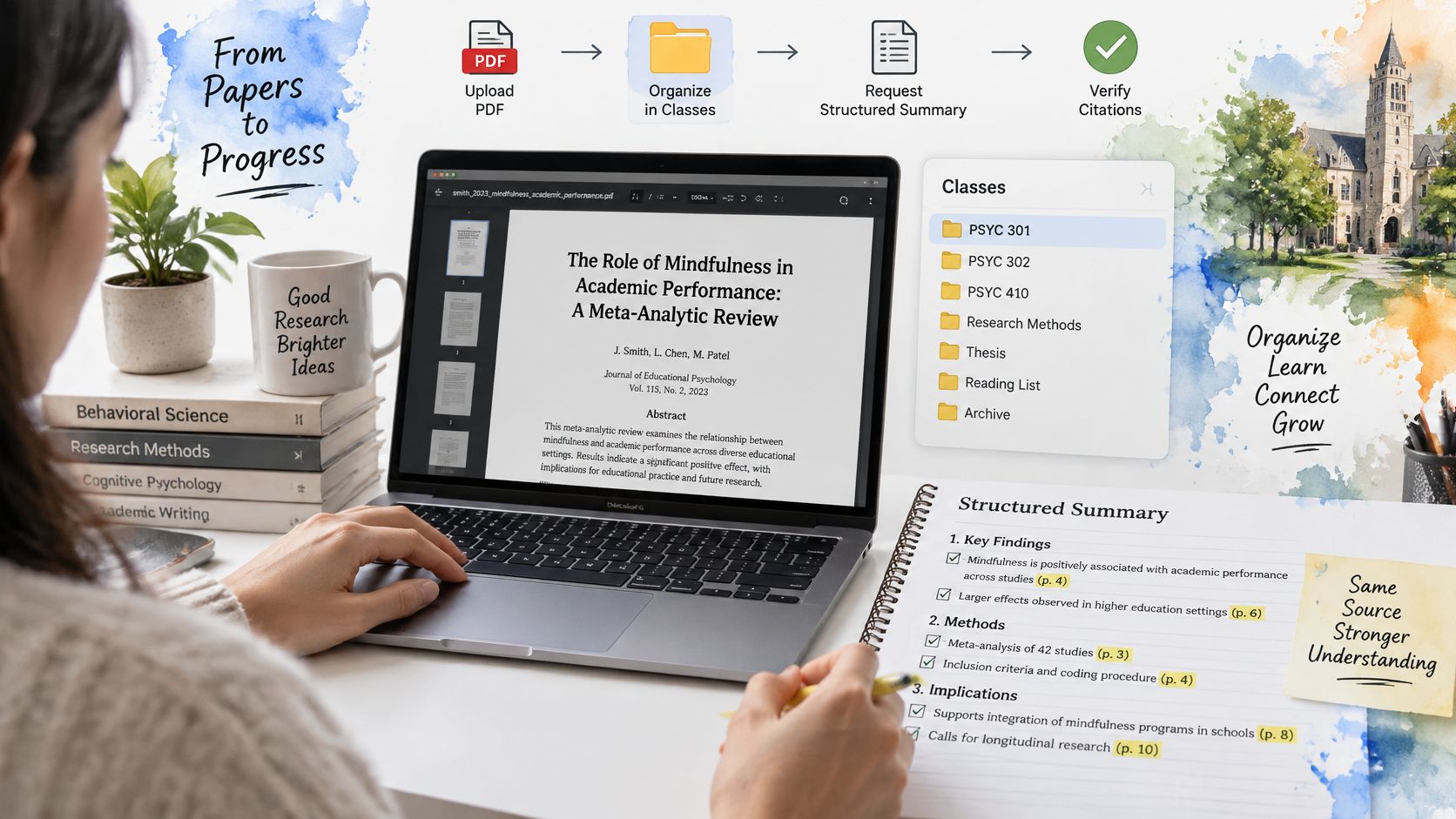
1. Upload and file the paper. Upload the research paper to ClassLecture.ai and file it under its course code in the Classes section. Grouping papers by course keeps a methods detail from one study out of the notes for another.
2. Request a structured summary. Ask for headings for research question, methods, results, and limitations. Empty headings show what you skipped. That format follows the same logic as structured analysis of a PDF document, instead of a loose paragraph you have to untangle.
3. Ask follow-up questions about specific claims. Ask for the sample size in the methods, or for how the authors defined the primary outcome. Answers include citations that link back to the exact document page, and supporting documents can be opened directly in the app, so you can read the original wording yourself.
4. Set the source scope. Limit answers to the uploaded paper, using notes and textbooks only, so chat does not mix in other lecture audio. A citation from the wrong file is as misleading as a missing one. If you are lining up a full term of reading on a Mac, you can also find semester planning apps for Mac to keep deadlines and files in one place.
5. Open each cited page and verify. A page number works like a bookmark, not a stamp of approval. Confirm the wording and every number against the original. Page citations cut lookup time. They do not replace checking, because AI summaries and answers can be incomplete or wrong.
Before the summary goes into notes or an assignment, confirm three things. The numbers match the page. Every causal word is backed by the study design. The limitations appear in your summary. If the paper says "associated with," your sentence should not say "caused." The same habit works for a recorded lecture: the workflow gives you a searchable timestamped transcript and answers tied to exact lecture moments.
Do one concrete thing this week. Write one summary by hand for a paper you must know. Mark each number with its page. The next day, answer two questions from memory about what the result does not let you claim.
Upload a research paper you're studying to ClassLecture.ai, generate a structured summary with page-cited answers, and turn each verified finding into flashcards and practice questions you can retrieve later. You'll spend less time hunting through PDFs and more time checking claims, spotting limitations, and proving to yourself that you can use what the paper found.
The ClassLecture.ai Team
We build ClassLecture.ai, the AI study assistant that turns your recorded lectures into transcripts, summaries, flashcards, and answers cited to the exact timestamp — so you learn faster from your own professor's words.
Keep reading
How to Study Smarter Not Harder: A Research-Backed Guide
Learn how to study smarter not harder with evidence-based strategies like active recall, spaced repetition, and AI tools that cut rewatching time.
ReadHow to Summarize a Lecture With AI in Minutes (2026 Guide)
Turn a 90-minute lecture into a tight, accurate study summary. A step-by-step guide to summarizing lectures with AI without hallucinations.
ReadAP Microeconomics Unit 3 Study Guide with Practice Questions
Master AP Microeconomics Unit 3 with clear explanations of supply, demand, elasticity, and market structures, plus examples and practice questions.
Read