New World Foods and Old World Foods: Origins and Impact
New World Foods and Old World Foods explained: origins, Columbian Exchange history, key crops like maize and potatoes, and their impact.
If a tomato feels Italian, a chili feels Thai, and a potato feels Irish, what exactly makes any of them a New World food? That question exposes the most common confusion about New World foods and Old World foods. We're often really asking three different questions at once. Where was a food first domesticated, where did people adopt it later, and where do farmers grow most of it today?
Those questions can have three different answers. A crop can begin in the Americas, become central to cooking in Europe, and now be produced mostly in Asia. That doesn't make the labels useless. It means you've got to use them narrowly, as labels for origin before 1492, not as labels for cultural belonging, quality, or present-day production.
Think of origin as a passport and present-day production as a home address. A passport tells you where someone started. It doesn't tell you where they live now, what language they speak at home, or which traditions they've made their own. Foods work the same way, and keeping that distinction clear will save you from most exam errors on this topic.
Table of Contents
- Old World and New World Foods at a Glance
- How the Columbian Exchange Moved Crops Both Ways
- What New World Crops Changed in Old World Diets and Farms
- Regional Stories Behind Tomatoes, Chili Peppers and Potatoes
- Were New World Foods Automatically Better?
- Turn Lecture Recordings Into Study Material on This Topic
Old World and New World Foods at a Glance
Where did a food begin, and where does it belong now? Those questions have different answers. New World foods were first domesticated in the Americas before 1492. Old World foods originated in Afro-Eurasia, the connected landmass of Europe, Asia, and Africa. These labels describe origin, not where a food is grown, eaten, or most closely associated with today.
The distinction is biogeographic, meaning it concerns where species evolved and were first domesticated. A Journal of Economic Perspectives survey of the Columbian Exchange identifies maize, potatoes, sweet potatoes, cassava, beans, tomatoes, cacao, peanuts, and chili peppers as crops from the Americas. Wheat, rice, barley, sugarcane, bananas, citrus, coffee, and most Old World livestock originated in Afro-Eurasia. After 1492, people moved these organisms across the Atlantic, changing where they were grown and how they were used.
A Starting Table, Not a Complete List
Use the table to compare each food's place of origin with a clue to its present-day role. The two columns answer different questions, much like a person's birthplace and current home address. This is a study guide, not a complete catalogue of crops.
| Food | Where it was first domesticated | Present-day note |
|---|---|---|
| Maize | Americas | One of the world's largest staple crops by tonnage |
| Potato | Andes, South America | A major global staple, grown across Asia and Europe |
| Sweet potato | Americas | Important staple in Africa and Asia |
| Cassava | Americas | Tropical staple that can stay in the ground until harvest |
| Tomato | Americas | Central to Mediterranean cuisines |
| Chili pepper | Americas | Spread through India, Korea, Thailand, China and Hungary |
| Peanut | Americas | Widely grown across Africa and Asia |
| Cacao | Americas | Production now concentrated in West Africa |
| Wheat | Afro-Eurasia | Major crop in the Americas as well |
| Rice | Afro-Eurasia | Staple across much of Asia |
| Sugarcane | Afro-Eurasia | Major export crop in the Americas after 1492 |
| Coffee | Afro-Eurasia | Major export crop in Brazil |
| Bananas | Afro-Eurasia | Staple across tropical regions |
Cacao's origin is American, while much of its present-day production is in West Africa. Coffee began in Afro-Eurasia, yet Brazil is a major producer. Classifying either crop by its modern production location would confuse its present address with its origin.
The tomato makes the same distinction easier to see. Its importance in Italian sauces reflects culinary adoption, not its origin. Italian cooks made the tomato part of their cuisine, but the tomato remains a New World food because it was first domesticated in the Americas.
Classify Any Food in Three Steps
For an unfamiliar food, separate origin, adoption, and current production. Start with evidence of where people first domesticated it, rather than the cuisine where you encountered it.
- Identify the pre-1492 origin. Ask where people first domesticated the plant or animal.
- Trace adoption afterward. Ask when it reached other regions, who began growing or cooking it there, and how its use changed.
- Check present-day production separately. Ask where farmers grow it now and whether it is used as food, animal feed, an export crop, or an industrial input.
The potato shows why all three steps matter. Its domestication began in the Andes of South America, making it a New World food. It was later adopted in Europe and Asia, where farmers and cooks made it part of local diets. Today, it is grown globally, with production concentrated in Asia. These statements describe different stages, so they do not conflict.
Wheat works the same way in reverse. Its Afro-Eurasian origin does not change because farmers in the Americas later adopted it on a large scale. American production belongs in the adoption and present-day columns, not the origin column.
Why the Labels Still Help
The labels remain useful when they describe a crop's starting geography before sustained contact between hemispheres. They can also point to ecological complementarity: American staples sometimes fitted growing conditions that wheat and rice did not occupy as well.
Culinary identity is a different matter. A dish does not lose its cultural roots because an ingredient began on another continent centuries ago. Cuisines develop as cooks combine ingredients, techniques, and tastes over time. Origin is one part of a food's history, not a verdict on where it belongs. After centuries of exchange and adaptation, New World foods and Old World foods are useful historical labels, but they cannot fully describe a food's place in modern cuisine.
How the Columbian Exchange Moved Crops Both Ways
In 1492, Christopher Columbus began voyages that connected the Americas with Europe, Africa, and Asia in a sustained way. The movement that followed is called the Columbian Exchange. As the FAO account of global maize and the exchange describes, it transformed food systems by moving crops, animals, and culinary practices between the Americas, the "New World," and Europe, Africa, and Asia, the "Old World." It also reports that global maize production in 2021 represented a 104% increase since 2000 and that the United States and Brazil together accounted for 39% of world maize production in 2021, a modern echo of relationships the exchange created.
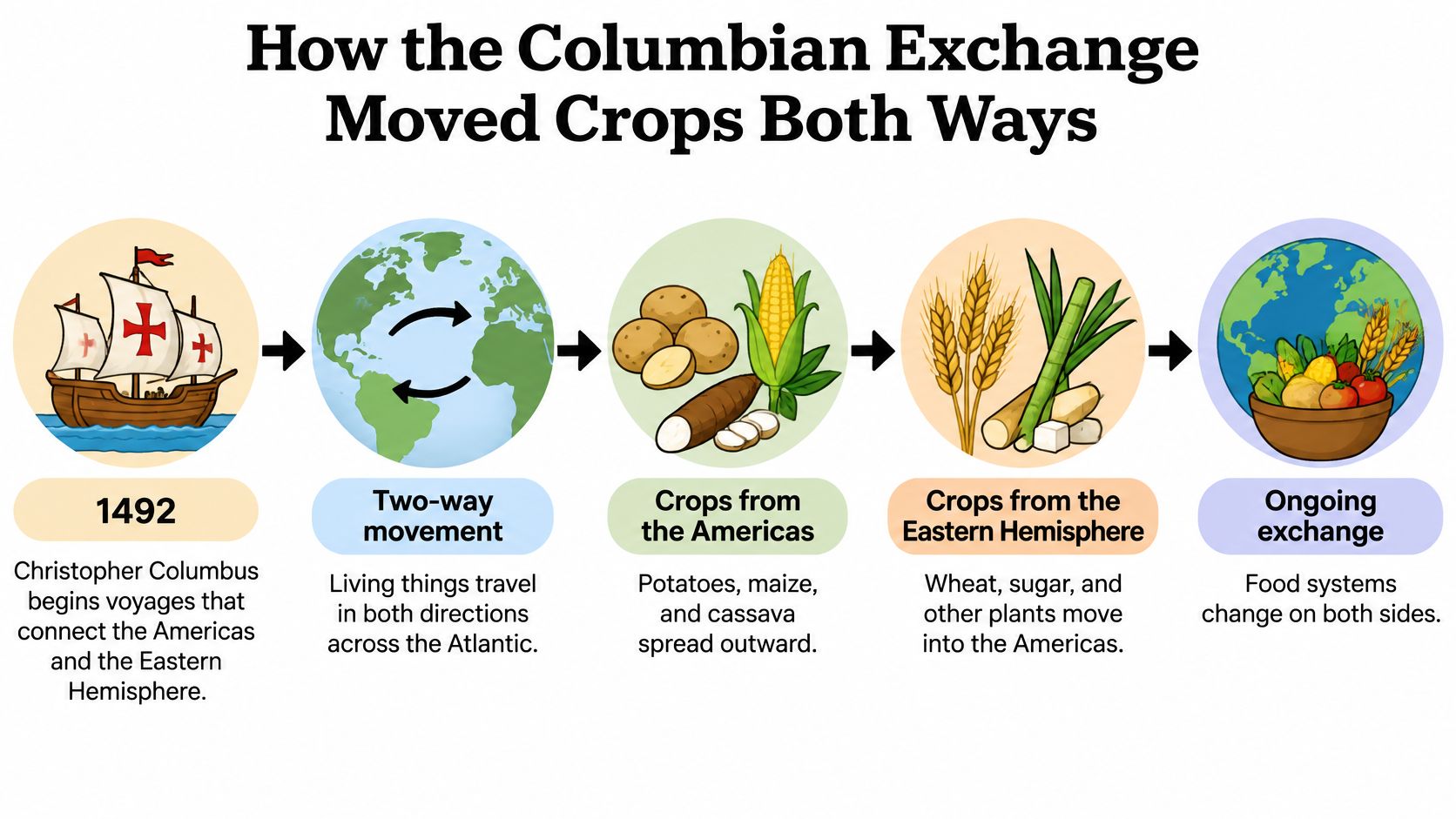
The direction of travel is the first thing to lock in. Maize, potatoes, tomatoes, cacao, cassava, chili peppers, peanuts, and sweet potatoes travelled east from the Americas. Wheat, rice, sugarcane, bananas, coffee, cattle, pigs, and sheep travelled west from Afro-Eurasia. If you're reviewing this period alongside other units, an AP World History Unit 3 review can help you place those movements beside the political changes happening at the same time.
Three Phases of Movement
In the first decades of contact, ships carried seeds, plants, and animals across the Atlantic, sometimes deliberately and sometimes as part of provisioning settlements. Nothing spread everywhere overnight. A crop had to survive the voyage, suit a new climate, and persuade farmers and cooks to use it.
During the sixteenth-century spread, American crops moved more widely through European, African, and Asian farms. Traders, colonists, missionaries, and local farmers all played roles, and each region tested crops against its own soils, labour, prices, and tastes. Some foods caught on quickly as cheap sources of calories or intense flavour. Others took much longer to become ordinary.
In the later plantation phase, Old World crops such as sugarcane expanded across parts of the Americas as export commodities. Production for distant markets reshaped land use and labour systems, often coercively. Coffee followed a related path as an introduced crop that became a major American export. If you want to taste an older Old World coffee tradition on its home side of that journey, traditional Mokha coffee from Yemen offers a useful contrast with coffee's later life in Brazil.
Crops didn't travel alone. Animals, diseases, farming methods, and people moved too, so changing diets came bundled with ecological and social change.
That's why the exchange shaped food systems on several continents, not just in the Western Hemisphere. A new animal could change how people ploughed, transported goods, or ate meat. A new pathogen could devastate communities and alter who farmed the land. Food history here is never only about recipes.
Remember the exchange as two-way traffic, and the labels become easier. "New World" and "Old World" track which side a living thing started on before it crossed. They don't describe which direction was more important.
What New World Crops Changed in Old World Diets and Farms
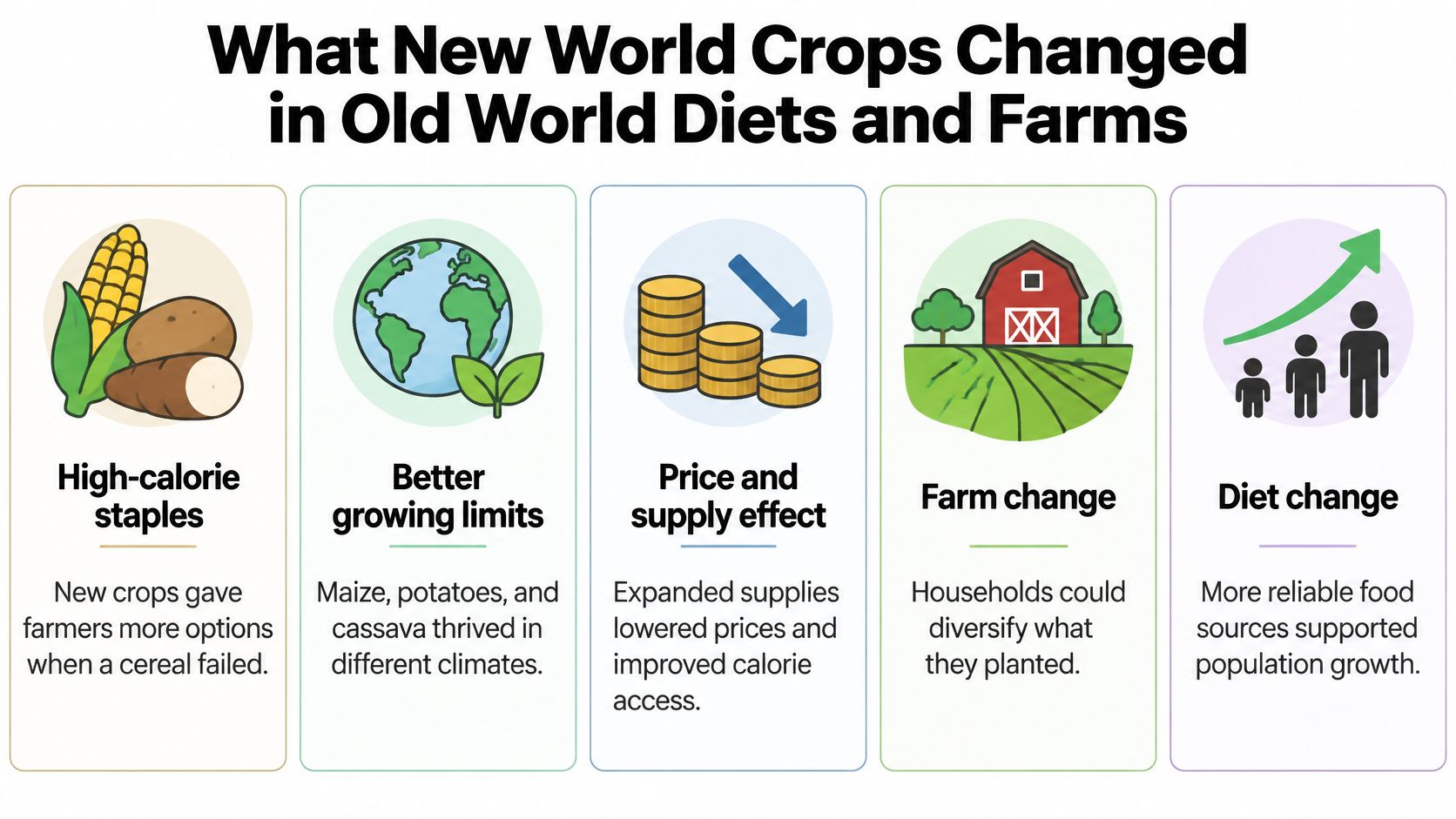
The biggest farm-level change wasn't novelty. It was insurance. New World staples added high-calorie crops with different growing limits, so farmers who'd depended heavily on one cereal gained another option when weather or disease threatened that harvest.
The Journal of Economic Perspectives research summary on the exchange identifies potatoes, sweet potatoes, maize, and cassava as calorically rich crops transferred to the Old World, and it traces their impact to yield potential, climatic flexibility, and the ability to complement or substitute for cereal production. Read that as a cause-and-effect chain, not as a claim that every new crop automatically improved life. Weather, soil, prices, and local food habits still decided what happened in a particular village.
How Different Growing Limits Changed Risk
Potatoes can grow in environments too wet for wheat or too dry for rice, which gave some households a productive crop for land or seasons that cereals handled poorly. Cassava suits many tropical systems and can function as a reserve crop because its harvest can be delayed in the ground. Maize and sweet potatoes likewise fitted particular climates and farming calendars rather than replacing every older staple everywhere.
- More crop options: Farmers could spread risk across plants that didn't all fail under the same conditions.
- More available calories: High-yielding staples could raise the amount of food a plot produced.
- Greater population-supporting capacity: Where calories became steadier, communities could support more people.
- New market and processing uses: Crops could move beyond the dinner plate into animal feed, trade, and later industrial uses.
Follow the chain carefully. A crop that tolerates a different climate reduces exposure to a localized cereal failure. Reduced exposure can make harvests steadier. Steadier harvests can improve calorie access and, over time, support population growth. Each link is conditional, which is why the same crop could matter enormously in one region and much less in another.
Cacao shows a different pathway, from ingredient to luxury commodity shaped by processing, sugar, and consumer taste. If you're curious how modern tasters judge that finished product, these tips for tasting premium chocolate make a neat present-day endpoint to cacao's long journey.
The Other Side of Dependence
Diversification reduces risk only if farmers diversify. If a community leans heavily on one narrow staple, dependence can magnify vulnerability to pests, disease, or climatic shocks. A productive crop can therefore be both a safety net and a single point of failure, depending on how people use it.
The reverse flow transformed the Americas just as profoundly. Wheat, rice, sugarcane, cattle, pigs, and horses changed American land use, labour systems, diets, and trade. Pastures replaced some regions, plantation crops reorganized work, and introduced animals altered transport, meat consumption, and farming power.
Those gains came with externalities, meaning costs that didn't appear in a simple celebration of higher output. The exchange also brought pathogens, invasive species, soil erosion, and social disruption. Students who list only delicious new ingredients miss the ecological and human price attached to the transfer.
When you compare any two foods, don't ask only which one is familiar. Ask how much food it yields, where it tolerates growing, and what happens if everyone depends on it.
Use a four-variable benchmark for comparison. Check origin, edible energy, environmental tolerance, and vulnerability under monoculture. That benchmark turns New World foods and Old World foods from a memorized list into an analytical tool you can apply to any crop in an exam essay.
Regional Stories Behind Tomatoes, Chili Peppers and Potatoes
Start in a Mediterranean kitchen, where tomatoes end up in sauces, salads, and stews built around bread, olive oil, and slow cooking. The tomato didn't succeed there because it was destined for those dishes. It succeeded because local cooks fitted a new ingredient into existing meal structures. If you grow your own and want the botanical basics behind that story, you can find details about tomato plants and compare the plant's needs with the climates where it later thrived.
That lesson applies everywhere. Adoption depended on local ecology, labour, prices, and cooking habits, not on a crop's origin alone. If you're memorizing these cases for a test, AP World History flashcards work best when each card separates where a crop began from where it became culturally central.
Chili Peppers and Potatoes Took Different Roads
Move now to a market where dried chilies are piled beside other spices. Chili peppers spread through India, Korea, Thailand, China, and Hungary, and cooks in each place adapted them to local spice traditions. They became curry heat in one setting, an ingredient in pickles in another, and paprika in Hungary. The plant travelled once, biologically speaking, but its culinary meaning multiplied.
The potato's road began in the Andes, reached Europe in the sixteenth century, and eventually crossed Asia. According to the FAO potato statistics summary, potatoes represented about 4% of global primary crop production in 2020, while Asia produced roughly half of the world's potatoes. A crop with an American passport now has its largest production address in the Old World, which is the passport and home address distinction playing out at continental scale.
Potatoes earned that place through high yield and an ability to grow in relatively diverse conditions. But dependence on a narrow genetic base also contributed to the vulnerability exposed by the nineteenth-century Irish Potato Famine. The lesson isn't that potatoes were a mistake. It's that a crop's strength under normal conditions doesn't remove the danger of relying on too few varieties.
Four Crops, Four Regional Lessons
| Crop | Region where it became central | Typical local use | What it shows |
|---|---|---|---|
| Tomato | Mediterranean Europe | Sauces, salads and stews | Fitted into existing bread and sauce traditions |
| Chili pepper | India, Korea, Thailand, China and Hungary | Curries, pickles and paprika | Spread through spice cultures far from the Americas |
| Potato | Europe, then Asia | Staple starch; Asia produces about half the world crop | High yield, but a narrow genetic base carried risk |
| Maize | Americas, Africa and Asia | Food, animal feed and biofuels | A New World crop became a global commodity |
Read the final column as the point of each story. Tomatoes show cultural fit, chilies show culinary translation, potatoes show productivity with concentrated risk, and maize shows how a food can become a global commodity far beyond direct human meals. No single word like "success" captures all four.
Apply that thinking to any crop you meet. Ask where it grew well, who could afford it, whose labour produced it, and which local dishes absorbed it. The same food can produce very different nutritional and culinary outcomes depending on where and how people grow and cook it.
Were New World Foods Automatically Better?
No. That's the direct answer, and it's the one the evidence supports. Expanded supplies could lower prices and improve calorie access, but a crop's arrival didn't guarantee healthier diets, fairer labour, or safer farms. Origin is not a grade.
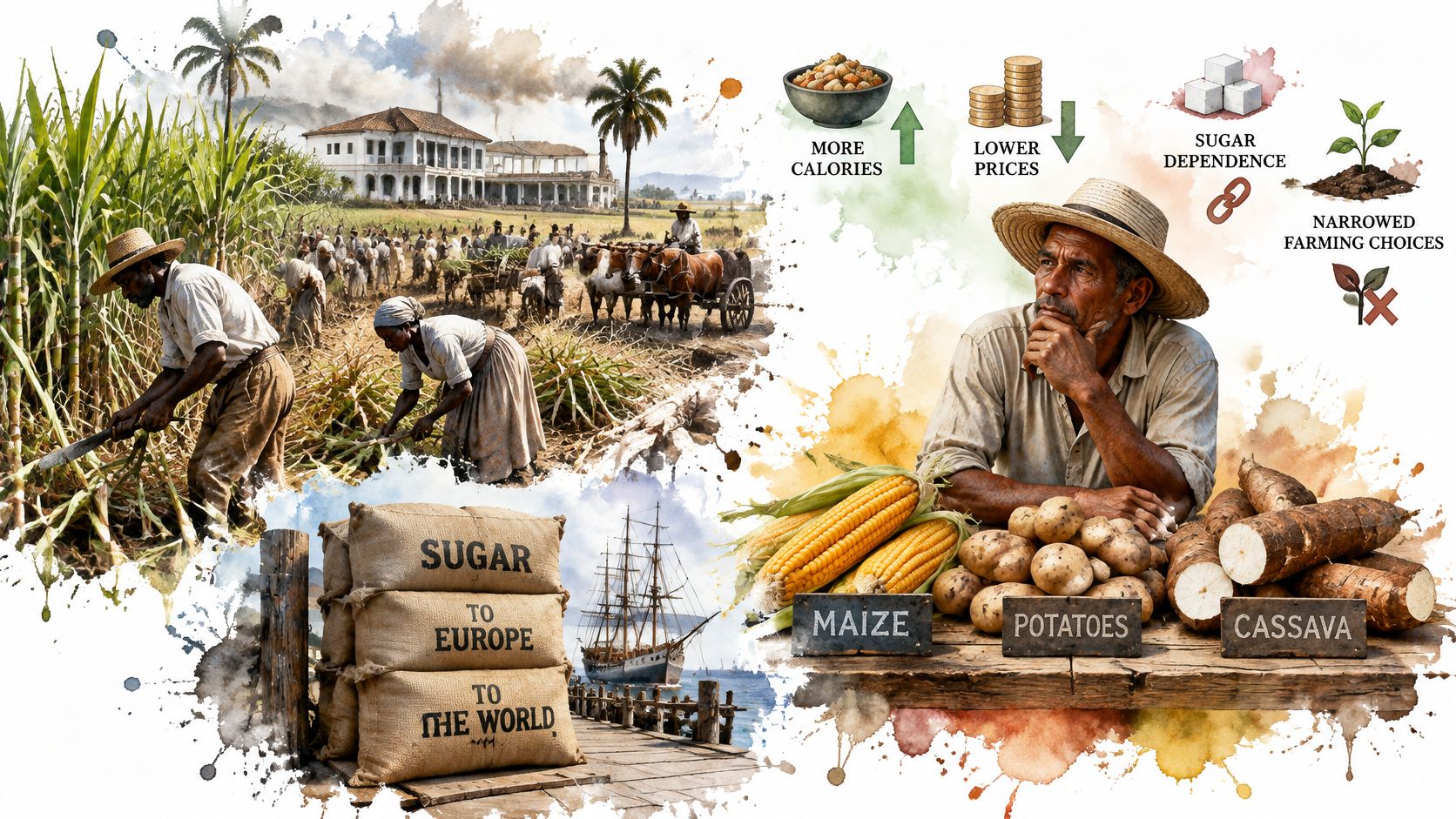
Sugar makes the caution concrete, even though sugarcane itself travelled from the Old World to the Americas. Plantation economies pushed dependence on sugar and other export crops, tying land and labour to distant demand. A region could produce a valuable commodity while its own people's diets narrowed. More trade didn't automatically mean more nourishment.
More Species Globally, Less Diversity Locally
Here's the contrarian pattern worth debating. The Columbian Exchange moved more species across oceans, so the global menu of available crops grew. Modern commercial agriculture, however, often rewards a small number of uniform, high-yielding cultivars, so diversity on individual farms and plates can shrink. Those two statements don't contradict each other. They're measuring diversity at different scales.
Recent reporting on indigenous crops and the global food crisis estimates that roughly 75% of global crop genetic diversity has been lost as production shifted toward fewer, genetically uniform cultivars, while approximately two billion people experience micronutrient deficiencies. That pairing matters. A food system can produce enormous quantities of calories and still leave many people short of specific nutrients.
- Potential of neglected crops: Millets, pulses, wild greens, and fonio can contribute nutrients such as iron, zinc, and provitamin A in suitable local systems.
- Barriers to wider use: Weak distribution systems can keep a nutritious crop commercially invisible even where farmers know it well.
- Consumer awareness: Shoppers and institutions can't choose foods they've never encountered, can't prepare, or can't buy reliably.
Don't flip the old simplification into a new one. Not every traditional or indigenous food is automatically healthier or more sustainable in every setting. You've still got to ask about yield, nutrient content, water needs, labour, storage, and whether people want to eat it. Careful comparison beats romantic labels.
Hybrid Plates Break the Boxes
Consider a plate built around maize and beans with introduced meats, dairy, and spices. You can trace each ingredient's passport, and that's a valuable historical exercise. But calling the finished dish purely New World or purely Old World would erase the cooks who combined those elements into something new. Cuisines are negotiated cultural systems, built through trade, migration, necessity, and taste.
That's where the labels reach their limit. They're precise about biological origin and vague about belonging. A Hungarian paprika dish isn't less Hungarian because chilies began elsewhere, just as a Brazilian coffee tradition isn't less Brazilian because coffee began in Afro-Eurasia. Centuries of hybridization mean most living food cultures are layered.
Balanced question for students: Did the Columbian Exchange increase food diversity globally while modern agriculture later reduced it locally?
A nuanced answer is yes, in different senses. More species crossed oceans, yet commercial systems can still homogenize farms and diets. Hold both scales in view, and you'll avoid the two weakest conclusions about New World foods and Old World foods, that exchange was pure progress or that mixing was pure loss.
Turn Lecture Recordings Into Study Material on This Topic
This topic blurs easily in lectures on food history, geography, and agriculture because names, dates, and directions of travel pile up quickly. Build your review around the origin versus adoption distinction, not around one long undifferentiated crop list. A guide to turning a lecture recording into notes can help you set up that workflow before you start.
- Upload or record the lecture so you've got a searchable transcript of what your instructor said.
- Ask targeted questions, such as why potatoes spread through Europe, then check the timestamped citation behind each answer.
- Generate an AI summary and compare it against the transcript to confirm key claims before you trust them.
- Build flashcards with origin on one side and present-day role on the other, using the opening table as your model.
- Review with spaced repetition at increasing intervals, and deliberately test yourself on tomatoes, cacao, and coffee, where passport and home address differ.
ClassLecture.ai can work from your uploaded lectures, notes, and textbooks, answer questions with timestamp and page citations, and schedule flashcard review. Still check every claim against your own course materials, especially dates and crop origins your instructor emphasized. Start with one lecture on the Columbian Exchange this week and turn it into ten clean origin-versus-adoption cards.
Turn your next lecture on New World foods and Old World foods into transcripts, cited answers, summaries, and flashcards that keep origin, adoption, and present-day production separate. Visit ClassLecture.ai, upload one recording or set of notes, and test yourself until the passport and home address of every major crop are clear.
The ClassLecture.ai Team
We build ClassLecture.ai, the AI study assistant that turns your recorded lectures into transcripts, summaries, flashcards, and answers cited to the exact timestamp — so you learn faster from your own professor's words.
Keep reading
AP World History Flashcards That Build Real Exam Skills
AP World History flashcards organized by the four periods and six themes, with spaced repetition tips, source-based prompts, and a clear import workflow.
ReadAP World History Unit 3 Review That Actually Sticks
Targeted AP World History Unit 3 review covering gunpowder empires, global trade, key terms, timelines, and practice questions for the 1450–1750 era.
ReadHow to Study for AP World: A Realistic Plan
Learn how to study for AP World History with unit priorities, DBQ tactics, and a week-by-week schedule tailored to the exam.
Read