AP World History Flashcards That Build Real Exam Skills
AP World History flashcards organized by the four periods and six themes, with spaced repetition tips, source-based prompts, and a clear import workflow.
You're the night before a unit test, flipping a huge deck that says things like "Ottomans" on one side and a paragraph on the other. You recognize almost everything. Then the SAQ gives you an unfamiliar source, and nothing you memorized tells you what to do with it. That's not a memory problem. It's a card design problem, and it's fixable.
Table of Contents
- Why Most AP World History Flashcard Decks Underperform
- The Four Periods and What Each One Actually Tests
- The Six Themes and How to Tag Every Card
- A Reusable Card Schema for Every Topic
- Six Historical Thinking Skills and the Cards That Drill Them
- Spaced Repetition and Active Recall That Actually Stick
- Building Cards From Lecture Transcripts and Textbooks
- Importing Your Deck Into ClassLecture.ai Step by Step
- Adapting Your Deck for the May 2027 Exam Changes
- Choosing the Right Deck Organization for Your Study Stage
- Quick Reference Cheat Sheet
- FAQ for AP World History Flashcards
Why Most AP World History Flashcard Decks Underperform
I've watched students grind through enormous decks and still freeze because their AP World History flashcards only trained recognition. They could match a term to a definition, but they couldn't explain a cause, compare two empires, or use a fact as evidence. The exam doesn't reward a private vocabulary list. It rewards historical reasoning under time pressure.
The scale alone should warn you against one-size-fits-all decks. In 2025, 411,547 students took the exam, 13.9% earned a 5, and 64.3% received a score of 3 or higher, with a mean score of 3.16, according to the College Board AP World History score distribution. That spread matters. Basic cards build factual recall, but top scores require causation, comparison, continuity, and change.
What Has to Change in Your Deck
You're covering roughly 1200 CE to the present across Asia, Africa, Europe, the Americas, and the Islamic world. An undifferentiated pile can't carry that load. You need four jobs done well:
- Build the deck: Write one precise prompt per card, not a topic label.
- Organize it: Sort every card by period and theme so chronology stays visible.
- Study it correctly: Use retrieval and spaced scheduling over weeks, not one cram session.
- Make it transfer: Add source-based and claim-evidence cards before the exam format shifts further that way in May 2027.
If flipping the card is the first moment the answer feels familiar, the card hasn't taught you anything yet.
The Four Periods and What Each One Actually Tests
Chronology is your spine. The College Board organizes the course from approximately 1200 CE to the present, as outlined on the College Board AP World History exam page. Dates matter only when they anchor a process, so tag every card to one period first.
Period 1, c. 1200 to c. 1450, asks how states expanded and regional networks intensified. Your strongest cards connect state-building to belief systems, trade routes, and environmental knowledge. Ask how a state legitimized power or how exchange changed a region, not just who ruled it.
Period 2, c. 1450 to c. 1750, asks how land-based and maritime empires consolidated power. Link the Columbian Exchange, Atlantic commerce, gunpowder empires, and expanding maritime routes on separate cards. One card on the mechanism, one on regional effects, one on who gained and who paid.
Where Students Usually Blur the Chronology
Period 3, c. 1750 to c. 1900, asks how industrialization, new political ideas, and imperialism reshaped societies. Connect industrial technology with urbanization, labor changes, nationalism, and European imperial expansion. If you're reviewing this stretch, pair your cards with a focused AP World History Unit 3 review so empire administration doesn't drift into the wrong century.
Period 4, c. 1900 to the present, asks how global conflict, decolonization, nationalism, and international institutions transformed politics. Cards here should trace causes across borders, because isolated national stories won't answer comparative prompts.
Take gunpowder empires as one stretched example. A Period 2 card asks how Ottoman, Safavid, and Mughal rulers used artillery and bureaucracy to centralize power. A later comparison card asks why similar military technology didn't produce identical outcomes as industrial states gained new advantages in Period 3. Same term, different historical work. That's the point. Your deck should encode processes, causes, consequences, similarities, and differences, not dates floating alone.
The Six Themes and How to Tag Every Card
Period tells you when. Theme tells you what kind of question the card can answer. Tag by theme and retrieval gets sharper, because you're sorting by the lens an exam prompt will use.
The six themes are Humans and the Environment, Cultural Developments and Interactions, Governance, Economic Systems, Social Interactions and Organization, and Technology and Innovation, as set out in the College Board AP World History course framework. A topic tag like "Ottomans" is too broad to help you choose evidence.
| Theme | Strong card formats |
|---|---|
| Governance | Cause and effect, compare state-building, claim and evidence |
| Economic Systems | Causation chain, compare exchange networks, continuity and change |
| Cultural Developments | Source purpose, compare belief systems, claim and evidence |
| Environment | Cause and effect, regional effect, continuity and change |
| Social Interactions | Compare hierarchies, consequence card, source limitation |
| Technology and Innovation | Mechanism card, cause and effect, compare adoption |
One Empire, Several Tags
Cross-thematic indexing means one empire earns multiple, distinct cards. The Ottoman Empire under Governance asks how administration held diverse territory together. Under Culture, it asks how religion legitimized rule. Under Economics, it asks how trade revenue supported the state.
Apply the same move elsewhere. The British Raj can be Governance, Economic Systems, or Social Interactions depending on the prompt. Ming and Qing China can test Technology, Governance, or Environment. Don't force one tag to do all the work. Write separate cards, tag each by its primary lens, and let review sessions pull one theme across several periods when you need cumulative practice.
A Reusable Card Schema for Every Topic
Stop improvising card format every time you study. Use one schema and let the content vary.
Front: one precise prompt that can't be answered yes or no. Back: a definition or explanation, time range, geographic scope, theme tag, period tag, and one consequence or connection. Add a short "why it matters" line with a specific piece of evidence you could use in an SAQ, DBQ, or LEQ.
Three Topics Rewritten Properly
Don't keep a card that asks only what the Columbian Exchange was. Split it. Ask for its mechanism, then its effects in one region, then its beneficiaries and costs, then a comparison with an earlier Afro-Eurasian exchange network. Four cards, four retrievable answers.
For mechanized textile production, write separate prompts on what changed in the production process, how labor organization shifted, why urbanization followed, and how industrial output supported imperial expansion. Each card carries Period 3 and a different theme tag where appropriate.
For the Meiji Restoration, ask what threat prompted reform, which institutions changed, how the state used foreign models selectively, and what consequence followed for Japan's regional power. Notice the pattern. You're not memorizing a paragraph. You're building answers you can deploy.
Validation Checklist Before You Save a Card
- One job: Does the front ask for one thing only?
- Placed in time: Are period, date range, and region on the back?
- Usable as evidence: Could this answer support a claim in writing?
- Connected: Does it name a cause, consequence, or comparison?
- Answerable cold: Could you say the answer aloud before flipping?
If a card fails two checks, rewrite it now. Don't study a vague card five times and hope it improves.
Six Historical Thinking Skills and the Cards That Drill Them
Here's the blunt part. The exam question isn't "What is this term?" It's "Can you recognize, interpret, and use this term inside an unfamiliar source?" Many decks fail exactly there. They build familiarity without transfer, a gap described in the AP World History curriculum profile on thinking skills and assessment.
Translate Each Skill Into a Card Type
- Developments and processes: Ask what changed, in what sequence, and where.
- Sourcing and situating: Give a short stimulus. Ask for audience, purpose, historical situation, or point of view.
- Claims and evidence: Present a thesis. Ask which evidence supports it and why.
- Contextualization: Ask what broader process surrounds this event or source.
- Comparison and causation: Use compare and contrast prompts and causation chains with explicit connectors.
- Argumentation: Ask for a defensible claim in one sentence, backed by one named piece of evidence.
A source card might show two lines from an imperial official and ask, "What is the author's purpose, and what limitation does that purpose create?" A claim-evidence card might state, "Industrialization strengthened European imperial expansion," then require one supporting development and one sentence explaining the link.
A bigger vocabulary deck can make the course feel familiar while leaving you unprepared for a document you've never seen.
That's why adding more definition cards often doesn't solve the problem. You don't need unlimited cards. You need cards that force the same moves the rubric rewards, including continuity and change prompts and cross-regional comparisons.
Spaced Repetition and Active Recall That Actually Stick
Say your answer out loud or write it before you reveal the back. That's active retrieval. Recognition after flipping doesn't count, and honest ratings matter more than speed.
Use the four ratings consistently. Again means you couldn't produce the answer. Hard means you produced it slowly or incompletely, so it should return sooner. Good means a clean answer at normal effort. Easy means immediate and complete, so it can wait longer. If you mark shaky cards Easy to clear the queue, the schedule can't help you.
A Simple Review Grid
| First learned | Review 1 | Review 2 | Review 3 |
|---|---|---|---|
| Day 0 | Day 2 | Day 7 | Day 21 |
Difficult cards revisit sooner, easy cards later, and practice continues across multiple weeks or months. That pattern fits the approach described in the College Board AP World History Modern course overview, which supports structured, repeated practice rather than isolated recall. For rating discipline and session setup, use this guide on how to study flashcards alongside your grid.
Vary formats so you don't memorize card wording instead of history. Rotate short answers, cloze deletions, compare and contrast prompts, causation chains, and source-analysis cards. A single week of cramming leaves no room for failed cards to return, get corrected, and return again. Start early enough for the schedule to work.
Building Cards From Lecture Transcripts and Textbooks
Your best deck usually comes from your own class, because your teacher's emphasis decides what gets tested locally. Read transcripts and textbook pages like a card miner, not a highlighter.
Strong passages contain definitions, named processes, turning-point events, comparative claims, and causal connectors such as "because," "as a result," and "led to." Those connectors are gold. They convert directly into causation chain cards. A sentence contrasting two empires becomes a comparison card. A named process with a date range and region becomes a developments card.
Weak passages include paragraph-long narratives, hedged opinions without evidence, and off-topic tangents. Don't paste a narrative onto a card back. Break it into mechanism, effect, and significance, or leave it out.
Keep One Structure as Material Arrives
Work chapter by chapter in a PDF, DOCX, or EPUB textbook and queue new prompts into existing period and theme groups. Don't create a parallel deck for every upload. The workflow for turning lecture recordings into flashcards works best when each recording enriches the structure you've already built.
Audit as you go. If a lecture term can't be placed in a period, tagged to a theme, and connected to a consequence, it's not ready to become a card yet.
Importing Your Deck Into ClassLecture.ai Step by Step
If your material lives in recordings and documents, ClassLecture.ai can turn that material into flashcards inside one class workspace. Follow the sequence in order so your period and theme organization survives the import.
- Sign in: Use Google, Microsoft, email, or a magic link.
- Create your class: Select or create a class and label it with the course code, term, and year.
- Upload source material: Add audio or video in MP3, MP4, M4A, WAV, MOV, or WEBM format, attach an external video URL if needed, or upload notes and textbooks in PDF, DOCX, DOC, ODT, TXT, Markdown, RTF, HTML, EPUB, or XML format. The free tier includes up to 3 hours per month, and paid tiers support up to 30 hours.
- Choose source scope: Set Q&A to draw from transcripts only, documents only, or both.
- Generate cards: Create flashcards in question-and-answer and fill-in-the-blank formats, then edit vague prompts into your schema.
- Schedule review: Use FSRS spaced repetition with Again, Hard, Good, and Easy ratings, and check due cards across lectures in the exam readiness widget for the class.
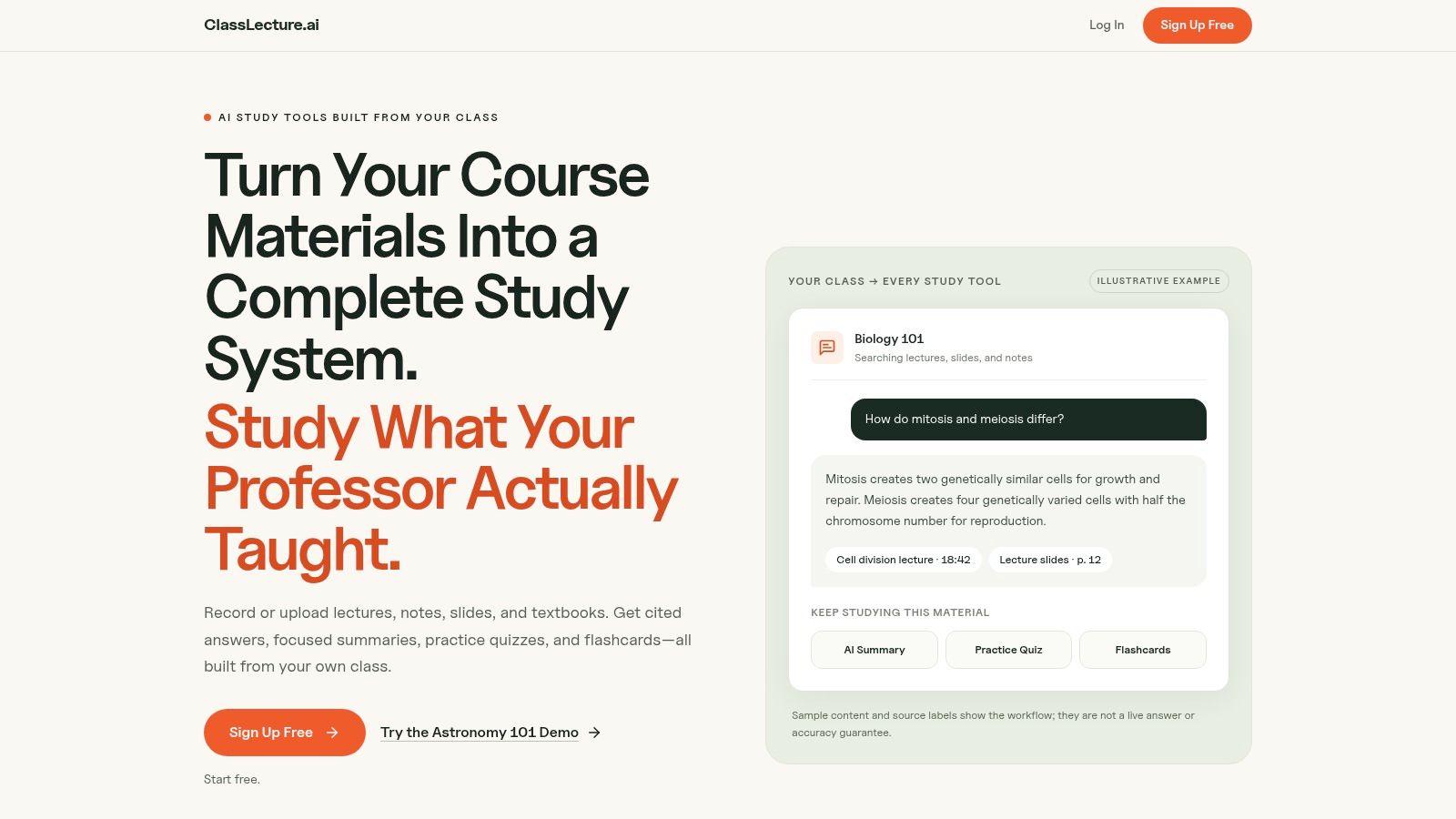
Export chat sessions as PDF when you want an offline record of explanations tied to a lecture. Keep your own edits in charge. Generated cards are a draft, and your period tags, theme tags, and why-it-matters lines make them exam-ready.
Adapting Your Deck for the May 2027 Exam Changes
Don't rebuild your deck from zero. Add an exam-mode layer to the recall cards that already work.
Beginning with the May 2027 exam, all three SAQs will include source material, students must answer all three, and the LEQ will become one required broad prompt with greater flexibility in selecting relevant developments, according to the College Board AP World History course and exam description clarifications. The amount and type of evidence required for points remains the same.
Three Additions That Cover the Shift
- Source-based SAQ cards: Add one set per period. Show a short text, image description, or data cue, then ask for identification, contextualization, and one evidence-backed explanation.
- Broad LEQ prompt cards: Add one per period asking you to choose relevant developments across regions and defend a line of reasoning.
- Thesis cards: Add a "defensible thesis in one sentence" card for each unit, with two supporting developments named on the back.
Rotate these cards across periods so you can't rely on guessing the era from the deck name. The goal isn't more evidence overall. It's transparent practice showing how knowledge you already have earns rubric points when a term appears inside a source.
Choosing the Right Deck Organization for Your Study Stage
Your organization should change as the exam gets closer. A first pass needs chronology. Final review needs skills under source-based conditions.
| Method | Best stage | Strongest card type | Best for |
|---|---|---|---|
| Pure chronological | First pass through the course | Developments and processes | Students still placing events in sequence |
| Theme-first | Mid-course cumulative review | Comparison and causation | Students connecting regions across units |
| Skill-first | Final weeks before the exam | Claim-evidence and argumentation | Students converting knowledge into SAQ, DBQ, and LEQ points |
| Source-based | May 2027 format preparation | Sourcing and contextualization | Students who know content but stall on unfamiliar documents |
Most students should start chronological, switch to theme-first for cumulative review, and finish with skill-first plus source-based practice. Don't reorganize constantly. Change the dominant view when your study stage changes, while keeping period and theme tags on every card so nothing has to be rebuilt.
Quick Reference Cheat Sheet
Keep this beside your deck while you build and review.
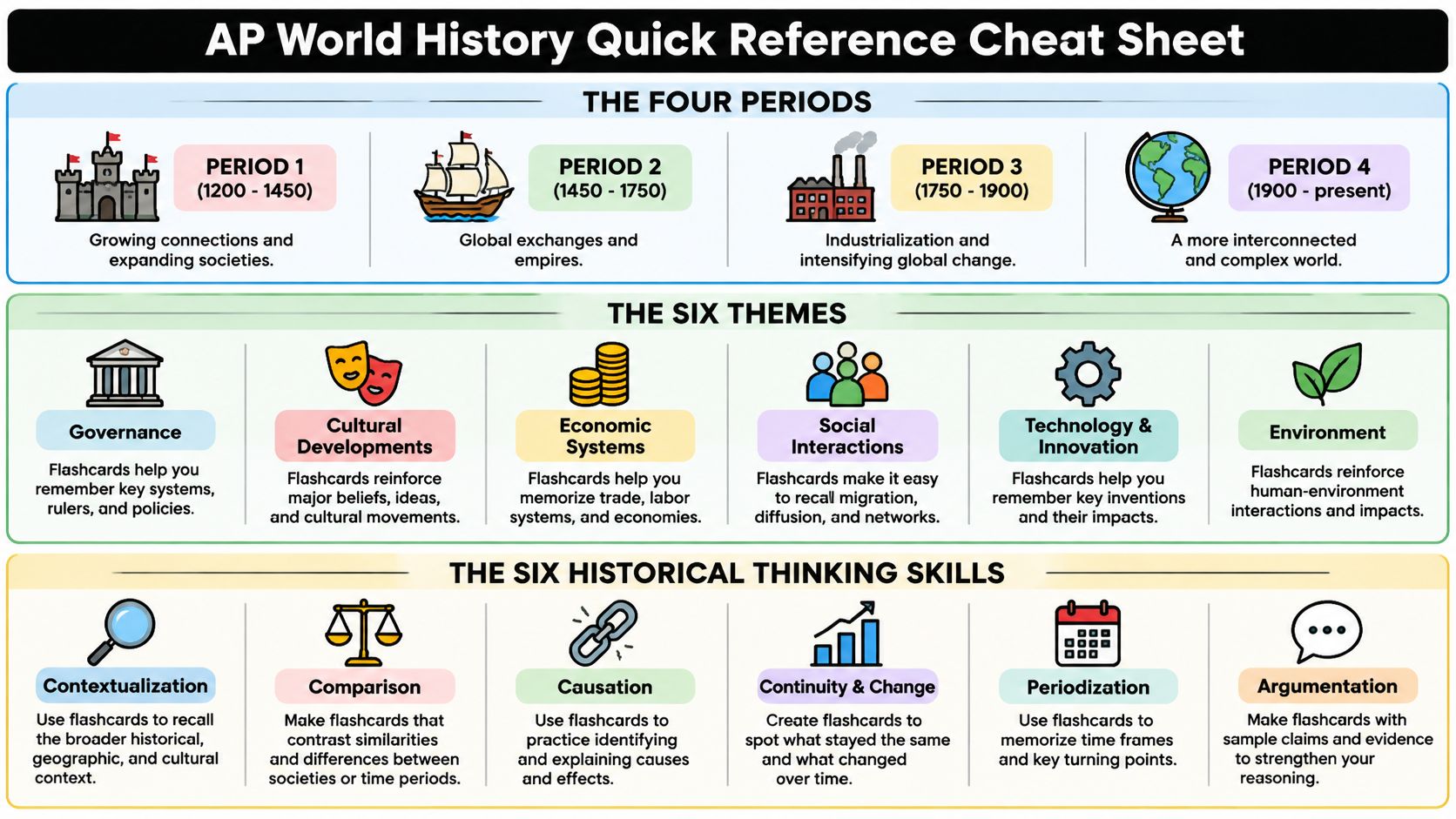
- Four periods: c. 1200 to c. 1450, c. 1450 to c. 1750, c. 1750 to c. 1900, c. 1900 to present.
- Six themes: Environment, Culture, Governance, Economic Systems, Social Interactions, Technology and Innovation.
- Six skills: Developments, sourcing, claims and evidence, contextualization, comparison and causation, argumentation.
- Card schema: Precise prompt, explanation, time range, region, period tag, theme tag, consequence, why it matters.
- Review rhythm: Learn, then revisit on Day 2, Day 7, and Day 21, with hard cards sooner.
- Import flow: Sign in, create a class, upload material, choose source scope, generate, edit, schedule.
FAQ for AP World History Flashcards
How Many Cards Should a Complete Deck Have
There's no magic total, and chasing one creates bloated decks. Build unit by unit, keep only cards that pass your validation checklist, and let the complete deck grow from usable unit decks. A smaller set you can answer cold beats a huge set you merely recognize.
When Should I Drop a Card That Isn't Sticking
Rewrite it first. Cards usually fail because the prompt is vague, the answer contains several ideas, or the context is missing. Split it, add period and region, or convert it into a comparison. Drop it only if the content can't be placed in the framework or used as evidence.
How Do Flashcards Fit With DBQ Practice
Run them in parallel, don't substitute one for the other. Use flashcards to keep evidence, contextualization points, and sourcing moves retrievable. Then do timed DBQ work to practice selecting documents, grouping evidence, and building an argument. Cards lower the memory load. Writing practice teaches you to spend that freed-up attention on reasoning.
Turn your AP World lectures, textbook chapters, and class notes into period-tagged, theme-tagged flashcards you can review with spaced repetition, then question the same material through conversational Q&A when a concept won't stick. Visit ClassLecture.ai to upload your first lecture or document and build a deck that trains recall and exam reasoning together.
The ClassLecture.ai Team
We build ClassLecture.ai, the AI study assistant that turns your recorded lectures into transcripts, summaries, flashcards, and answers cited to the exact timestamp — so you learn faster from your own professor's words.
Keep reading
How to Study for AP Psychology That Actually Works
Learn how to study for AP Psychology with a research-backed plan that covers the five units, MCQ skills, FRQs, and spaced retrieval practice.
Read10 Best AP Government Flashcards for 2026 Exam Prep
Explore 10 AP Government flashcards from top study platforms, with import tips, usage guidance, and spaced-repetition practice for 2026 exam review.
Read10 AI Flashcards Maker Tools for Students
Compare 10 ai flashcards maker tools for student workflows, source checking, imports, exports, spaced repetition, and lecture-based study.
Read