How to Study for AP Psychology That Actually Works
Learn how to study for AP Psychology with a research-backed plan that covers the five units, MCQ skills, FRQs, and spaced retrieval practice.

Most students study AP Psychology as if the exam were a vocabulary contest. They reread notes, highlight definitions, replay lectures, and feel increasingly familiar with the material. Then a question presents an unfamiliar scenario, asks about a research design, or requires an explanation under time pressure, and that familiarity disappears.
That approach is backwards. If you want to know how to study for AP Psychology, build your preparation around timed retrieval and application, not repeated exposure. Every lecture, chapter, and notes file is raw material. Your job is to turn it into questions, retrieve the answers without help, apply concepts to new situations, and revisit weak material across spaced sessions.
Table of Contents
- Why Most AP Psychology Study Plans Fail
- Mapping the Five Units and the Skill Weighting
- Turning Lectures and Chapters Into Application Prompts
- Scheduling Spaced Retrieval Across Weeks and Months
- Matching ClassLecture.ai Tools to Each Skill Bucket
- Running Timed Multiple-Choice Blocks Without Guesswork
- Practicing Free Response and Locking In the Last Two Months
Why Most AP Psychology Study Plans Fail
The most popular AP Psychology advice is also the least useful: “Review your notes every night.” Reviewing can help you notice information, but noticing isn't the same as producing it. The exam doesn't ask whether a definition looks familiar. It asks you to recognize the right concept inside a situation, evaluate a study, interpret evidence, and explain your reasoning.
The current College Board exam contains 75 multiple-choice questions in 90 minutes, followed by two free-response questions in 70 minutes. Multiple choice contributes 66.7% of the total score, while free response contributes 33.3%. That structure gives you about 72 seconds per multiple-choice question, so passive review leaves a dangerous gap between “I understand this in my notebook” and “I can use it quickly on the exam.” See the College Board AP Psychology exam description for the official format and scoring structure.
Practical rule: If a study activity doesn't require you to produce an answer, it should not be your main activity.
Familiarity is not retrieval
Rereading notes feels efficient because the material becomes smoother each time. You recognize the terminology, remember where a diagram appeared on the page, and mistake that ease for mastery. The problem emerges when the notes are closed.
Two established learning effects explain why a different routine works better. The spacing effect favors spreading practice across sessions instead of concentrating it in one sitting, while the testing effect favors retrieving information through questions rather than merely restudying it. A 2025 meta-analytic review of spacing and retrieval practice supports using both effects in a study cycle.
That means your lecture notes shouldn't be the finished product. They should become prompts such as:
- Which concept explains this behavior, and what evidence supports the choice?
- What variable was manipulated, and what outcome was measured?
- Which brain structure is implicated, and why?
- Why is the tempting alternative incorrect?
- What ethical issue or limitation appears in this study?
If your current routine is mostly rereading, recording yourself, or rewriting material in prettier notes, change it now. Use your resources once to understand the content, then convert them into questions that force an answer from memory. For a useful contrast between passive review and active learning, consult this guide to studying smarter rather than harder.
Mapping the Five Units and the Skill Weighting
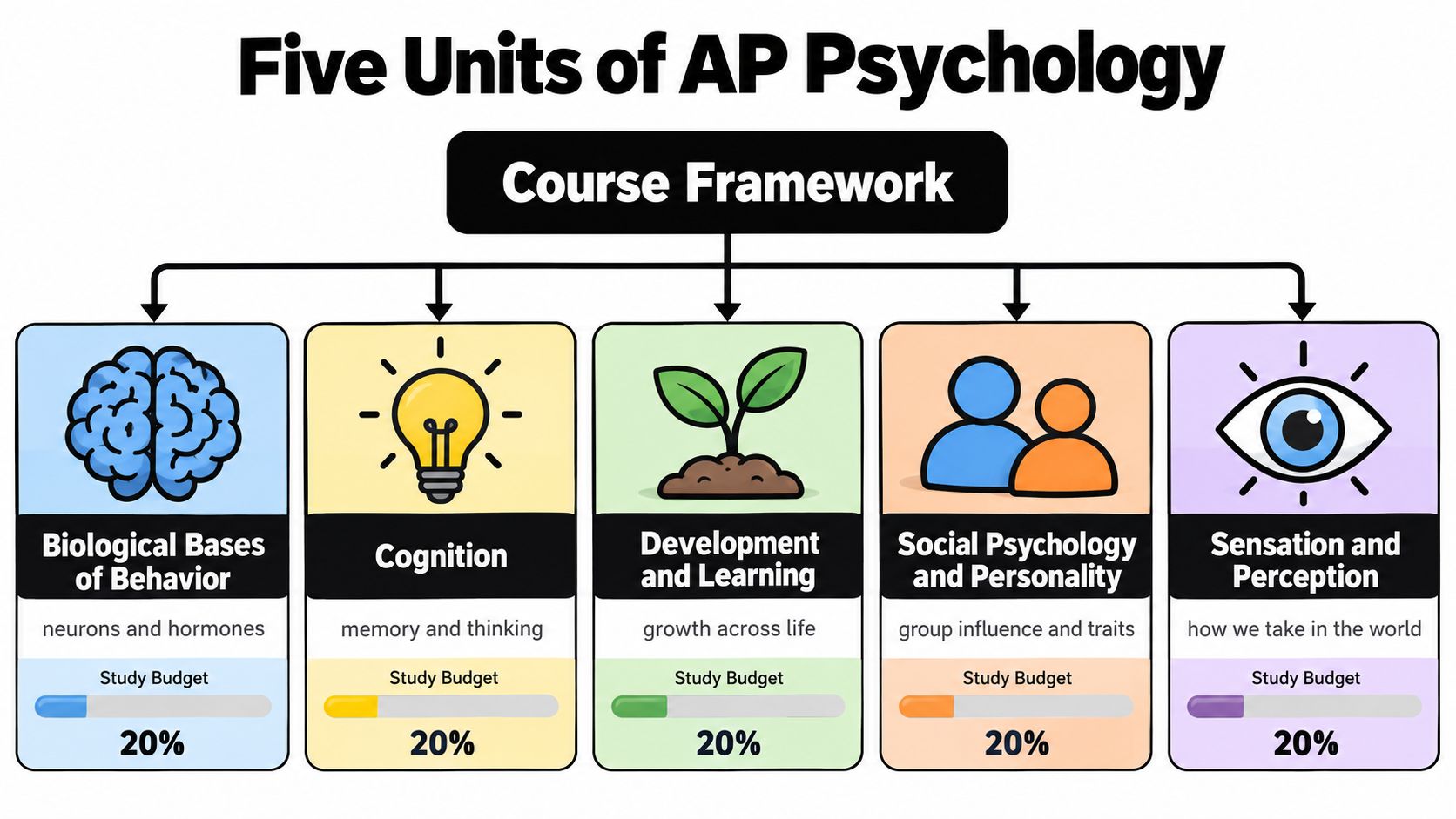
AP Psychology preparation becomes much easier when you stop treating the syllabus as one enormous list. The College Board framework divides the course into five units, and each unit represents an estimated 15% to 25% of the multiple-choice section according to the official AP Psychology course framework. You need broad coverage first, then targeted repair.
The five units are:
- Biological Bases of Behavior, including the brain, nervous system, hormones, and biological influences on behavior.
- Cognition, including memory, thinking, intelligence, and problem solving.
- Development and Learning, including psychological development, conditioning, and learning processes.
- Social Psychology and Personality, including social influence, relationships, personality, and individual differences.
- Mental and Physical Health, including psychological disorders, treatment, stress, and health-related behavior.
Budget practice by skill
Content coverage is only half the plan. The multiple-choice skill distribution is approximately 65% concept application, 25% research methods and study design, and 10% data interpretation. Those figures should determine your practice mix, not your personal preference for memorizing terms.
Use this diagnostic process:
- Complete one mixed practice set without building a study schedule around guesses about your weaknesses.
- Record every miss by both unit and skill.
- Separate a vocabulary problem from a misapplication problem. They require different fixes.
- Track your practice time against the 65/25/10 skill split.
- Recheck the sheet weekly and shift time toward persistent errors.
A student can know every major term in Cognition and still miss questions because they can't apply a concept to a scenario. Another student may understand the content but lose points by confusing correlation with causation or misreading a table. Your error record should reveal both problems.
Don't ask only, “Which unit is weak?” Ask, “What kind of thinking fails when I miss a question?”
Build a concept map for each unit, but don't stop at branches of vocabulary. Add mechanisms, examples, contrasts, and research-method connections. The map gives you coverage. Retrieval prompts and timed questions give you exam readiness.
Turning Lectures and Chapters Into Application Prompts
A lecture becomes useful study material only after you transform it. Start with one transcript, chapter, notes file, or textbook section. Pull out the important concepts, then create prompts that demand more than a definition.
For every topic, write questions in three forms:
- Identify the concept: A student studies more effectively after connecting new material to existing knowledge. Which cognitive process explains the improvement?
- Explain the mechanism: Why would elaborative rehearsal improve later recall?
- Distinguish an alternative: How is elaborative rehearsal different from maintenance rehearsal in this situation?
Those three prompts train recognition, explanation, and discrimination. The third matters because AP questions often place plausible concepts beside one another.
A worked Biological Bases example
Suppose a lecture covers the sympathetic nervous system, adrenal glands, and stress responses. Don't create a card that says, “Define the sympathetic nervous system.” Create a scenario:
Prompt: A student hears a sudden crash and experiences increased heart rate, rapid breathing, and heightened alertness. Which system is active, and what function does it serve?
Strong answer: The sympathetic nervous system is active because it prepares the body for action during a stressful or threatening situation. The increased heart rate and breathing help mobilize energy and attention.
Then force a contrast:
Prompt: Why wouldn't the parasympathetic nervous system be the best answer immediately after the crash?
Strong answer: The parasympathetic system supports rest and recovery, so it would be more relevant after the threat has passed and the body begins returning to its baseline state.
Finish with a research prompt:
Prompt: If a study measured heart rate before and after a stressful video, what would be the dependent variable?
Strong answer: Heart rate would be the dependent variable because it is the outcome being measured. The video condition would be the manipulated variable if researchers assigned participants to different video conditions.
A source-grounded tool such as ClassLecture.ai can turn uploaded lectures, notes, or textbooks into transcripts, conversational questions, study guides, and question-and-answer or fill-in-the-blank flashcards. Use the source scope carefully. Ask questions over the transcript alone when you want lecture-specific recall, over notes alone when you want textbook precision, or over both when comparing the materials.
Ask the system to generate prompts, but answer them yourself before checking the explanation. Automatic summaries save preparation time; they don't replace retrieval. The finished prompt bank should be short enough to use repeatedly and specific enough to expose confusion.
Your target isn't a giant archive of notes. It's a repeatable set of questions that makes you explain the concept, apply it to a fresh scenario, and reject a tempting alternative.
Scheduling Spaced Retrieval Across Weeks and Months
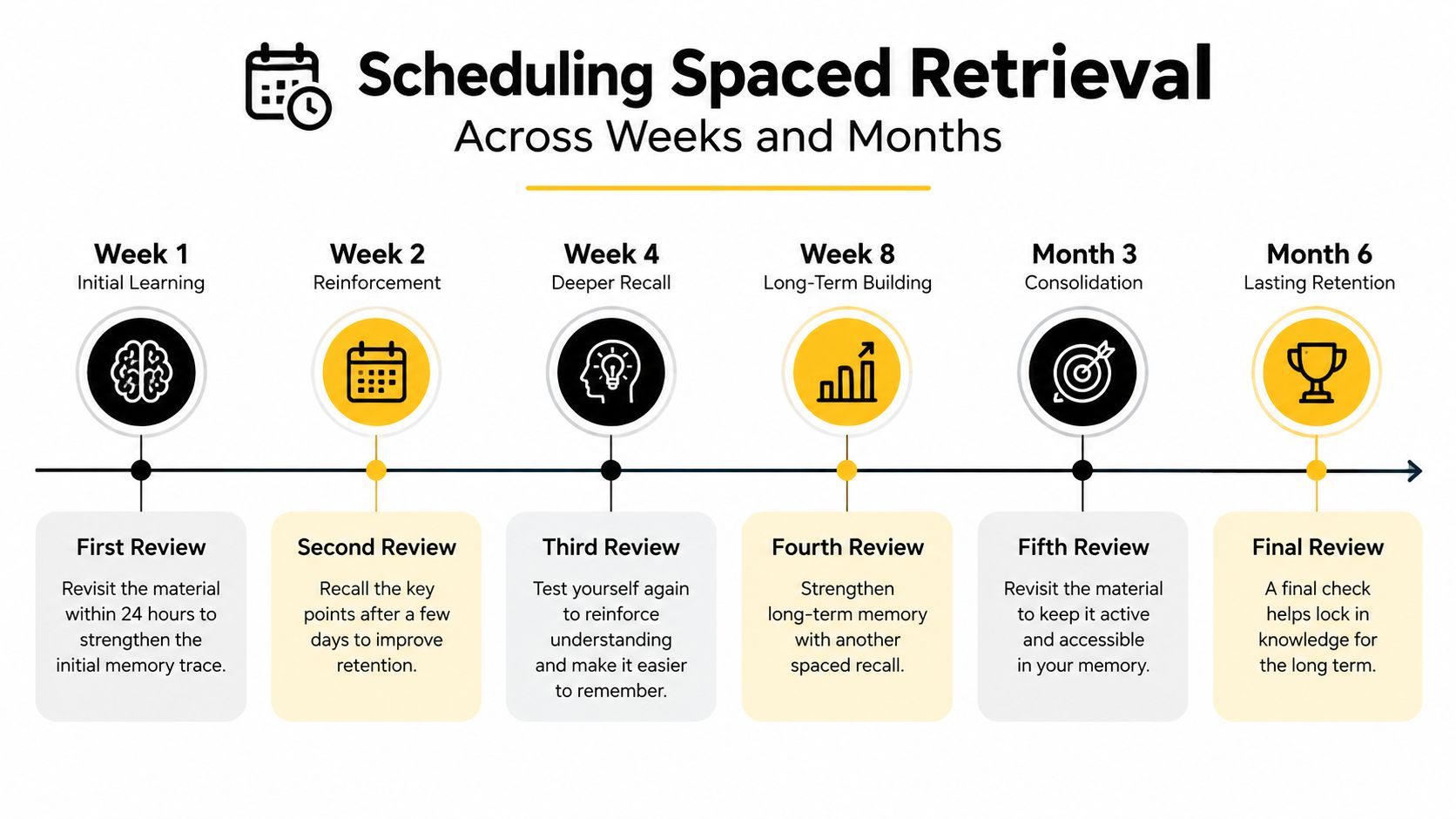
“Review it again later” is not a schedule. Put every concept on a calendar, then return missed material sooner than secure material. Retrieve new content the same day, after 2 to 3 days, after 7 days, and after 14 to 21 days. Move difficult items forward when performance shows that the gap is too long. Use the intervals as a starting structure, not a rigid formula.
A meta-analysis of 29 studies on spaced retrieval found a strong advantage for spaced retrieval over massed retrieval, with Hedges' g = 0.74. It found no meaningful overall advantage for progressively expanding intervals over uniform spacing, with g = 0.034. The practical conclusion is clear: spread retrieval across sessions, then adjust the schedule according to what you miss.
Turn ratings into decisions
If you use a spaced-repetition system, each rating should change the next review:
- Again: You could not retrieve the answer or made a serious error. Bring it back soon.
- Hard: You recalled it uncertainly or needed too much effort. Keep it close.
- Good: You answered accurately without help. Let the interval grow.
- Easy: You retrieved it immediately. Allow a longer gap.
For help building the deck, see this guide to spaced repetition flashcards. Rate retrieval, not familiarity. Hide the answer, produce a response, and judge its accuracy before checking the explanation.
Use a monthly rhythm that combines focused and mixed practice. Start with Biological Bases of Behavior and a small mixed set from older units. Then emphasize Cognition while bringing back missed biological concepts. Continue through Development and Learning, Social Psychology and Personality, and Mental and Physical Health, while keeping mixed retrieval in later sessions.
Topic order can create false confidence. A block devoted to cognition lets you search one mental folder. Mixed questions force you to identify the relevant framework before answering, which better matches the exam.
Find the cards that expose false confidence
The worst cards copy entire paragraphs. They are difficult to answer precisely and easy to recognize without understanding. Rewrite them as one-concept prompts built around a scenario, mechanism, or contrast.
Recognition-only review creates another trap. If you can choose the correct option after seeing four choices but cannot explain the concept with your notes closed, your recall is weaker than it appears. Track free recall separately from recognition, and prioritize cards that fail outside the multiple-choice format.
Matching ClassLecture.ai Tools to Each Skill Bucket
Use a different tool for each kind of work. Concept application needs scenarios and explanations. Research methods need precise interrogation of a study. Data interpretation needs questions that make you identify what was measured, manipulated, and found.
For concept application, use conversational questions over your own lectures and notes. Ask for a scenario, answer without looking, and then request a contrast with a related concept. Question-and-answer flashcards work well when you must define and apply an idea. Fill-in-the-blank cards are useful for terminology, but they shouldn't dominate your deck.
For research methods and study design, ask source-specific questions. Identify the independent variable, dependent variable, sample, design, possible confound, and ethical issue. If the study appears in a transcript or document, cited timestamps and page references make it easier to verify whether your answer matches the source.
For data interpretation, ask the material to surface graphs, tables, and statistics, then turn each item into a prompt. Use questions such as, “What is being measured?”, “What was manipulated?”, “What does this number mean?”, and “What conclusion is justified?” Avoid treating a statistic as decoration. Explain its meaning in the context of the study.
You can export a useful question-and-answer session as a PDF for offline review. Keep one export for difficult research studies and another for corrected explanations from your error log. Signing in through Google, Microsoft, email, or a magic link can reduce setup friction when you begin a session.
| Skill Bucket | Exam Weight | Best Feature | One-Line Use |
|---|---|---|---|
| Concept application | 65% | Conversational Q&A and scenario flashcards | Apply a concept to an unfamiliar behavior and distinguish it from a plausible alternative. |
| Research methods and design | 25% | Source-scoped questions with timestamps or page references | Identify variables, design choices, limitations, and ethics from a specific study. |
| Data interpretation | 10% | Graph, table, and statistics prompts | Explain what was measured, what changed, and what conclusion the evidence supports. |
The routing principle is more important than the software. Use summaries to orient yourself, questions to retrieve, and source references to correct errors.
Running Timed Multiple-Choice Blocks Without Guesswork
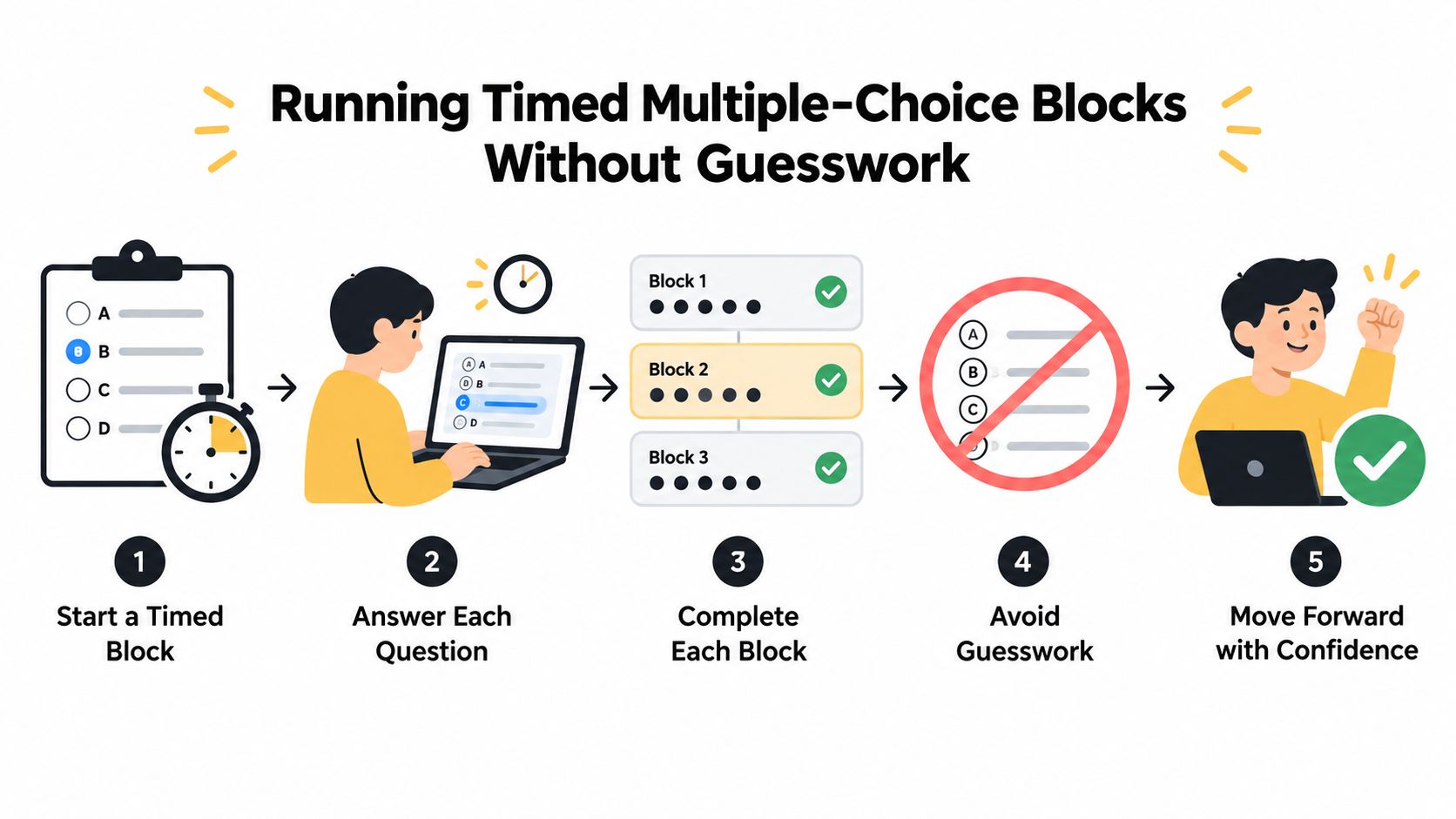
Timing should enter your preparation before the final week. Start with a 20-question mixed set, put the timer where you can see it, and work at the exam's average pace of about 72 seconds per question. Don't pause to look up terms. Mark uncertain questions, keep moving, and return only if time remains.
When two answers seem possible, eliminate what you can, compare the remaining choices against the wording, and select one. The College Board states that multiple-choice scoring is based on the number answered correctly, with no deduction for incorrect answers, so leaving a question blank gives away an opportunity. Every item needs an informed selection.
Use the error log immediately
Spend five minutes after the block classifying every miss and every lucky guess. Use four categories:
- Vocabulary confusion: You didn't know the term or mixed it with a related term.
- Misapplication: You knew the concept but chose it for the wrong scenario.
- Research-design error: You misunderstood variables, sampling, design, ethics, or causation.
- Data-reading error: You misread a graph, table, statistic, or conclusion.
For each error, write the tempting answer, the correct answer, and the evidence that separates them. A spreadsheet works. So does a PDF of corrected questions. The important feature is that your next study session targets the error rather than restarting the whole textbook.
In the last month, rotate mixed-unit blocks weekly. Every third practice session, complete the full 75-question multiple-choice section in 90 minutes under realistic conditions. Remove the comfort of frequent pauses. You need to learn not only what you know, but how your attention and pacing behave when the set keeps going.
Practicing Free Response and Locking In the Last Two Months
Rereading notes will not prepare you for free response. Timed retrieval will. Each answer should name the psychological concept, apply it to the prompt, use accurate evidence, and explain the connection. Dropping terminology into a paragraph earns little.
Write the response under timed conditions before checking any guidance. Then compare it with the College Board's released questions, scoring guidelines, and sample responses. Check whether each scoring point is easy to find, the evidence is accurate, and the explanation answers the exact question instead of repeating a definition.
Use an eight-week countdown
Weeks 8 to 6: Build one concept map for each official unit. Turn weak branches into application prompts, then begin spaced retrieval for every missed concept. Use lectures and chapters as raw material for prompts, not as material to reread passively.
Weeks 5 to 4: Continue mixed retrieval and complete one timed multiple-choice set each week. Keep research methods and data interpretation in the rotation, since both require application rather than simple recall.
Weeks 3 to 2: Add timed free-response drills. Practice defining, applying, supporting, and distinguishing concepts. Use this Psychology 101 review resource to clarify gaps, never to replace writing your own answer.
Week 1: Complete a full-length simulation and review your error log. Repair recurring mistakes. Repeat the response structures that cost you points.
Final weekend: Use light recall only. Review difficult cards, key contrasts, research-method distinctions, and corrected FRQs. Do not start a new content system when clear retrieval and calm execution matter more.
Keep this checklist visible:
- Convert every lecture into application prompts.
- Schedule retrieval across multiple sessions.
- Log missed and guessed questions.
- Run one timed mixed set each week.
- Write one free-response answer each week.
ClassLecture.ai turns lectures, notes, and textbooks into searchable study material, conversational questions, study guides, and spaced-repetition flashcards. Upload course materials, convert them into application prompts, and build a review routine that matches the exam. Visit ClassLecture.ai to begin.
The ClassLecture.ai Team
We build ClassLecture.ai, the AI study assistant that turns your recorded lectures into transcripts, summaries, flashcards, and answers cited to the exact timestamp — so you learn faster from your own professor's words.
Keep reading
10 Best AP Government Flashcards for 2026 Exam Prep
Explore 10 AP Government flashcards from top study platforms, with import tips, usage guidance, and spaced-repetition practice for 2026 exam review.
Read10 AI Flashcards Maker Tools for Students
Compare 10 ai flashcards maker tools for student workflows, source checking, imports, exports, spaced repetition, and lecture-based study.
Read7 Cranial Nerves Flashcards Resources for Better Recall
Explore 7 cranial nerves flashcards resources, from lecture-based decks and mnemonics to spaced repetition, diagrams, and custom sets in ClassLecture.ai.
Read