Psych 101 Review: Core Topics, Practice Q&A, and Study Tools
A practical psych 101 review with core topics, key terms, sample Q&A, and study tools to help you prep for exams and master intro psychology.
You're probably here with the usual Psych 101 situation. A quiz or midterm is close, your notes are scattered across slides, a notebook, and maybe three half-finished flashcard sets, and somehow terms like classical conditioning, working memory, and attribution error all feel familiar but slippery.
That's normal. Intro psych covers a lot of ground fast. The American Psychological Association notes that introductory psychology enrolls between 1.2 million and 1.6 million undergraduates each year, making it the second most popular college course in the United States after English composition (APA introductory psychology teaching report). A course that broad is supposed to feel like a survey. The challenge isn't just learning facts. It's learning how to sort them, retrieve them, and use them under exam pressure.
Most students don't fail Psych 101 because the ideas are impossible. They lose points because they study in a way that feels busy but doesn't hold. They reread, highlight, nod along, and then blank when a multiple-choice stem twists the wording by one inch.
Table of Contents
- What Psych 101 Review Actually Covers
- The Core Topics You'll See in a Psych 101 Course
- Five Concept Pairs Students Confuse Every Semester
- Psych 101 Practice Questions With Explanations
- A Retrieval and Spacing Study Plan That Works
- Choosing the Right Study Tools for Psych 101
- Smarter Psych 101 Review Habits to Build This Week
What Psych 101 Review Actually Covers
Two nights before a Psych 101 exam, a lot of students end up in the same loop. They reread a chapter on learning, flip to notes on memory, answer two practice questions, then realize they are recognizing terms more than they are recalling them. The work feels serious. The memory is still shaky.
A useful Psych 101 review fixes that problem by doing two jobs at once. It organizes the course into a few durable idea categories, and it pairs each category with the study move that helps you remember it later under test pressure. That second part matters. Intro psych is not just a pile of definitions. It is a course full of look-alike terms, small distinctions, and scenario questions that punish passive studying.
What students often mean by “review”
Students often use “review” to mean re-seeing material. Read the chapter again. Scan the slides again. Look over flashcards until the answers feel familiar.
Familiarity is a poor judge of learning.
If your notes stay open the whole session, you are usually practicing recognition, not retrieval. Recognition is the feeling of “oh right, I've seen this.” Retrieval is producing the idea with no visible prompt. Exams grade retrieval.
That matters even more in intro psych because many students are learning the field's vocabulary for the first time and may never take another psychology course. The goal of review, then, is not to touch every page again. The goal is to get the major ideas into memory in a form you can use.
What useful review looks like instead
Good review usually includes four parts, and each part matches a common exam problem.
- A map of the course. Students remember material better when later topics have a place to attach. Biological bases, learning, memory, development, social psychology, and research methods should feel like labeled folders, not one long blur of chapters.
- Concept boundaries. Psych tests love near-neighbors such as sensation versus perception or negative reinforcement versus punishment. You need short, clear rules for where one term stops and the other begins.
- Practice with explanations. Answering a question is only half the job. The stronger move is explaining why the tempting wrong answer is wrong. That is how you catch shallow understanding before the exam does.
- A repeatable workflow. Good intentions do not survive a busy week unless the method is simple enough to repeat. Short retrieval rounds, spaced over several days, beat one heroic cram session.
A good analogy is a messy closet. Review is not throwing every item back on the shelf and hoping the room looks cleaner. Review is sorting items into bins, labeling the bins, and then checking a day later whether you can find what you need without help.
If you want a clean overview before turning your notes into a study plan, the Psychology 101 free course preview shows one clear way the material is commonly grouped.
Some students study best in order. Others need to start with the pair they keep mixing up and work outward from there. Both can work, as long as the session includes retrieval, comparison, and repetition across time.
The Core Topics You'll See in a Psych 101 Course
Psych 101 often feels random until you notice the recurring clusters. Once you see those clusters, the course gets easier because every lecture starts landing in a known folder.
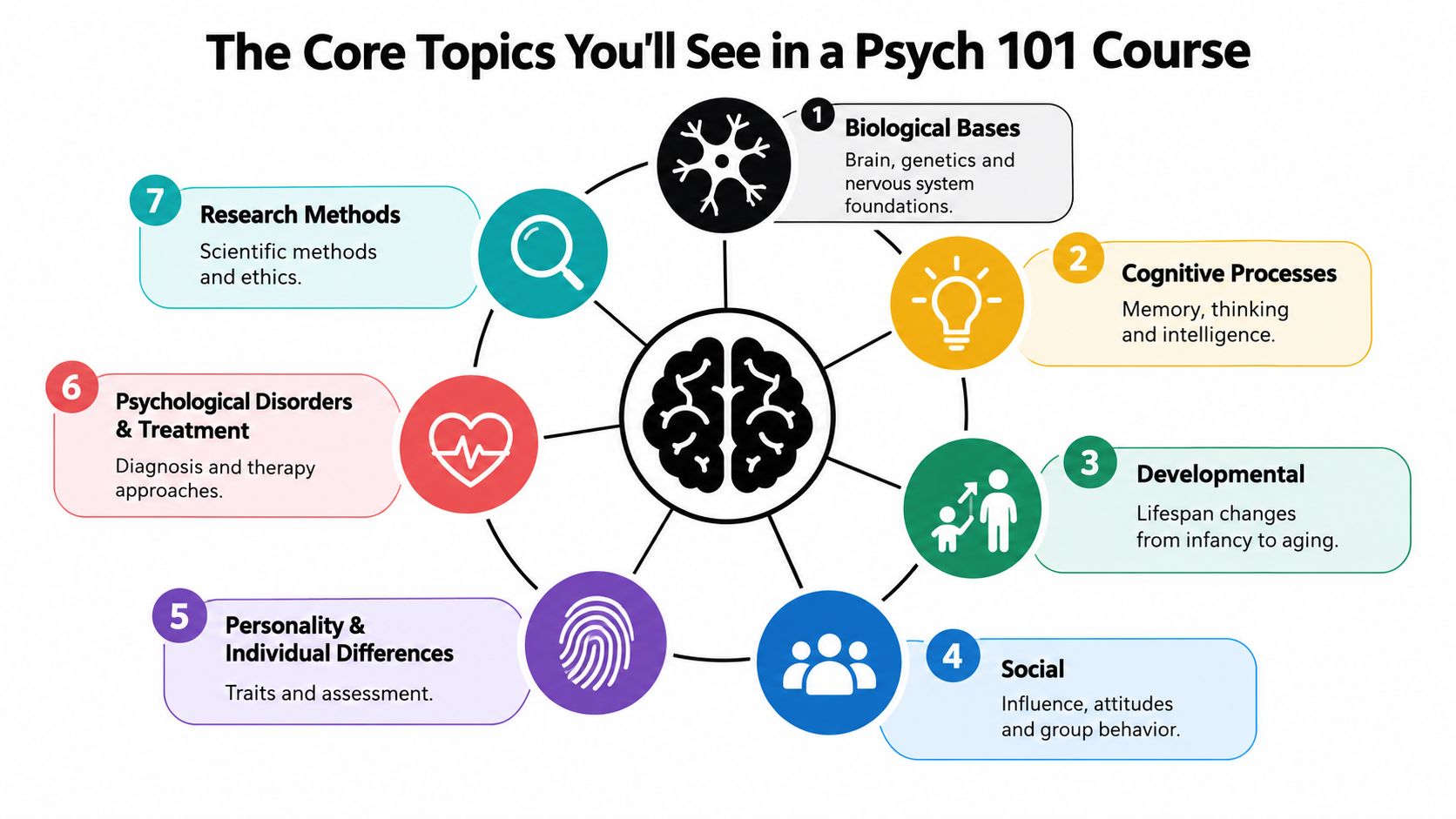
Biological foundations
Start here because many later units borrow this language. You'll usually see neurons, neurotransmitters, central nervous system, endocrine system, and major brain structures.
Common exam-style question: Which brain area is most closely tied to emotion or memory, and what does that function look like in behavior?
Students get stuck when they memorize body parts without linking them to function. Don't just memorize “amygdala.” Tie it to emotional salience. Don't just memorize “sympathetic nervous system.” Tie it to fight-or-flight activation.
Sensation and perception
This cluster asks how the nervous system detects input and how the brain interprets it. Terms that show up often include sensation, perception, signal detection, top-down processing, and perceptual set.
Classic exam-style question: Are you being asked about detecting a stimulus, or interpreting what the stimulus means?
That distinction matters because a stem may mention eyes or ears but be testing interpretation.
Learning and conditioning
This is one of the most testable units because it uses clean distinctions and vivid examples. Watch for classical conditioning, operant conditioning, reinforcement, punishment, generalization, and extinction.
Common question: Is the behavior reflexive or voluntary? That one question solves a lot of confusion.
Memory and cognition
This unit usually mixes structure with strategy. Key terms include encoding, retrieval, working memory, long-term memory, heuristics, and problem solving.
One high-yield question: Did the person fail to store the information, or fail to retrieve it at the moment they needed it?
Psychology's long history as an academic discipline is part of why this material feels so established. The field is commonly traced to 1879, when Wilhelm Wundt established the first psychology laboratory in Leipzig, and the American Psychological Association was founded in 1892 with 31 members. APA later documented a 630% membership increase from 4,183 in 1945 to 30,839 in 1970, reflecting the field's growth into a mass academic discipline (history of psychology overview).
Development across the lifespan
Expect infancy through older adulthood. Intro courses often emphasize attachment, cognitive development, adolescence, and aging.
A signature question sounds like this: What can this child understand at this stage that they could not at an earlier stage?
Students do better when they connect stages to examples, not labels alone.
Social psychology
This unit is often fun to read and easy to underestimate. Core terms include conformity, obedience, attribution, attitudes, and group behavior.
A frequent question: Did the person change behavior because of peers, or because an authority figure directed them?
Psychological disorders and treatment
This cluster usually covers major symptom patterns, the biopsychosocial model, and broad therapy orientations such as behavioral, cognitive, or psychodynamic approaches.
Keep an eye on questions like these:
- Diagnosis questions: What symptom pattern fits the description?
- Model questions: Is the explanation biological, psychological, social, or integrated?
- Treatment questions: Which therapy approach matches the stated goal?
One practical note from years of grading. If you can sort any lecture concept into one of these clusters quickly, you're already making the course easier on yourself.
Five Concept Pairs Students Confuse Every Semester
Some wrong answers don't come from not studying. They come from recognizing two terms but not seeing the hinge that separates them.
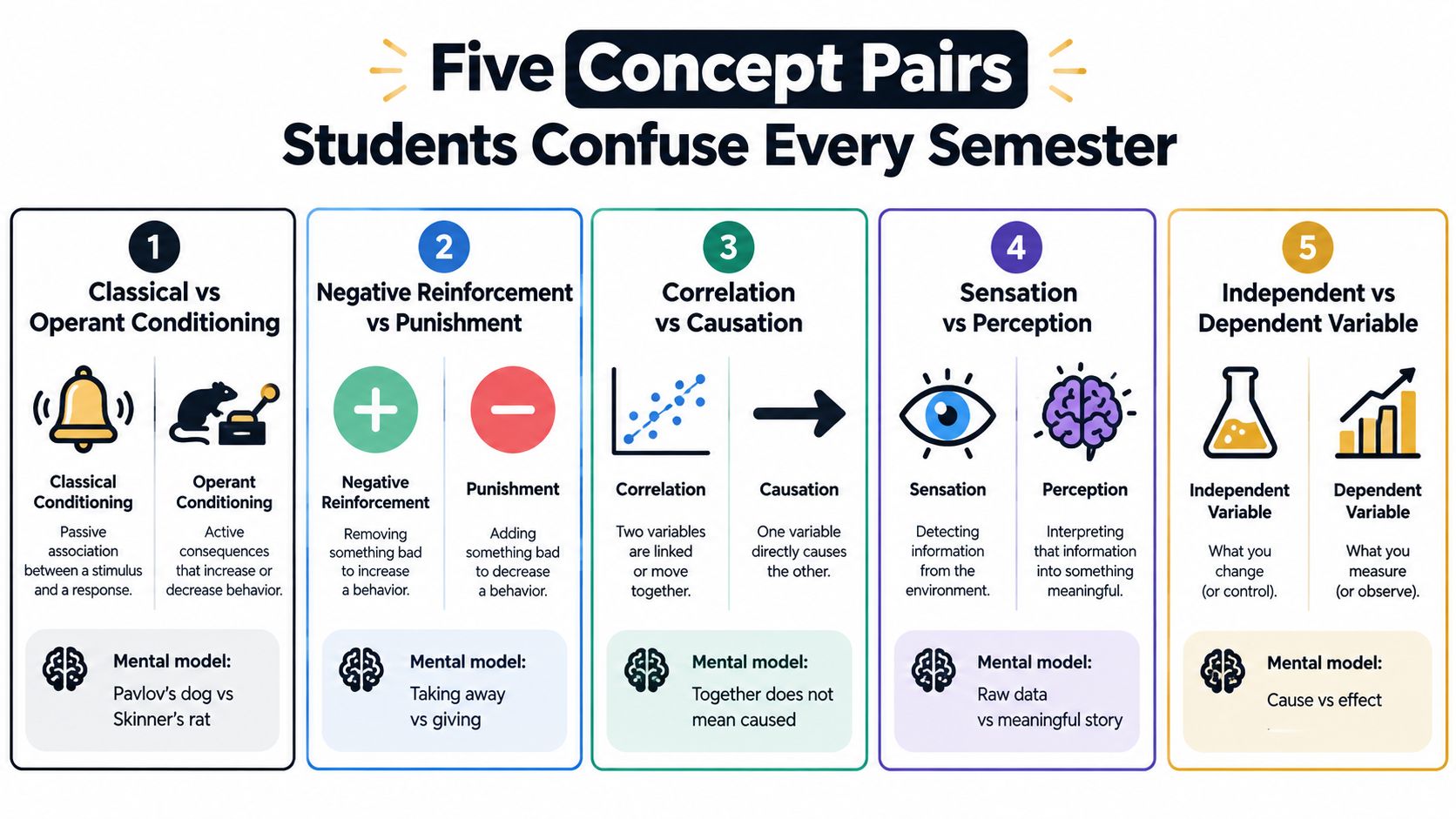
Classical conditioning and operant conditioning
Mental model: one is about association around a reflex, the other is about consequences shaping a choice.
If a dog salivates when it hears a bell linked with food, that's classical conditioning. If a child cleans up toys to earn a sticker, that's operant conditioning.
The trap is that both involve learning, rewards, and behavior change. The stem usually gives away the answer by asking whether the response is automatic or emitted voluntarily.
Short-term memory and working memory
Mental model: short-term memory holds information. Working memory does something with it.
Holding a phone number long enough to dial it is short-term storage. Reordering that number in your head, or mentally comparing it to another number, uses working memory.
Students often pick the broader, more familiar term. If the task involves manipulation, not just storage, choose working memory.
Correlation and causation
Mental model: two things can move together without one producing the other.
Ice cream sales and drowning rates can rise at the same time because summer changes both. That's correlation. It does not prove that one causes the other.
When a question gives you two variables moving together, pause and ask what else might explain both.
The wording trap is often subtle. “Associated with” is not the same as “caused by.”
Explicit memory and implicit memory
Mental model: explicit memory is conscious recall. Implicit memory shows up in performance without deliberate recall.
Remembering a definition from chapter three is explicit. Riding a bike or typing a familiar password pattern can rely heavily on implicit memory.
When the stem focuses on skills, habits, or performance without deliberate remembering, think implicit.
Conformity and obedience
Mental model: conformity bends toward peers. Obedience bends toward authority.
A student matching a group's wrong answer because everyone else said it first is conformity. A person following direct instructions from someone in charge fits obedience.
The trick wording usually swaps social pressure for formal authority. That single difference matters.
Psych 101 Practice Questions With Explanations
When you practice, don't just pick an answer and move on. Read the stem, predict the concept, then check the options. That habit catches a lot of avoidable mistakes.
Question 1
A student starts turning in homework on time because the instructor gives participation points for each on-time submission. Which concept best explains this change?
- A. Classical conditioning
- B. Operant conditioning
- C. Observational learning
- D. Sensory adaptation
Correct answer: B. Operant conditioning
The student's behavior changes because of a consequence. That's the clue. Participation points increase a voluntary behavior, so the question is about operant conditioning.
Why the others fail:
A is wrong because classical conditioning focuses on associations around reflexive responses. C might sound tempting because students do watch others, but the stem gives a direct consequence. D belongs to sensation, not learning.
Question 2
Which example best reflects working memory?
- A. Recognizing a classmate's face
- B. Holding a term in mind while comparing it to another definition
- C. Recalling your first-grade teacher's name
- D. Remembering how to ride a bicycle
Correct answer: B. Holding a term in mind while comparing it to another definition
This option includes active mental manipulation. That's the hallmark of working memory.
A is recognition, C is long-term recall, and D leans on procedural memory.
Question 3
A person's heart rate rises, breathing quickens, and digestion slows after hearing footsteps behind them at night. Which system is most directly active?
- A. Parasympathetic nervous system
- B. Sympathetic nervous system
- C. Somatic nervous system
- D. Endocrine feedback loop
Correct answer: B. Sympathetic nervous system
This stem describes fight-or-flight changes. Faster heart rate and slowed digestion are classic clues.
A is the “rest and digest” counterpart, so it's a common distractor. C controls voluntary skeletal muscle action more broadly. D may sound scientific, but it's too vague for what the stem is testing.
Question 4
A researcher finds that students who sleep more tend to score higher on exams. Which conclusion is safest?
- A. More sleep causes higher exam scores
- B. Higher exam scores cause more sleep
- C. Sleep and exam scores are related, but causation isn't established
- D. The relationship is invalid unless the variables are equal
Correct answer: C. Sleep and exam scores are related, but causation isn't established
This is the classic research methods trap. Correlation can show a relationship, not proof of cause.
A and B both overclaim. D is nonsense dressed up in technical language, which intro exams love to use as bait.
Question 5
A child can reason about concrete objects and understands conservation tasks but still struggles with highly abstract logic. Which developmental stage fits best?
- A. Sensorimotor
- B. Preoperational
- C. Concrete operational
- D. Formal operational
Correct answer: C. Concrete operational
The phrase concrete objects is practically the answer key. Conservation is another giant clue.
A and B describe earlier development. D would involve more abstract reasoning than the stem allows.
Question 6
Which brain structure is most closely associated with processing emotional significance, especially fear-related responses?
- A. Cerebellum
- B. Amygdala
- C. Medulla
- D. Occipital lobe
Correct answer: B. Amygdala
The amygdala is the key emotional processing answer here. Fear-related cues are the giveaway.
A is more tied to coordination, C to basic life-sustaining functions, and D to visual processing.
How to score your own practice honestly
Use a simple self-check after a set like this:
- Got it right and explained why: Count that as stable.
- Got it right but guessed: Mark it as shaky.
- Got it wrong because of a concept mix-up: Add both terms to a correction list.
- Got it wrong because of wording: Rewrite the stem in your own words.
If you want help turning your lecture notes into quiz-style prompts, a quiz generator for studying can speed up that process, especially when you're short on time.
A Retrieval and Spacing Study Plan That Works
A lot of Psych 101 review advice stops at “use flashcards.” That's incomplete. The stronger move is combining retrieval practice with spacing.
A large classroom-focused review covering 49 effect sizes and 5,374 learners found that 57% of retrieval-practice effects were medium or large, with benefits seen across education levels, content areas, timing, and feedback conditions (retrieval practice review by Agarwal and colleagues). A separate meta-analytic review reported a strong advantage for spaced retrieval over massed retrieval, with an effect size of g = 0.74 (meta-analytic review of spaced retrieval).
That sounds technical, but the practical meaning is simple. Don't just look at the material again. Try to pull it out of memory, then revisit it after some time has passed.
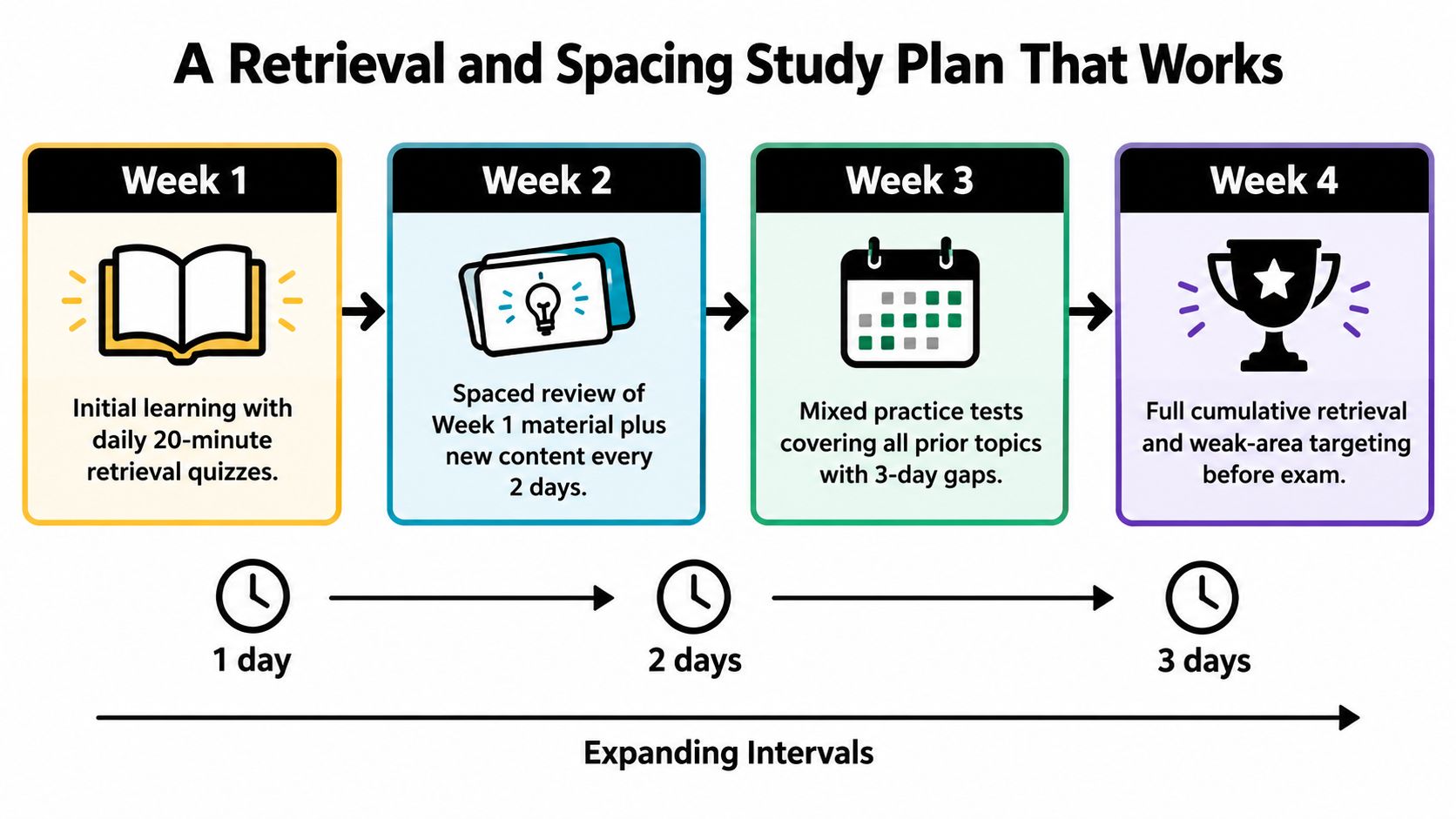
A four-week plan you can actually use
Week 1
Build a deck or question bank by topic cluster. Do a short closed-note recall session before checking anything. For each topic, write what you remember first, then compare it to notes.
Week 2
Start mixing topics. Put learning, memory, development, and research methods in the same session so your brain has to discriminate between them.
Week 3
Shift from single facts to exam format. Use multiple-choice stems, mini-scenarios, and a few short written responses.
Week 4
Do timed cumulative review. Spend more time on the topics you still miss, not the ones you already know well.
A simple daily rhythm works well:
- Fifteen-minute warm-up: Closed-note recall of yesterday's material.
- One deeper block: Answer questions, not just read.
- Five-minute reflection: Write what you missed and why.
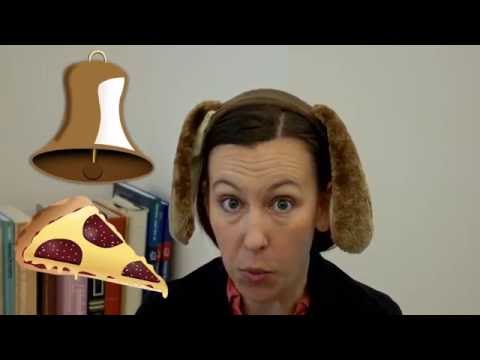
Here's a useful explanation of the spacing idea in action:
What to track
Don't track time alone. Track whether you could retrieve the answer without prompting.
A better metric: “Could I explain it cold?” beats “Did I spend an hour on it?”
If your answer only appears once you see the first letter, the slide title, or the answer choices, the memory is still weak.
Choosing the Right Study Tools for Psych 101
Different tools solve different review problems. Students waste time when they use one tool for everything.
Many Psych 101 resources give students piles of chapter questions but not enough guidance on how to study effectively. One college PSY 101 guide explicitly recommends distributed practice, elaborative interrogation, self-explanation, interleaving, and self-testing, while warning against rereading and highlighting. The same guide also frames review by learning objectives and notes that review sheets aren't exhaustive, which is a much smarter model than memorizing a packet (Monroe Community College PSY 101 study guide).
Match the tool to the task
| Study Task | Best Tool | Why It Works |
|---|---|---|
| Getting oriented before a unit review | One-page summary sheet | It shows the map before the details and helps you group terms correctly. |
| Memorizing definitions, theorists, and brain structures | Self-built flashcards | They force quick retrieval and make weak spots obvious. |
| Practicing scenario-based questions | Conversational Q&A with a classmate, tutor, or AI tool | It pushes you to explain, compare, and apply concepts, not just name them. |
| Reviewing lecture-specific details | Transcript or lecture notes | This keeps your study anchored to what your instructor actually emphasized. |
| Catching concept confusion | Error log or “leak list” | It turns repeated mistakes into a focused review target. |
Paper, digital, and hybrid setups
Paper flashcards are great if writing helps you encode terms. Digital flashcards are easier to sort, reschedule, and revisit in small pockets of time.
Pre-made decks save effort, but self-built decks usually teach more because you have to choose the wording. Summaries help with orientation, but they shouldn't become your whole method.
One reasonable hybrid is this:
- Start with a summary sheet for each major cluster.
- Build your own flashcards from missed questions and lecture vocabulary.
- Add one weekly Q&A session where you explain ideas out loud.
If you want one platform that combines lecture transcripts, conversational Q&A, AI-generated study guides, and flashcards with spaced repetition scheduling, ClassLecture.ai is one factual option for turning your own course materials into review tools. If you're making cards from scratch, this guide on how to make flashcards online is a practical starting point.
Smarter Psych 101 Review Habits to Build This Week
Passive rereading feels neat, organized, and responsible. It also hides your weak spots. The minute your notes are closed, you find out what stuck.
That's why I push students toward active recall early, even if it feels less smooth. The struggle is the point. When you try to retrieve an answer and can't quite do it, you've just found the exact place your next few minutes should go.
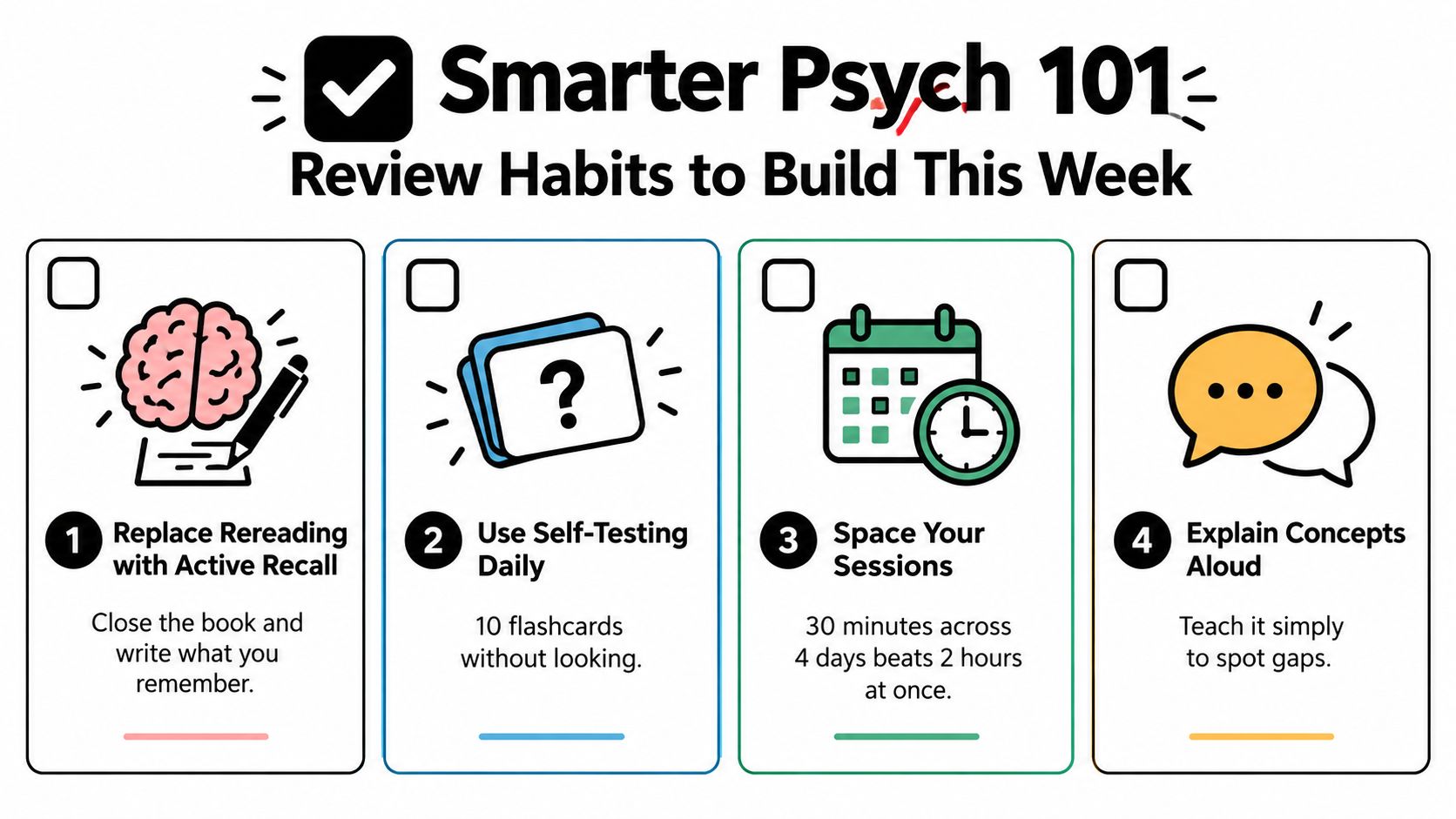
Four upgrades for your next study session
- Replace highlighting with a closed-note summary: Read a small section, close it, and write what you remember in plain language.
- Split one long block into two short retrieval rounds: Try one round earlier in the day and another later, with no notes at first.
- Attach each concept to a real example: If you can connect operant conditioning to a daily behavior, it usually sticks better.
- Keep a leak list: Every missed term or confused pair goes on one running page. Re-quiz that list a few days later.
Study like the exam will ask, not like the textbook is written.
These aren't huge lifestyle changes. They're small swaps. But small swaps repeated across a semester are what usually separate “I sort of knew it” from “I could answer it under pressure.”
If tonight's review is even a little more active than last week's, you're already moving in the right direction.
If you want your Psych 101 review to come from your actual lectures instead of generic notes, ClassLecture.ai can turn recordings, slides, notes, and textbooks into transcripts, flashcards, study guides, and conversational Q&A. That's especially useful for intro psych, where the smartest review usually follows your instructor's wording, examples, and learning objectives rather than a one-size-fits-all packet.
The ClassLecture.ai Team
We build ClassLecture.ai, the AI study assistant that turns your recorded lectures into transcripts, summaries, flashcards, and answers cited to the exact timestamp — so you learn faster from your own professor's words.
Keep reading
AP Biology DNA Replication: A Complete Guide for Students
Master AP Biology DNA replication with clear explanations of enzymes, leading and lagging strands, replication forks, and common exam misconceptions.
ReadAP Microeconomics Unit 3 Study Guide with Practice Questions
Master AP Microeconomics Unit 3 with clear explanations of supply, demand, elasticity, and market structures, plus examples and practice questions.
ReadAP English Exam Study Guide: Read, Write, and Score Higher
A complete AP English exam study guide covering reading, writing, rubrics, practice prompts, and revision strategies to help you score higher in 2026.
Read