AP Psych Unit 9: Social Psychology Topics and Study Plan
Master AP Psych Unit 9 social psychology: key topics, exam traps, and how to turn lectures into timestamped summaries and flashcards with ClassLecture.ai.

When does following a group reflect social pressure, and when might it be a sensible response to better information? That question reveals what many AP Psychology Unit 9 guides miss: knowing a term isn't enough. On the exam, you need to identify who is influencing whom, what response the situation demands, and which details could change the outcome.
A reliable approach is to sort each scenario by its mechanism, then check whether the evidence supports a broad claim or only a narrower conclusion. That turns a list of vocabulary into a way to reason through unfamiliar examples.
Table of Contents
- What AP Psych Unit 9 Covers and How It Is Tested
- Commonly Confused Concepts Side by Side
- Key Studies and What Each One Proves
- How to Sort an Attribution Question in Seven Steps
- Where Classic Social Psychology Effects Break Down
- How to Turn Unit 9 Lectures Into Study Materials
- Check Your Unit 9 Readiness Before the Exam
What AP Psych Unit 9 Covers and How It Is Tested
AP Psychology Unit 9 is Social Psychology, the study of how the actual, imagined, or implied presence of others can shape thoughts, feelings, and behavior. Its central idea is that a situation can influence someone's actions in ways that a personality-based explanation alone might not predict. The unit is commonly described as about 8–10% of the exam, but check your current course outline: earlier College Board materials used different unit numbers and titles. An older College Board sample syllabus, for example, labeled Unit 9 “States of Consciousness.”
The College Board's core domains include attribution theory, attitude change, conformity, obedience, group behavior, prejudice, altruism, aggression, attraction, bystander effects, social facilitation, cognitive dissonance, and self-fulfilling prophecies. Use this topic map as a reference, not as a substitute for your teacher's course outline.
| Topic | Core question | Anchor term or study | Common exam trap |
|---|---|---|---|
| Attribution | Why did this person act that way? | Fundamental attribution error | Mixing it up with self-serving bias |
| Attitudes and attitude change | How do beliefs and behavior shift? | Cognitive dissonance | Assuming behavior always follows attitude |
| Conformity | Why do people match a group? | Asch line-judgment study | Treating conformity as weakness by default |
| Obedience | Why do people follow an authority's order? | Milgram shock study | Confusing obedience with conformity |
| Group behavior | How do groups change decisions and actions? | Groupthink, group polarization, social loafing, social facilitation | Treating groupthink and polarization as the same process |
| Prejudice and discrimination | How do attitudes toward groups turn into action? | Stereotypes and in-group bias | Using prejudice and discrimination as synonyms |
| Aggression | When do situations provoke harm? | Frustration-aggression reasoning | Assuming aggression is only a personality trait |
| Attraction | What makes people like each other? | Proximity and similarity | Treating attraction as only physical |
| Altruism and bystander effect | When do people help? | Darley and Latané emergency studies | Assuming more witnesses always means more help |
| Self-fulfilling prophecy | How do expectations create outcomes? | Expectation-driven behavior | Describing it as a simple wish or guess |
Start with the question in the second column. It tells you what the concept is trying to explain before you reach for a label. If a scenario describes someone changing an answer after hearing a group's response, ask whether a direct command was made; if there wasn't, conformity may fit better than obedience.
Study move: Tag each lecture slide with one row from the map. Then use this AP Psychology study guide to build a review routine around those topic chunks, rather than treating the unit as one long vocabulary list.
Commonly Confused Concepts Side by Side
Ask one diagnostic question first: who is applying pressure, and what do they demand? If a group's behavior influences someone without an explicit instruction, the mechanism may be conformity. If an authority figure directly orders an action, obedience is the better fit. The distinction is about the source and form of pressure, not whether the person feels comfortable.
| Concept | Source of pressure | Required response | Key moderators | Classic example |
|---|---|---|---|---|
| Conformity | Real or imagined group pressure | Change behavior or judgment to match the group | Unanimity, group size, ambiguity, presence of a dissenter | Asch line-judgment task |
| Obedience | A direct demand from an authority | Follow the demand, even despite personal objections | Perceived authority, proximity, institutional legitimacy, diffused responsibility | Milgram shock study |
| Groupthink | Desire for consensus in a cohesive group | Suppress dissent, risking a poor decision | Cohesion, isolation from outside views, directive leader, time pressure | A group decision that ignores warnings |
| Group polarization | Discussion among members with similar views | Move toward a more extreme version of an initial view | Shared starting views, discussion content, informational diversity | Like-minded debate that hardens positions |
| Deindividuation | Crowds or settings with low identifiability | Show reduced self-awareness and accountability | Anonymity, group size, arousal, low identifiability | Crowd behavior with reduced personal restraint |
With conformity, unanimity matters because a dissenting voice can make it easier to resist the group. Ambiguity matters because people may rely more on others when they're unsure of the correct answer. With obedience, consider whether the authority seems legitimate and how close the authority is to the person receiving the demand. Those details help explain why social influence varies across situations instead of operating like an automatic switch. OpenStax's overview of conformity, compliance, and obedience provides a useful framework for comparing these mechanisms.
Groupthink and group polarization also aren't interchangeable. Groupthink concerns decision-making under pressure to maintain consensus, while group polarization concerns a shift toward more extreme versions of members' starting views after discussion. A group can agree without showing groupthink, and a group can become more extreme without suppressing dissent.
Deindividuation refers to reduced self-awareness and accountability. Anonymity can be relevant, but it isn't a complete definition: ask whether the scenario shows reduced self-monitoring or accountability, not merely whether someone is using an anonymous account.
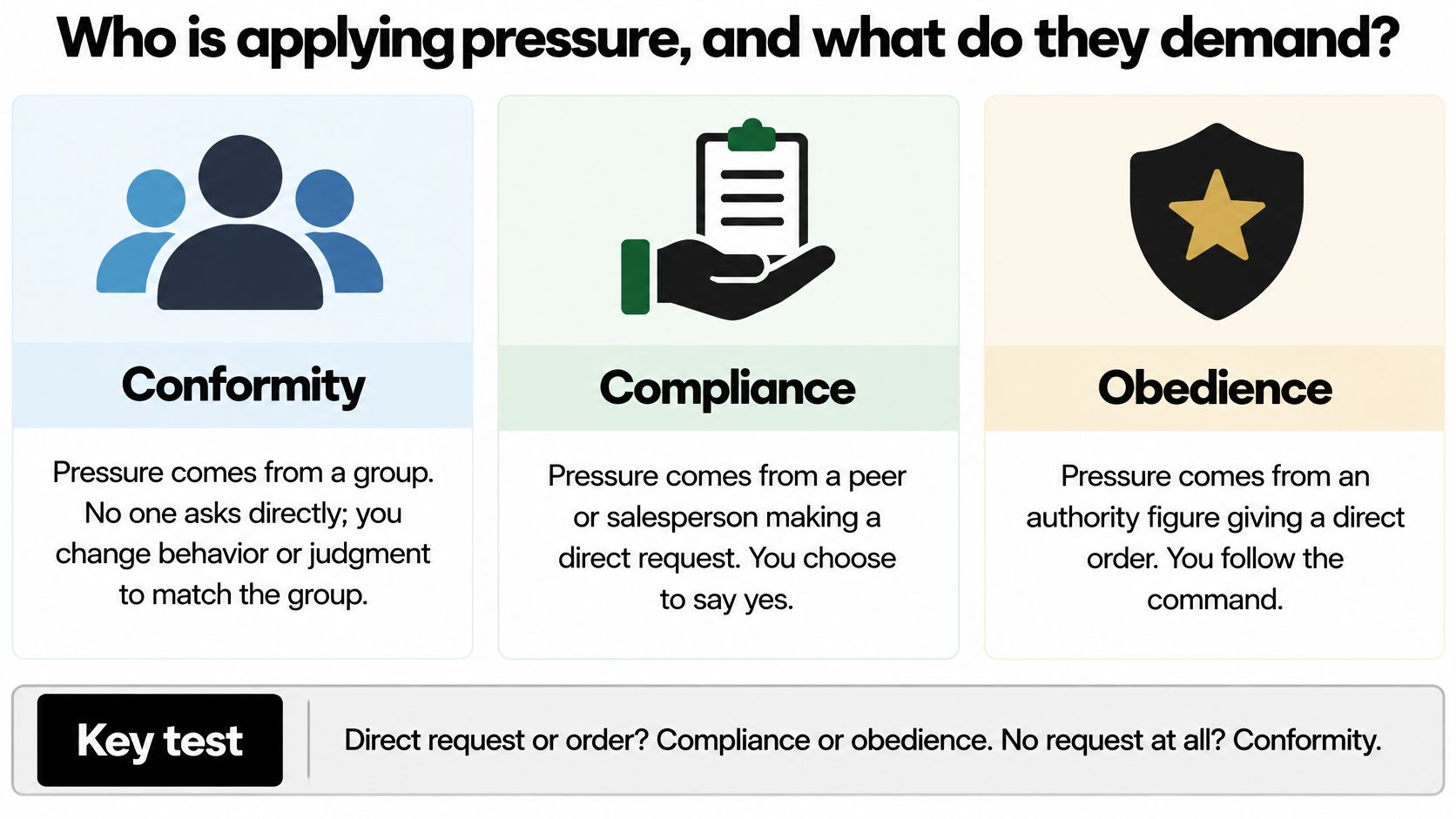
Think of the concept names as the dishes and the mechanisms as the ingredients. On an unfamiliar question, identify the pressure source and demanded response first. Then check moderators and predict what behavior the mechanism would make more likely.
Key Studies and What Each One Proves
In Milgram's baseline obedience experiment, 26 of 40 participants, or 65%, continued to the maximum apparent 450-volt shock level, even after hearing the learner's protests. Students often slide from "many people obeyed" to "everyone obeys," and the study does not support the second claim. It shows how strongly an authority situation can shape behavior under controlled conditions. A strong answer names the boundary alongside the number.
The natural boundary check is Burger's 2009 partial replication. The procedure stopped at 150 volts, and about 70% of participants continued to that cutoff, a result that was not statistically significantly different from Milgram's at the same point. Two cautions follow. The replication suggests obedience rates may have held over time, yet the shorter procedure also means no participant faced the full shock sequence, so the comparison stays partial by design.
| Study | What happened | Headline finding | Main limitation |
|---|---|---|---|
| Asch line-judgment task | Participants judged line lengths after confederates gave unanimous wrong answers | Many individuals went along with the group at least once | One task type and a narrow sample of American men |
| Milgram obedience studies | Participants acting as teachers were instructed by an experimenter to administer apparent shocks | In the baseline condition, 26 of 40 continued to the maximum | Deception and stress raised ethical concerns; later replications varied |
| Stanford Prison Experiment (1971) | Students were assigned to guard or prisoner roles in a simulated prison | Roles and setting appeared to shape harmful conduct | It ended after six days; the sample was limited, the researcher was involved, and ethical problems arose |
| Darley and Latané emergency studies | Participants heard a simulated emergency alone or with others | Helping became less likely as the number of bystanders grew | Laboratory conditions; help also depends on ambiguity and perceived responsibility |
Read the table by mechanism, not by name. In Milgram, an experimenter applies pressure and demands continued obedience; in Asch, a unanimous group supplies the pressure; in the prison simulation, an assigned role does; in Darley and Latané, pressure spreads across witnesses rather than concentrating in one source. When an unfamiliar scenario appears on the exam, matching its pressure source to the right study is faster than guessing which famous name fits. If your lecture described a variation, check whether the scenario matches that variation before you commit.
The Stanford Prison Experiment, conducted by Philip Zimbardo at Stanford University, gives a historical example of social roles and institutional context. The planned simulation was intended to last approximately two weeks, but it ended after six days when the treatment of prisoners deteriorated and raised serious ethical concerns. Its sample, researcher involvement, and ethical problems limit how confidently its findings can be generalized. Britannica's account of the Stanford Prison Experiment describes its history and context.
For a free-response answer, each study works like a photograph taken under particular lighting: accurate within its frame, incomplete outside it. Connect Asch to group unanimity, then explain that a single dissenter changes the pressure a participant faces. Naming a limitation or a condition that could weaken the effect is what turns a memorized result into evidence.
How to Sort an Attribution Question in Seven Steps
A student forgets a lab notebook, and her teacher calls her careless. The scenario is one sentence long, but AP questions build entire prompts on whether you can separate the observable event from the explanation someone attached to it. Before you reach for a vocabulary term, sort the mechanism: who is explaining the behavior, whose behavior is being explained, and whether the outcome was a success or a failure. Then run the same seven steps every time.
-
Write the behavior neutrally. "Priya forgot her notebook." Hold back "careless," because that is an interpretation, not an observation.
-
Record the inferred cause. The teacher supplies "careless." Copy the cause the scenario gives you before deciding whether it holds up.
-
Classify the locus. "Careless" places the cause inside Priya, an internal attribution. A delayed bus or a sudden change in her routine would place it outside her, an external attribution.
-
Check stability. Ask whether the cause is likely to persist. One forgotten notebook does not establish a lasting pattern.
-
Check controllability. Could Priya have prevented the cause? Possibly, if she had packed the night before, but the scenario gives no information about her morning, so a careful answer says so.
-
Identify the bias being tested. An observer who explains another person's behavior through personality while overlooking the situation points to the fundamental attribution error. An explanation that shifts depending on whether someone judges their own action or another person's points to the actor-observer bias. Claiming credit for success while deflecting failure onto circumstances points to self-serving bias.
-
Match the answer to the evidence. Choose the option that fits both the cause's locus and the specific bias. A familiar term is not correct just because it appears in the unit.
The most common slip is confusing actor-observer bias with self-serving bias. Actor-observer bias compares how someone explains their own behavior with how they explain someone else's. Self-serving bias concerns only that person's own outcomes, splitting credit for success from blame for failure. The tell is in the scenario's scope: two targets of judgment suggest actor-observer, while two outcomes for one person suggest self-serving.
If the scenario centers on a person judging themselves, check for self-serving bias first. Then see whether the question contrasts how that person explains their own behavior with how they explain someone else's.
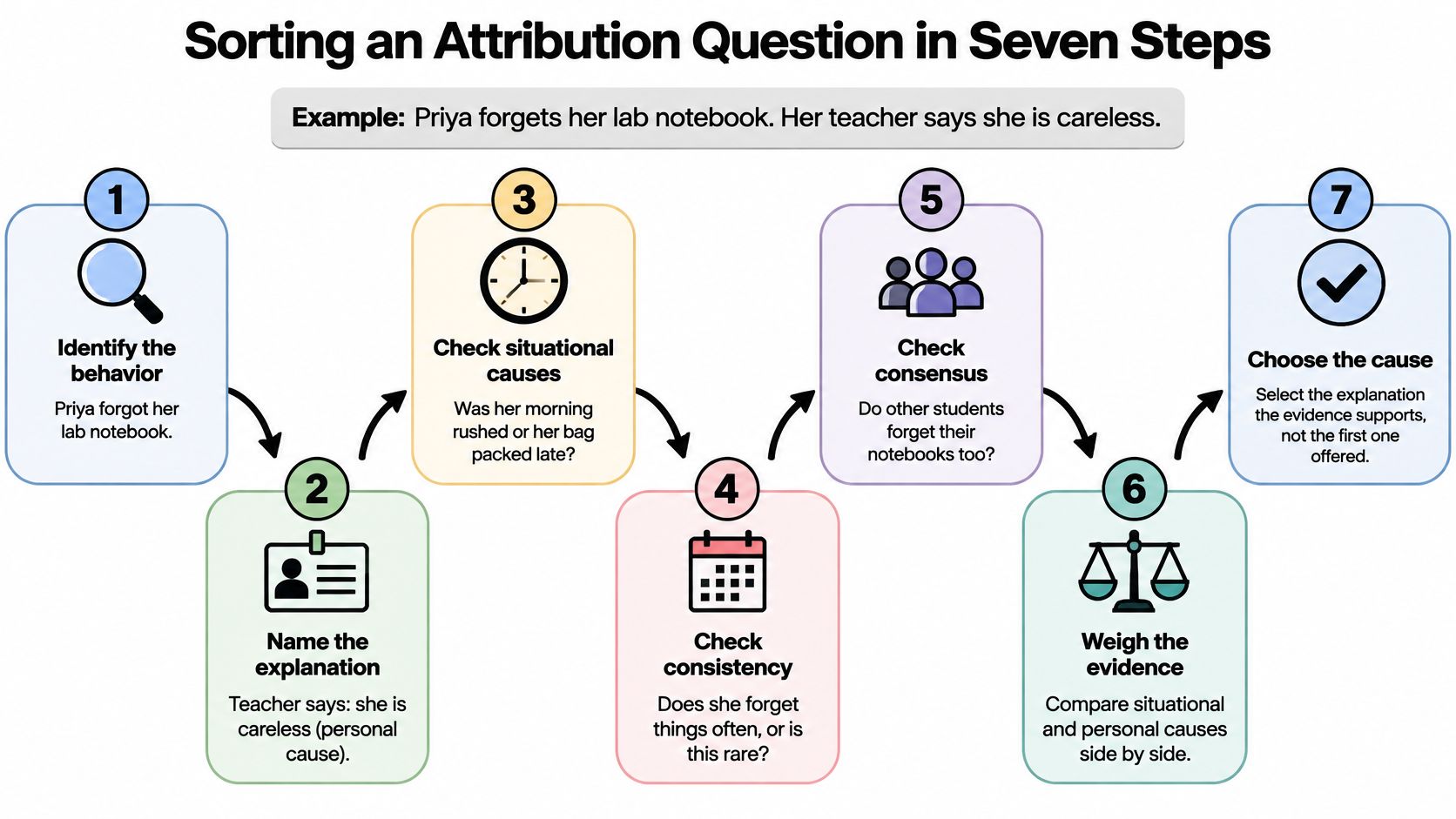
Working through the steps keeps the teacher's first interpretation labeled as a hypothesis rather than a fact. As noted earlier, the unit's core distinction sits between internal and external explanations, and every bias on the exam grows from how an observer handles that choice.
Where Classic Social Psychology Effects Break Down
“More people are present, so nobody helps” is too absolute. Classic social-psychology effects are better treated as probabilistic patterns, not promises about every person or situation. Think of an effect as a weather forecast: it can describe a tendency without guaranteeing what happens on one particular afternoon.
| Claim students make | Why it is incomplete | Stronger answer |
|---|---|---|
| Conformity always means weakness | People may use a group as an information source when they believe others know more | Ask whether the person seeks accurate information or social acceptance |
| The bystander effect always happens with more people | Help depends on ambiguity, perceived responsibility, danger, and relationships | Check whether the emergency is clear and who feels responsible |
| Groups always make worse decisions | Informational diversity, group norms, and dissent can change the outcome | Name the group's norms and whether members shared unique information |
| Liking a post proves an attitude | Online engagement isn't the same as a privately held attitude | State what was measured and what was only observed |
| The power of the situation explains everything | Personal values, prior knowledge, culture, and institutions can moderate behavior | Offer a situational and a personal explanation, then weigh them against the evidence |
Culture matters because expectations about individuals, groups, and social norms can shape how people interpret situations. A careful answer names the cultural setting it assumes rather than presenting one pattern as universal. Likewise, conformity isn't necessarily mindless compliance: if a person is unsure and believes the group has better information, matching the group may be a way of seeking an accurate answer.
Digital examples need the same precision. A like is an observable action, not direct access to a person's private attitude. An anonymous setting doesn't by itself prove deindividuation, and an online group's extreme views might reflect self-selection rather than a shift caused by discussion.
For lecture examples, ask what else could explain the behavior. Maybe group discussion influenced a decision, or perhaps people with similar views selected the same discussion space in the first place. Strengthen your answer by stating the alternatives and pointing to a timestamped lecture example or textbook passage that supports each one.
How to Turn Unit 9 Lectures Into Study Materials
Rewatching a lecture can feel productive because familiar material is easier to follow the second time. Exam questions ask for retrieval without the slide in front of you, so build materials that make you produce the distinction, name the mechanism, and cite the evidence.
Each lecture works like raw testimony: useful, but only after you check what it actually said. The common confusion is mistaking “I recognized the example” for “I can explain who applied pressure, what they demanded, and which condition would change the result.” Keep those skills separate.
-
Upload or record the lecture. Save the audio or video in whatever study tool you use, with clear labels for date, unit, and topic. Common formats include MP3, MP4, M4A, WAV, MOV, and WEBM.
-
Check the transcript against the slides. Match each relevant slide to a row in the topic map. Correct names or explanations the transcript misses, then mark the mechanism in the margin: source of pressure, required response, and observed behavior.
-
Create a summary and study guide. Generate a short summary plus a topic-organized guide from the transcript, then compare both with the original material. If a guide smooths over a disagreement or caveat, keep the caveat visible.
-
Make flashcards by topic. Create question-and-answer cards and fill-in-the-blank cards for each topic row. For targeted practice, use these psychology flashcard ideas so each card asks for the mechanism behind the term.
-
Ask source-grounded questions. Limit answers to your transcripts or course sources and request competing explanations with cited timestamps. Ask what evidence supports a situational explanation of a person's behavior, what evidence supports a personal explanation, and what boundary would weaken each claim.
-
Build comparison cards. Make one card for each easily confused pair, using the same fields: source of pressure, required response, moderator, and predicted behavior.
-
Review due cards and check readiness. Use spaced review for cards that are due, rating each one by whether you explained the mechanism and boundary accurately. Send weak topics back to step 2.
| Study output | What it helps you practise | What to verify |
|---|---|---|
| Transcript | Finding the lecture's wording | Names and key terms against the audio |
| Study guide | Reviewing explanations by topic | Whether it matches your course materials |
| Flashcards | Retrieving definitions and distinctions | Whether each answer tests a mechanism |
| Q&A response | Applying ideas to a scenario | Every cited timestamp against the recording |

Keep the loop small: one lecture, one mechanism, one verified example. When an answer sounds convincing, ask which condition would weaken it and where your course materials show that boundary.
Check Your Unit 9 Readiness Before the Exam
Run this check without your notes. Can you define each of the ten topic-map rows in your own words? Given an unfamiliar attribution vignette, can you sort it with the seven-step method in under a minute, naming who applies the pressure and what response it demands? For every classic effect, can you name one condition that weakens it?
Each missed item tells you exactly where to look next. Scan your lectures for a timestamped example of every shaky topic. If two or more topics give you trouble, skip the full re-read. Spend about 20 minutes asking questions about the weakest ideas, rebuild their comparison cards, and add flashcards for the confusions that keep resurfacing. The guide to generating study quizzes shows how to turn those review questions into another round of retrieval practice.
No study tool can guarantee an exam score. The goal is to recall concepts accurately and reason from the evidence in your actual course materials.
Today, upload the lecture for the topic you find hardest and ask one Q&A question about its boundary conditions. Check the cited timestamp against the recording, then explain the answer in your own words.
ClassLecture.ai turns lectures and course materials into transcripts, study guides, flashcards, and source-grounded Q&A with cited timestamps. Use it to practise distinguishing social-psychology mechanisms with evidence from your own class, and visit ClassLecture.ai to get started.
The ClassLecture.ai Team
We build ClassLecture.ai, the AI study assistant that turns your recorded lectures into transcripts, summaries, flashcards, and answers cited to the exact timestamp — so you learn faster from your own professor's words.
Keep reading
Flashcards Questions Answers: 8 Proven Examples
Explore 8 proven flashcards questions answers examples—from Leitner boxes to AI-generated Q&A cards made from your own lecture transcripts.
ReadMeeting Recording and Transcription for Smarter Study
Learn how meeting recording and transcription turns lectures and study groups into searchable, timestamped transcripts you can question, summarize, and export.
ReadPolyatomic Ions Flashcards for Better Chemistry Recall
Use polyatomic ions flashcards to learn formulas, names, charges, charge-balancing rules, and spaced-repetition study routines for introductory chemistry.
Read