Polyatomic Ions Flashcards for Better Chemistry Recall
Use polyatomic ions flashcards to learn formulas, names, charges, charge-balancing rules, and spaced-repetition study routines for introductory chemistry.

You turn over a flashcard, see sulfate, and immediately remember SO₄²⁻. Then your homework asks for calcium sulfate, and you hesitate. Does the charge become a subscript? Do you need parentheses? Knowing the ion feels different from knowing what to do with it.
Good polyatomic ions flashcards should help you cross that gap. Start with names, formulas, and charges, then practice building compounds, comparing related ions, and explaining mistakes. You don't need to stare harder at a crowded reference sheet. You need cards that ask you to use what you remember.
Table of Contents
- Why Recognition Alone Is Not Enough
- Learn the Notation Before the Ions
- Organize Common Ions by Chemistry Family
- Build the Core Formula and Name Deck
- Practice Formula Construction and Charge Balance
- Separate Easily Confused Ion Pairs
- Import the Deck into a Spaced Repetition Tool
- Build a Review Routine That Improves Recall
- Cross-Reference Ions With Course Tasks
- Use the Quick Reference and Self-Test
Why Recognition Alone Is Not Enough
Recognizing ammonium, nitrate, or sulfate is a useful beginning. But a correct answer on a matching card doesn't tell you whether you can write a compound formula without help. The missing skill is often the connection between an ion's identity and its role in a neutral compound.
That distinction deserves attention. A reported assessment found that 88.3% of surveyed students acknowledged misconceptions about polyatomic-ion valencies, with naming and writing oxoanion formulas remaining particularly difficult, as described in the polyatomic-ion assessment discussion.
The familiar study-table moment looks like this:

Make every card serve a purpose
Build a deck that lets you move among different tasks:
- Recognition: Identify an ion from its formula.
- Recall: Write its formula and charge from its name.
- Construction: Use the ion in a compound.
- Diagnosis: Explain why a plausible answer is incorrect.
For introductory chemistry, nursing, and allied-health learners, this means keeping the deck connected to the nomenclature questions in your own course. Your instructor's required list should determine which entries you study.
Use family cards when the list feels disconnected, detailed cards when a formula slips, and contrast cards when similar names blur together. You don't have to review every entry in order. Choose the card type that addresses the mistake you're making.
Learn the Notation Before the Ions
A polyatomic ion is a charged collection of atoms that acts as a unit. A monatomic ion contains a single atom; a polyatomic ion contains multiple atoms. When reading its formula, separate the atom counts from the charge.
In SO₄²⁻, the lowered ₄ tells you how many oxygen atoms belong to the ion. The raised ²⁻ gives the charge of the entire sulfate ion. It doesn't mean there are extra oxygen atoms, and it doesn't apply only to the final oxygen.
Use the diagram to separate these visual jobs:
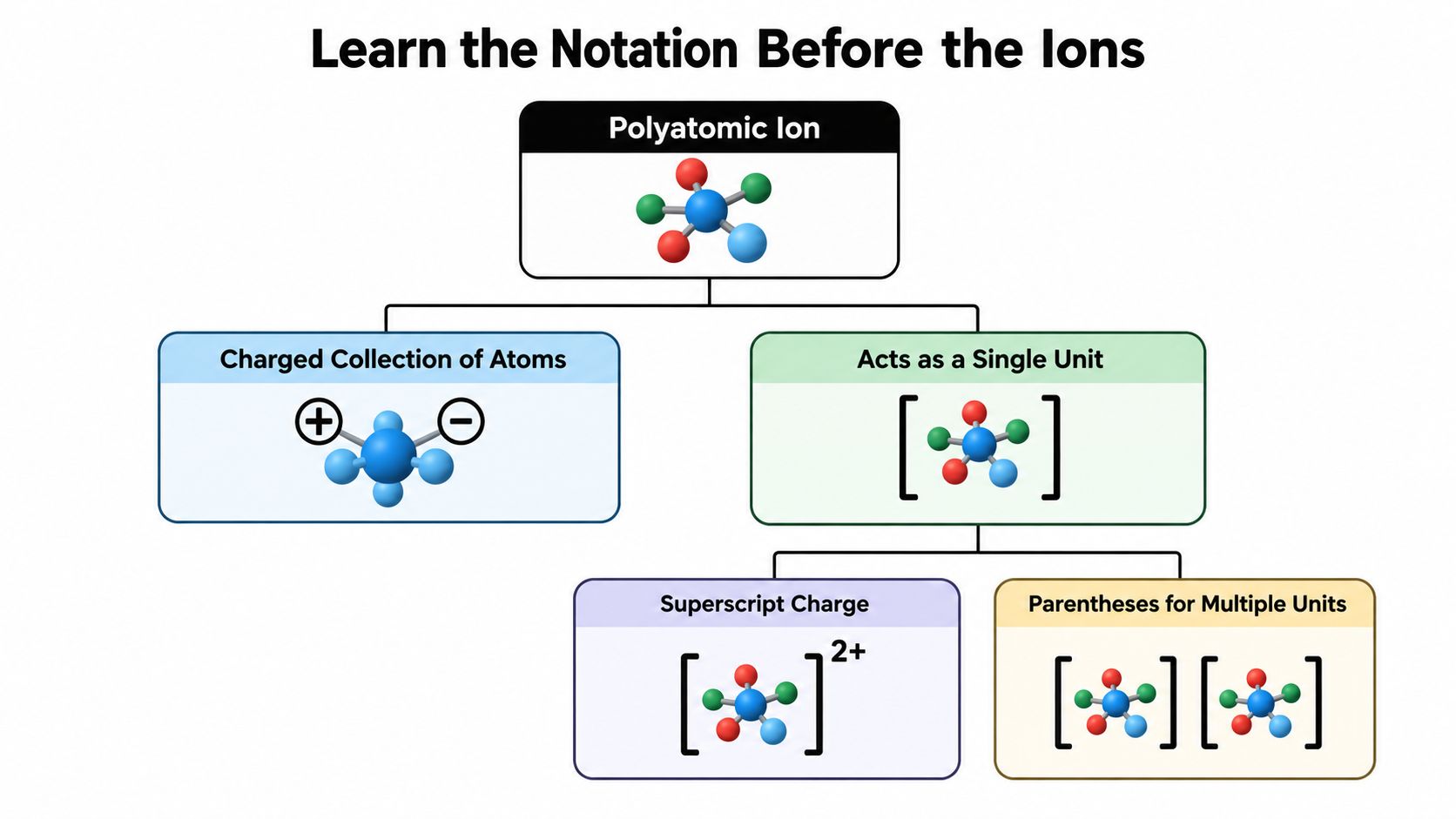
Read the position before the number
| Notation | What to read |
|---|---|
| SO₄²⁻ | A sulfate ion, including its overall charge |
| (SO₄)₂ | Multiple sulfate groups within a larger formula |
| (SO₄)²⁻ | A parenthesized sulfate group with a superscript charge, not multiple sulfate groups |
The important distinction is where the number sits. Adding parentheses around SO₄²⁻ doesn't multiply the ion. A subscript outside the closing parenthesis does that.
In a compound formula, parentheses show which atoms belong to a repeated group. Keep that group intact rather than changing the ion's internal subscripts.
Notation check: Before naming an unfamiliar formula, identify which marks count atoms, which count groups, and which indicate charge.
Try this learner check: in NH₄⁺, which mark counts hydrogen atoms, and which mark describes the ion's charge? The lowered mark counts hydrogen; the raised plus sign describes the whole ion.
Make the charge part of every answer. If you recall the atom pattern but omit the charge, you haven't yet retrieved everything needed for compound construction.
Organize Common Ions by Chemistry Family
An alphabetical list helps you find a name. A family-based list helps you compare formulas. Group related entries so that you can notice what stays the same and identify exactly what changes.
Use this map as a visual index, then check each formula against your course list:
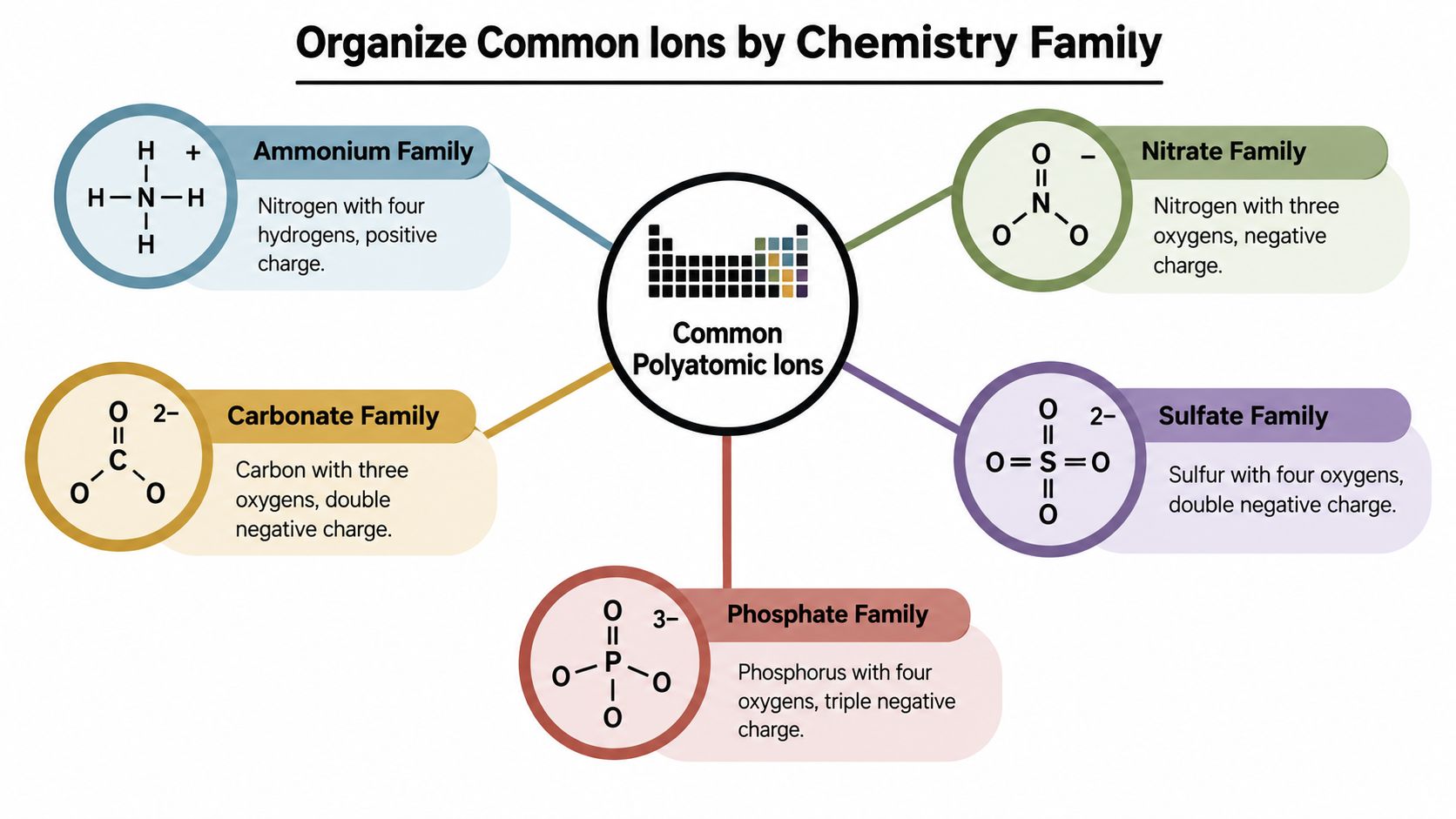
Give each group a recognizable cue
- Ammonium: Connect the nitrogen-and-hydrogen composition with a positive charge. Don't place it with nitrate just because both contain nitrogen.
- Nitrate and nitrite: Keep the nitrogen-and-oxygen formulas together so you can compare their oxygen counts.
- Sulfate and sulfite: Use sulfur as the family cue, then retrieve the complete formula rather than stopping at the central atom.
- Carbonate family: Connect carbonate with hydrogen carbonate, also called bicarbonate, while keeping their charges distinct.
- Phosphate family: Group phosphate with the hydrogen-containing phosphate ions your instructor requires.
For other common oxoanions on your syllabus, create separate family tags instead of forcing them into these categories. Hydroxide can remain a standalone core entry.
This is a study organization, not a claim that every ion containing the same element behaves identically. Family membership gives you a place to begin retrieval; it doesn't replace the exact formula.
The related functional-group flashcards guide offers another context for organizing chemistry study material around recognizable groups. Keep those cards separate from your ion deck so the questions remain precise.
Use the video as an additional review resource, with your required ion list beside you:

Finish a family review by asking yourself: Which required ions contain nitrogen? Which contain sulfur? Which family includes hydrogen-containing variants?
Answer with full formulas and charges. Naming the central element alone is only a navigation cue, not a complete response.
Build the Core Formula and Name Deck
Start with a selective core deck, not every ion you can find online. The table below supplies a reusable starting set. Keep the entries your instructor requires, then extend the same format when your course introduces another ion.
Give every entry a stable identifier. That identifier lets you connect a recognition card to a contrast question or worked problem without copying the full explanation onto every card.
Core Polyatomic Ions Flashcard Reference
| Card ID | Name | Formula With Charge | Family | Practice Prompt |
|---|---|---|---|---|
| AMM | Ammonium | NH₄⁺ | Ammonium | Write ammonium's formula and charge. |
| HYD | Hydroxide | OH⁻ | Standalone core ion | Name OH⁻. |
| NIT-A | Nitrate | NO₃⁻ | Nitrogen oxoanions | Complete nitrate's formula, including charge. |
| NIT-I | Nitrite | NO₂⁻ | Nitrogen oxoanions | Write nitrite without looking at nitrate. |
| SUL-A | Sulfate | SO₄²⁻ | Sulfur oxoanions | Name SO₄²⁻. |
| SUL-I | Sulfite | SO₃²⁻ | Sulfur oxoanions | Write sulfite's formula and charge. |
| CAR | Carbonate | CO₃²⁻ | Carbonate | Recall carbonate from its name. |
| HCAR | Hydrogen carbonate, bicarbonate | HCO₃⁻ | Carbonate | Name HCO₃⁻ using your course convention. |
| PHO | Phosphate | PO₄³⁻ | Phosphate | Write phosphate's complete ion formula. |
| HPHO | Hydrogen phosphate | HPO₄²⁻ | Phosphate | Name HPO₄²⁻. |
| DHPHO | Dihydrogen phosphate | H₂PO₄⁻ | Phosphate | Recall the formula from the full name. |
Make the cue unambiguous
A useful front asks for a specific response. Write sulfate's formula and charge is clearer than Tell me about sulfate. The first prompt has a definite answer; the second could invite a name, an atom count, a charge, or an unrelated explanation.
Keep the back compact. For SUL-A, use the formula, family tag, and a short reminder to inspect the superscript. Put a longer explanation on a separate diagnostic card if you need it.
You can also create a completion variant:
Front: Complete the charge in SO₄__ for sulfate.
Back: SO₄²⁻. Retrieve the charge with the ion, not as an optional extra.
That card targets charge recall. It doesn't replace a card that asks you to produce the whole formula without visible clues.
For HYD, a compact application note might say used in Ca(OH)₂. For CAR, it might say compare with HCAR. These are navigation aids, not extra questions you must answer on every review.
Control alternate names
Use the naming conventions taught in your course. The carbonate entry explicitly includes hydrogen carbonate and bicarbonate, but don't add guessed alternate names to other cards.
If your notes use a different notation, record the source location beside the entry and ask your instructor when the difference matters. Don't combine conflicting lists without checking first.
Before adding more material, test whether you can answer each core card from its stated cue. A small, precise deck is easier to diagnose than a large collection of cards whose expected answers keep changing.
Practice Formula Construction and Charge Balance
Consider calcium hydroxide. You're given Ca²⁺ and recall OH⁻. The task isn't to attach their symbols in sequence. It's to choose amounts that make a neutral compound while preserving hydroxide as a group.
The construction process looks like this:
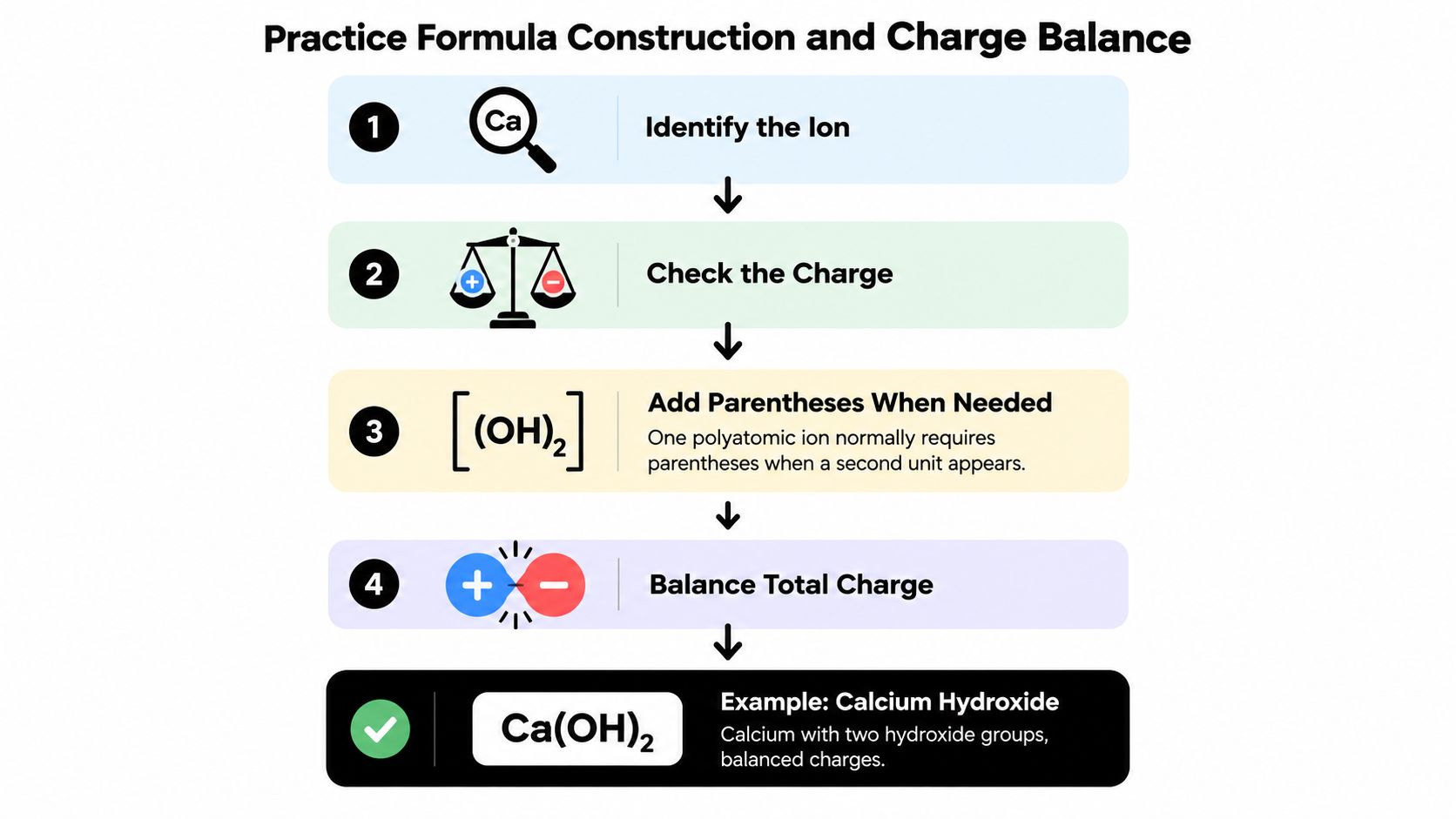
Work through calcium hydroxide
Calcium contributes a positive charge of two. Each hydroxide contributes a negative charge of one, so calcium needs two hydroxide groups to balance it. Write Ca(OH)₂.
The outside subscript applies to the entire OH group. By contrast, CaOH₂ places the subscript only after hydrogen. It doesn't represent the required repeated hydroxide group, so it's incorrect for calcium hydroxide.
Notice what you didn't change: hydroxide's internal composition. You adjusted how many hydroxide groups appear, not what hydroxide is.
Preserve the ion first. Adjust the number of whole ions second.
Turn the reasoning into application cards
| Card prompt | Worked answer |
|---|---|
| Why is Ca(OH)₂ correct but CaOH₂ incorrect? | Calcium requires repeated hydroxide groups. Parentheses make the outside subscript apply to OH together. |
| Complete Ca(OH)__ using Ca²⁺ and OH⁻. | Ca(OH)₂. The total positive and negative charges cancel. |
| Write a compound from Na⁺ and NO₃⁻. | NaNO₃. Their charges balance without repeating nitrate. |
| Write a compound from Ca²⁺ and NO₃⁻. | Ca(NO₃)₂. Nitrate repeats as a whole group. |
| Write a compound from NH₄⁺ and SO₄²⁻. | (NH₄)₂SO₄. Ammonium repeats; sulfate doesn't. |
Keep these worked answers visible while you're learning the method. Once the reasoning is familiar, hide the solution and require yourself to explain the choice before revealing it.
A useful error card asks, What exactly did the writer change incorrectly? That is more diagnostic than asking only whether a formula is right or wrong.
For example, if you write CaNO₃ for calcium nitrate, ask whether you forgot nitrate's charge or failed to use the charge you already knew. Those are different problems and deserve different follow-up cards.
Finish each construction problem with an independent check: identify the groups you wrote, count their contributions, and confirm that the total charge cancels. Don't judge a formula merely by whether it resembles an answer you've seen before.
Separate Easily Confused Ion Pairs
Sulfate and sulfite look similar because they're related. That similarity is precisely why they belong on a contrast card, where you must identify the difference rather than recognize either formula in isolation.
Avoid a prompt such as Which sulfur ion is this? It leaves too much unspecified. Ask for the name, complete formula, charge, or a particular comparison.
Common Ion Pairs Learners Confuse
| Ion Pair | Formulas and Charges | Key Distinction | Flashcard Prompt |
|---|---|---|---|
| Sulfate and sulfite | SO₄²⁻; SO₃²⁻ | Different oxygen counts, same charge | Which formula is sulfite, and what changed? |
| Carbonate and bicarbonate | CO₃²⁻; HCO₃⁻ | Hydrogen appears and the charge differs | Write bicarbonate, then identify both differences from carbonate. |
| Nitrate and nitrite | NO₃⁻; NO₂⁻ | Different oxygen counts, same charge | Name NO₂⁻ without looking at the paired name. |
| Phosphate and hydrogen phosphate | PO₄³⁻; HPO₄²⁻ | Hydrogen appears and the charge differs | Which formula includes hydrogen, and what is its charge? |
Compare only what the pair supports
For the sulfate/sulfite and nitrate/nitrite pairs, -ite has fewer oxygen atoms than -ate, while the charge stays the same within each pair. Don't turn that observation into the mistaken rule that every ion ending in -ate has the same oxygen count or charge.
Hydrogen-containing contrasts require a different question. For carbonate versus bicarbonate, check both the added hydrogen and the changed charge. Looking only for H leaves the answer incomplete.
Use a distractor to expose partial recall. If a prompt asks for sulfate and you answer SO₃²⁻, you remembered sulfur and the charge, but selected sulfite's oxygen count. Your correction card should target that distinction rather than send you back through the whole deck.
Reverse the task as well:
- Name first: Write nitrite's formula without a visible comparison.
- Formula first: Name HPO₄²⁻ precisely.
- Explanation first: State what distinguishes the requested pair before writing either formula.
Tag the sulfur contrast with SUL-A and SUL-I, the nitrogen contrast with NIT-A and NIT-I, the carbonate contrast with CAR and HCAR, and the phosphate contrast with PHO and HPHO. Those connections let you return to the exact core entry when a comparison exposes a gap.
Import the Deck into a Spaced Repetition Tool
Prepare your cards in a spreadsheet before importing them. Use a Front field for the question and a Back field for the expected answer. Keep identifiers and family tags in separate fields if your chosen tool supports them.
Don't assume that an attractive spreadsheet will import correctly. Field separators, formatting controls, image handling, and reverse-card settings differ among products, so consult your tool's import instructions before transferring the complete deck.
Use a consistent copy pattern
| Field | Example content |
|---|---|
| ID | SUL-A |
| Front | Write sulfate's formula and charge. |
| Back | SO₄²⁻. Family: sulfur oxoanions. Application reference: calcium sulfate construction card. |
| Tags | sulfur; core; name-to-formula |
| Source | Your lecture title and the relevant page or timestamp |
For a formula-first variant, put Name SO₄²⁻ on the front and Sulfate on the back. Keep it as a separate card rather than expecting yourself to practice both directions mentally from the same prompt.
The AI flashcards maker guide provides a related workflow for creating cards from study materials. Whether you generate cards or type them yourself, inspect their wording and chemistry before treating them as a review set.
Test the formatting before expanding
Import a small sample that includes a positive ion, a negative ion, and a compound containing parentheses. Open the actual review screen rather than checking only the editor.
- Inspect typography: Confirm that subscripts and superscripts remain distinguishable.
- Check field placement: Make sure the answer hasn't appeared on the front.
- Test reversals: Verify that a reverse card asks a meaningful question.
- Preserve references: Confirm that identifiers and source notes remain accessible.
If your tool can't display the preferred notation, adopt an explicit fallback such as SO4, charge 2−. Don't leave a plain-text number in a position where you might mistake it for either an atom count or a charge.
Build a Review Routine That Improves Recall
A review session should reveal what you can produce without help, not how familiar the answers look. Begin with due cards, read the prompt, and commit to an answer before revealing the back. For formula questions, write the notation rather than imagining a vague visual shape.
Keep different task types in the review queue. A name-to-formula card tests a different response from a construction problem or an error explanation. Don't substitute repeated success on the easiest type for practice on the others.
Rate the answer you actually gave
If you're using an FSRS-based workflow with Again, Hard, Good, and Easy, apply the ratings to your response rather than your confidence after seeing the answer.
- Again: You couldn't retrieve the answer, or your answer was wrong.
- Hard: You retrieved the correct answer with substantial difficulty.
- Good: You answered correctly with manageable effort.
- Easy: You retrieved the complete answer readily.
A missing charge is still a missing part of a formula-and-charge answer. Don't promote an incomplete response because you recognized the correction immediately.
For scheduling context, the spaced-repetition flashcards guide explains a related review approach. Let your chosen system manage review timing while you focus on honest responses and useful corrections.
Rewrite cards that hide the problem
Question-and-answer cards suit explanations. Fill-in-the-blank cards can isolate a missing charge, name, or subscript. Choose the format according to what you need to diagnose, not to add variety.
If you repeatedly miss a card, pause and inspect it. Does the question have a definite answer? Does the back explain the error? Have you combined several unrelated tasks on a single front?
Review decision: When a card keeps failing, inspect the prompt before adding more repetitions.
Use your lecture or textbook to resolve uncertainty, and save its page or timestamp in the card's source field. A generated answer should remain something you can verify, not a replacement for the material your instructor assigned.
End the session by repairing the troublesome card. Rereading the same unclear prompt won't tell you whether the difficulty came from chemistry, notation, or wording.
Cross-Reference Ions With Course Tasks
A useful deck connects each ion to the work you're expected to complete. Keep the core identity card stable, then attach separate application cards based on lecture examples, assigned nomenclature exercises, and corrections from your homework.
That separation matters. If you add every new problem to the back of a core card, a simple recall question becomes an unpredictable mini-exam.
Match the card to the assignment
| Course task | Card to create | Reference to retain |
|---|---|---|
| Name an ion from its formula | Formula-to-name question | Core card ID and family |
| Write a compound from given ions | Construction problem | IDs for each polyatomic ion used |
| Correct a formula | Error-diagnosis question | Relevant construction example |
| Distinguish similar answer choices | Contrast question | Both ion IDs and their family |
| Explain an instructor's convention | Course-specific question | Original page or timestamp |
A calcium nitrate application card can point to NIT-A and the nitrogen oxoanion family. An ammonium sulfate card can point to AMM, SUL-A, and their respective families. Keep those references on the back so they don't reveal the answer prematurely.
Preserve the original context
When adapting a lecture example, record the exact question your instructor asked. A task about naming an ion isn't interchangeable with a task about naming an entire compound.
Attach the lecture title and timestamp, or the document title and page. If the instructor supplied the cation's charge in the original problem, preserve that information unless retrieving it is deliberately part of your new task.
- Keep the scope: Include the ions required for your class.
- Retain conventions: Use the notation and naming forms your instructor expects.
- Check generated variants: Verify every new formula and answer against the underlying method.
- Separate uncertainty: Flag unresolved discrepancies instead of memorizing competing answers.
The outcome should be a connected set of course-specific questions, not an ever-expanding generic chemistry deck. Each added card should address a recognizable assignment skill or a mistake you've made.
Use the Quick Reference and Self-Test
When you need a rapid lookup, start with the chemistry family, then locate the exact entry in the core table. If similar names are causing trouble, consult the contrast table. Finish by attempting an application card without looking at its worked answer.
Use reference material to resolve uncertainty, then close it before testing yourself. Otherwise, you're checking whether you can locate an answer rather than retrieve it.
Try a mixed self-test
| Prompt | Answer to check afterward |
|---|---|
| Write ammonium's formula and charge. | NH₄⁺ |
| Name NO₂⁻. | Nitrite |
| Does calcium hydroxide need parentheses around hydroxide? | Yes, Ca(OH)₂. |
| Is NaNO₃ charge-balanced using Na⁺ and NO₃⁻? | Yes. |
| Which is sulfate, SO₄²⁻ or SO₃²⁻? | SO₄²⁻. |
For the construction questions, explain your answer aloud or in writing. A correct formula obtained by guessing doesn't provide the same evidence of understanding as a formula you can justify.
Correct the specific miss
- Wrong name: Revisit the corresponding core or contrast card.
- Wrong charge: Practice the complete ion response.
- Wrong parentheses: Return to the worked construction card.
- Unclear convention: Check the original course material.
Mark the missed card for another review and add a brief correction in your own words. Don't restart the entire list because a particular pair remains confusing.
Your polyatomic ions flashcards are doing useful work when you can retrieve the ion and apply it without visible cues. Keep checking course-specific expectations in the original materials, even as your independent recall becomes more reliable.
ClassLecture.ai offers question-and-answer and fill-in-the-blank flashcards from uploaded study materials, alongside spaced-repetition review. Visit ClassLecture.ai to turn your polyatomic-ion lecture notes into practice cards, then verify the formulas against your course materials and add construction and error-correction prompts where you need them.
The ClassLecture.ai Team
We build ClassLecture.ai, the AI study assistant that turns your recorded lectures into transcripts, summaries, flashcards, and answers cited to the exact timestamp — so you learn faster from your own professor's words.
Keep reading
AP World History Flashcards That Build Real Exam Skills
AP World History flashcards organized by the four periods and six themes, with spaced repetition tips, source-based prompts, and a clear import workflow.
ReadHow to Study for AP Psychology That Actually Works
Learn how to study for AP Psychology with a research-backed plan that covers the five units, MCQ skills, FRQs, and spaced retrieval practice.
Read10 Best AP Government Flashcards for 2026 Exam Prep
Explore 10 AP Government flashcards from top study platforms, with import tips, usage guidance, and spaced-repetition practice for 2026 exam review.
Read