Spaced Repetition Flashcards: A Complete Guide for 2026
Master any subject with spaced repetition flashcards. Learn the science-backed strategy to improve memory and ace your exams in 2026.
Learners who distributed practice across five sessions achieved a 5.1× improvement in retention after 36 hours compared with massed study. Spaced repetition flashcards work because they make you retrieve information after a delay, not because they give you more chances to look at it.
That result challenges the way most students revise. Rewatching a lecture can feel calm, organised, and productive, yet familiarity is a poor test of whether you can recall an answer under exam pressure. The practical question isn't how much content you've seen. It's whether you can produce the answer when the slide, transcript, or textbook is closed.
Table of Contents
- Why Spaced Repetition Beats Cramming
- The Science Behind the Method
- How Algorithms Like FSRS Schedule Reviews
- Evidence from High-Stakes Learning Environments
- Beyond Recall and Its Limits
- Building a Spaced Repetition Workflow with ClassLecture.ai
- Optimizing for Different Subjects and Schedules
Why Spaced Repetition Beats Cramming
Distributed practice across five sessions produced a 5.1× retention improvement after 36 hours compared with massed study in a controlled flashcard study. The same research found a 1.9× improvement after 12 hours, which shows why spacing matters even inside a short revision window. A 2022 review of spacing research connects these findings to the broader evidence behind modern flashcards, as detailed in the next section.
A student who watches a recorded pharmacology lecture twice may recognise every drug name on a practice page. Ask that student to explain the mechanism without notes, and the confidence can disappear. The lecture created familiarity. It did not guarantee accessible memory.
Practical rule: If you can only answer after seeing the first few words, you recognised the material. You did not fully retrieve it.
Recognition is not recall
Cramming piles exposure into one block and reduces the need to retrieve. You read the definition, see the diagram, and feel that the content makes sense. Because the material stays visible, the task feels easier than it really is.
A flashcard removes that support. The prompt asks you to produce an answer, separate similar concepts, or complete a missing step. That effort is uncomfortable on purpose. When you check the answer, you get direct feedback about what you know and what still needs work.
This changes the role of a lecture recording. It becomes source material for active study, not the study session itself. A useful workflow turns a lecture into concise questions, tests those questions, and schedules difficult cards for another encounter after enough time has passed for retrieval to require effort.
What to do with limited study time
Do not turn every sentence of a lecture into a card. Extract the definitions, mechanisms, distinctions, processes, and likely exam prompts you need to recall independently. Then rate your answer accurately. A card you guessed is not the same as a card you knew.
The sequence is simple:
- Read a focused prompt.
- Answer before revealing the back.
- Check the source-grounded answer.
- Mark the card according to recall quality.
- Return when the schedule says the memory needs another test.
That process feels less fluent than rereading, but it gives a better picture of exam readiness. Students with crowded schedules need that accuracy. A comfortable revision session can hide gaps until the assessment exposes them.

The Science Behind the Method
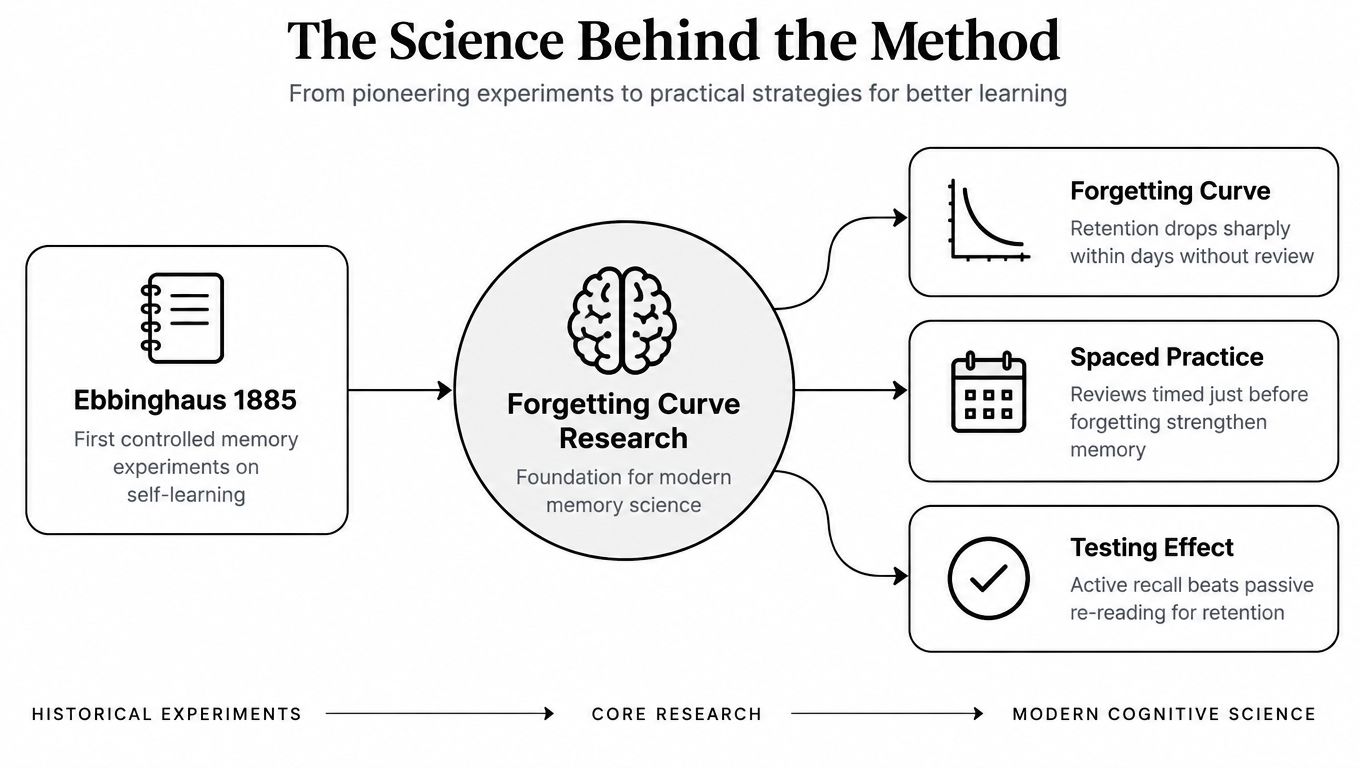
The core idea predates modern flashcard apps. Hermann Ebbinghaus showed in 1885 that review timing changes what people retain, which is why spacing matters at all. The useful takeaway is practical, not mystical. A memory that is left alone becomes harder to pull up, while a well-timed retrieval strengthens access.
Massed practice and distributed practice work differently. When reviews sit close together, the material still feels fresh and recognition does much of the work. When reviews are separated, the learner has to rebuild the answer with less support, and that effort gives the brain a better test of whether the knowledge is really there.
Why the delay matters
A review right after reading mostly checks familiarity. A review after a meaningful delay asks the harder question, can you retrieve the answer without the page or slide in front of you? The best interval depends on the card and the learner, but the mechanism stays the same. Reviews need enough forgetting pressure to force recall, while stopping short of complete loss.
A large 2022 review reported that 87% of the 323 studies summarised by Cepeda and colleagues used inter-study intervals shorter than one day. The published review of spacing research also says the spacing effect appears across many delay lengths. Students often assume spacing only means revisiting material later the same day. It can, but durable study plans usually spread reviews across days or weeks.
For a practical explanation of retrieval practice, interleaving, and related methods, see effective learning techniques.
Retrieval, consolidation, and feedback
Spacing does not work through delay alone. The learner has to attempt retrieval and then receive feedback. A card you flip through quickly is closer to rereading than testing. A card that forces you to generate an answer, compare it with a reliable explanation, and judge it accurately gives the schedule useful information.
Sleep and the time between sessions also support consolidation. You do not need to explain every memory process to use the method well. You do need to separate exposure from performance. If a student can recognise a term but cannot define it, apply it, or distinguish it from a nearby concept, the card has exposed a real gap.
That is the practical value of the method. It shows where confidence is ahead of retention, and it keeps study time focused on what still needs work.
How Algorithms Like FSRS Schedule Reviews
A spaced-repetition scheduler answers a deceptively difficult question: when should this card appear again? It uses your review history, your rating, and assumptions about how quickly the memory is likely to weaken. The aim isn't to show every card as often as possible. It's to allocate review time where another retrieval is useful.
Older systems such as SM-2 use heuristic rules. A card's interval changes according to review ratings and an ease factor. This approach is understandable and effective enough for many learners, but it treats scheduling as a formula applied to review outcomes. It doesn't model every card and learner relationship with the same level of flexibility.
FSRS, or Free Spaced Repetition Scheduler, takes a more adaptive approach. It aims to estimate card difficulty and forgetting probability, then predict an interval that balances retention against workload. In practical terms, the algorithm behaves less like a fixed calendar and more like a personal trainer who changes the next workout after seeing how you recovered from the last one.
What the scheduler learns from you
Suppose you answer a card correctly after a long delay. That review suggests the card can tolerate a wider interval. If you fail a card that looked easy before, the system has new evidence that its previous schedule was too optimistic, or that the card itself needs rewriting.
Your ratings therefore matter:
- Again signals that the answer wasn't available and the card needs prompt recovery.
- Hard indicates partial or effortful recall that shouldn't receive the same interval as fluent recall.
- Good represents successful retrieval at a normal level of difficulty.
- Easy tells the scheduler that the card was retrieved with little strain.
Community and benchmark reporting indicates that FSRS can reduce required reviews by about 20% to 30% while maintaining the same retention rate, and that tested collections showed lower prediction error than SM-2 in 99.6% of cases. The FSRS and SM-2 comparison provides that reported benchmark context.
How to use an algorithm without surrendering judgment
Don't treat the schedule as an unquestionable authority. A badly written card can produce misleading ratings, and a card that tests several ideas at once may feel difficult for the wrong reason. Split compound prompts, add context where confusion is predictable, and edit answers that aren't precise enough to verify.
The algorithm is most useful when the input is clean and your ratings are honest. Avoid pressing “Easy” because you want the queue to shrink. Avoid pressing “Again” because you dislike the topic. A scheduler can estimate memory behaviour, but it can't understand a vague lecture note or decide whether you need a worked example before memorising a formula.
Evidence from High-Stakes Learning Environments
Spaced repetition has practical value where students must retain dense material over time, not just perform well on a short laboratory task. A nationwide quasi-experiment followed 799 first-year nursing students across 19 Norwegian campuses. Digital flashcard users significantly outperformed non-users on the final exam, with an effect size of d = 0.42. They were nearly three times more likely to pass, with an odds ratio of 2.84, and more than twice as likely to earn the highest grade, with an odds ratio of 2.31. The large nursing education study reports these outcomes.
The setting matters. Nursing students work through cumulative terminology, mechanisms, and tightly connected concepts. A missed detail can weaken later reasoning, so a review system that exposes forgotten material has value beyond helping students recognise familiar words. Digital cards do not replace clinical judgement or application. They strengthen the knowledge base those activities require.
A second test in medical education
A separate randomised study included 26,258 family physicians and residents. Spaced repetition produced stronger results than no spaced repetition at both a later learning checkpoint and a subsequent knowledge-transfer checkpoint. The same medical education research reports both comparisons.
That distinction matters for implementation. A scheduler can help a learner retain information for a later assessment, while professional performance still depends on interpretation, prioritisation, communication, and action. Flashcards work best as the foundation of a wider sequence: an AI tool can turn lecture material into candidate cards, an algorithm such as FSRS or SM-2 can schedule retrieval, and the learner can then test the knowledge with cases, simulations, written explanations, or practice questions.
What this means for ordinary coursework
Students do not need to prepare for a professional licence to use the same structure. In a lecture-heavy undergraduate course, information often arrives faster than it can be retained reliably. Spaced cards create a recurring review queue, making forgotten material visible before the exam rather than during it.
Use the evidence to test the method, not to promise a particular grade. The practical conclusion is narrower and more useful: when an assessment depends on durable recall, distributed retrieval deserves a defined place in the study plan. Track whether the cards help you answer without cues, and reserve study time for application instead of mistaking a full review queue for complete preparation.
Beyond Recall and Its Limits
Spaced repetition strengthens foundational knowledge, but it cannot replace practice that resembles the assessment or real task. A card can help you remember a vocabulary definition, anatomical structure, safety principle, or accounting concept. It cannot ensure that you speak naturally, write persuasively, diagnose a case, or select the right procedure in an unfamiliar situation.
A systematic review of second-language learning from 2015 to 2025 found that digital flashcards with spaced repetition consistently improved receptive vocabulary, while producing limited gains in speaking and writing. The review of digital flashcards in language learning also warned against relying too heavily on visual cues. Recognising a translation on a card is different from producing the right word during conversation.
Match the tool to the outcome
Choose card types according to what the exam or real-world task demands:
- Recall: Use concise cards for definitions, classifications, formulas, terminology, and key relationships.
- Explanation: Ask yourself to compare concepts or explain a mechanism in your own words.
- Application: Follow review with cases, worked problems, scenarios, or practice questions.
- Production: Speak, write, draw, calculate, or perform the procedure without card support.
A medical meta-analysis found a strong overall benefit for objective tests, while calling for more research into card design, delivery, and long-term performance. That finding supports a measured interpretation. Flashcards can improve the knowledge that objective assessments capture, while leaving important parts of professional competence to other forms of practice.
The algorithm matters, too. FSRS or SM-2 can decide when a card returns, but neither scheduler determines whether the prompt represents the right skill. An AI lecture workflow may generate a useful recall card, yet the learner still needs to convert important cards into explanation, application, or production tasks.
The best deck is not the largest one. It is a memory layer inside a wider workflow: understand the lecture, retain the required knowledge, then practise the performance the assessment demands.

Building a Spaced Repetition Workflow with ClassLecture.ai
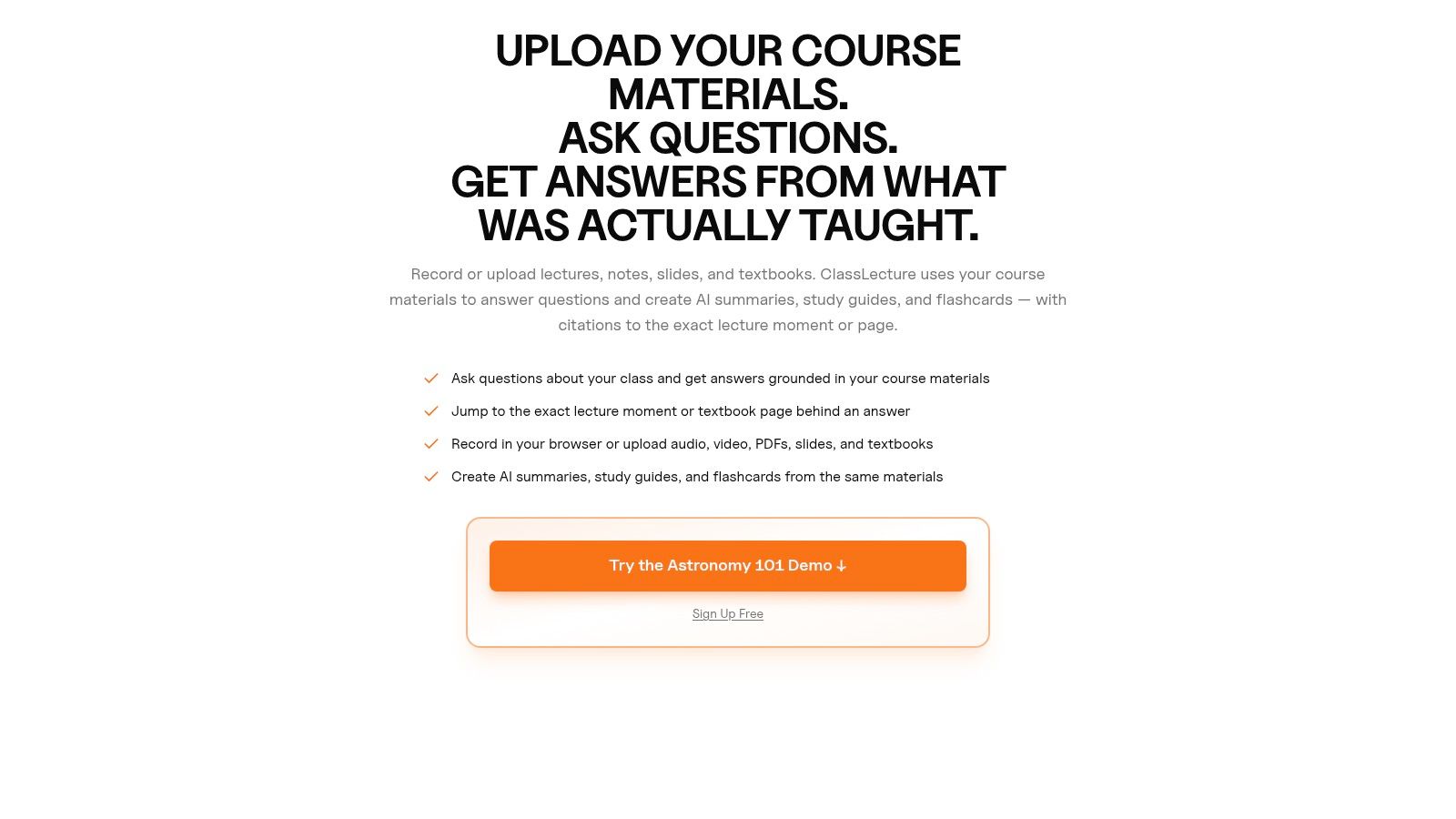
A practical workflow starts with the material you already have. Upload a lecture recording, transcript, textbook, PDF, or notes into an AI study platform, then generate cards from the source rather than from a generic summary. Source-grounded prompts make it easier to check whether a card reflects what your instructor taught.
The platform can process lecture and course materials, generate question-and-answer or fill-in-the-blank cards, and organise them by class. It also supports bulk uploads, source-scope selection, and an exam-readiness view, so you can separate transcript content from textbook notes when a question needs a narrower evidence base.
A reliable lecture-to-review loop
- Collect the source. Upload the recording, notes, or reading for one class. Keep different courses and topics organised so the generated cards retain context.
- Generate a first deck. Ask for focused prompts that test one idea at a time. Remove duplicates, vague questions, and cards whose answers are too broad.
- Verify against the source. Check the transcript, page reference, or lecture context before accepting a card. AI can accelerate card creation, but source checking protects you from learning an inaccurate simplification.
- Review with active recall. Answer aloud or in writing before revealing the response. Use the review ratings consistently so the FSRS scheduler receives useful feedback.
- Use the due queue. Review cards from across the class rather than repeatedly drilling only the newest lecture. The exam-readiness widget can help identify where your review coverage is uneven.
For a more detailed approach to converting notes into usable prompts, follow this guide to flashcards for study notes.
The tool should remove mechanical work, not remove your judgement. If a card asks you to memorise a conclusion you don't understand, pause and use the lecture or source Q&A to resolve the concept. Then revise the card so it tests the understanding you actually need.
Optimizing for Different Subjects and Schedules
A fixed schedule can be a useful starting point, but it shouldn't dictate every learner's plan. A difficult pharmacology mechanism, a familiar definition, and a newly learned language word don't deserve identical treatment. Adaptive systems respond to your recall history, while a thoughtful student also adjusts the content, prompt, and study context.
A 2025 flashcard study reported better recall with methods that learn which reviews to present from user responses. A separate 2025 paediatrics study used intervals of 1, 3, 7, 14, and 28 days and reported post-test scores of 16.24 compared with 11.89 in controls, with p<0.0001. The research on adaptive flashcard scheduling illustrates why personalisation matters, while also showing that a schedule should be evaluated against the learner's real outcome.
Adjust the system around the exam
When an exam approaches, don't indiscriminately increase every card's frequency. Prioritise weak cards, high-value concepts, and material that hasn't yet survived a delayed retrieval. Keep easy cards on their normal path so they don't consume the time needed for fragile knowledge.
A card that repeatedly fails may need a shorter interval, but it may also need rewriting. Break a long answer into smaller prompts, add a contrast with the commonly confused idea, or attach a worked example. The study flashcards app guide can help you evaluate how a digital review workflow fits your routine.
The right system combines an adaptive scheduler with source-grounded content and application practice. Use the algorithm to manage timing, your lecture materials to establish accuracy, and practice questions or performance tasks to test transfer. You can also begin with the free preview courses before building a larger course-specific workflow.
ClassLecture.ai turns lectures, notes, textbooks, and recordings into searchable study materials, AI-generated flashcards, and scheduled review sessions. Visit ClassLecture.ai to try the free preview courses and start converting your next lecture into a source-checked spaced repetition workflow.
The ClassLecture.ai Team
We build ClassLecture.ai, the AI study assistant that turns your recorded lectures into transcripts, summaries, flashcards, and answers cited to the exact timestamp — so you learn faster from your own professor's words.
Keep reading
10 Flashcard Maker Free Tools for Smarter Study
Compare 10 flashcard maker free tools for lectures, notes, imports, exports, auto-generation, and spaced repetition, including ClassLecture.ai.
ReadHow to Study Flashcards the Smart Way
Learn how to study flashcards with spaced repetition, active recall, and better card design. A practical guide to faster, longer-lasting learning.
Read10 Trig Identities Flashcards Resources for 2026
Compare 10 trig identities flashcards resources, including interactive decks, printable aids, spaced repetition, study tips, and sample cards.
Read