Spaced Repetition Learning for Lecture Recall
Spaced repetition learning beats cramming for lecture recall. Get exam-based intervals, subject limits, and a routine for reviewing class recordings.
The most popular advice about spaced repetition learning is easy to summarize: review the material at expanding intervals and it will stick. That advice is half right, and the half it gets wrong decides whether your review system survives contact with a real exam timetable. A schedule copied from a video rarely matches how long you need to remember the lecture, and it says nothing about whether a flashcard is the right way to practice the thing you're trying to learn.
Two students can run the same app with the same intervals and get very different results. One is retrieving definitions she'll need next Tuesday. The other is re-reading cards about an accounting procedure he'll have to perform, under time pressure, in eleven weeks. Same tool, same gaps, different job.
By the end you'll have three things: a review table you pick by exam distance rather than by habit, the reason those gaps widen at all, and a routine that turns one recorded lecture into a small retrieval set with an honest rating rule and a source check. Start with why the obvious approach fails first.
Table of Contents
- Why Rereading a Lecture Feels Like Learning
- Review Intervals Matched to the Exam Date
- How Expanding Gaps Strengthen Long-Term Recall
- Where Spacing Helps and Where It Falls Short
- How to Build a Review Set from One Lecture
- How to Rate a Half-Remembered Answer
- Put This Week's Lectures on a Schedule
Why Rereading a Lecture Feels Like Learning
You replay the 50-minute recording twice on Tuesday, once with the slides open. By Thursday the lecture feels solid. Then the exam asks you to explain the idea without the slides in front of you, and the answer isn't there.
That gap between feeling ready and being ready has a name. Fluency is the comfort of recognizing material you've just heard again. It isn't retrieval, which is why a second pass through the notes can leave you worse prepared than a first pass followed by a closed-book attempt.
The two experiences look different when you put them next to each other.

Spaced repetition learning is planned retrieval of the same lecture points after gaps that widen as your recall holds. You aren't re-exposing yourself to the lecture. You're proving, from memory, that you still have it, then waiting longer before the next proof.
The gain from doing that is real but not unlimited. A 2025 educational study found students using a spaced-repetition intervention scored a mean 16.24 on the post-test against 11.89 for controls, p < 0.0001, as reported in the published trial. Meaningful, and still a study with a particular design, particular students and a particular test. Treat the number as evidence the method works, not as a promise about your grade.
Three things carry the rest of this. An interval table keyed to how far away your exam is. The reason the gaps expand instead of staying fixed. A way to turn one lecture into a retrieval set small enough to finish. One caveat before any of it: a definition card suits terminology, while a math step or a clinical procedure needs delayed problem attempts instead.
If you want the skill this whole method depends on, the guide to study habits that boost recall from Knobee AI covers the retrieval side in more depth than a single section can.
Set the first review on the day of class. Everything else in this article depends on that one habit starting.
Review Intervals Matched to the Exam Date
Pick your row by when you must still remember the material, not by a calendar you found online.
| When you must remember it | First retrieval | Later reviews | Why this spacing |
|---|---|---|---|
| Quiz tomorrow | Same day, then that evening | Do not stretch the gaps | Spacing shows little benefit when the test is under about one hour away |
| Exam in about one week | Within 24 hours of the lecture | Day 3, then day 7 | Fixed gaps near seven days are often the most consistently positive |
| Exam in about one month | Within 24 hours (day 1) | Day 4, day 10, day 21 | A longer retention horizon calls for wider gaps |
| Exam in about three months | Within 24 hours (day 1) | Day 7, day 21, then monthly | The best gap grows as the final test moves further out |
| Keep it after the course | Day 1, then a few days later | Keep expanding into weeks and months | Durable memory needs longer spacing than a next-day quiz |
Reading each row as a choice
For a quiz tomorrow, retrieve the same day and again that evening. Don't stretch anything, because with hours to go there's no room for an interval to do its work. Two short closed-book passes beat one cleverly spaced one.
For an exam in about a week, get a retrieval in within 24 hours of the lecture, then again near day 3 and day 7. Seven-day re-exposure gaps tend to produce the most consistently positive results in classroom studies.
The one-month row gives you four touches: day 1, day 4, day 10, day 21. The three-month row pushes the same logic out further, with day 7, day 21 and then monthly reviews. Material you must keep after the course keeps widening into weeks and months.
Why the gaps grow with the deadline
The pattern isn't a quirk of one app's algorithm. Cepeda and colleagues' 2006 review in Psychological Bulletin synthesized 839 assessments from 317 experiments reported across 184 articles, and the finding that matters here is the interaction: the most effective gap between repetitions gets longer when the learner must remember the material for a longer period.
That single sentence is why tomorrow's quiz and a finals deck should never share a timetable. The review found spacing to be a consistent effect across a large body of controlled research, and it also found that the right interval depends on the retention horizon, which means adaptive scheduling rather than one universal calendar. For lecture-heavy subjects, revisiting concise questions after class and then again days and weeks later counteracts the fast forgetting that follows first exposure.
Set only the first retrieval today. The later gaps get decided by how the next recall goes, not by a plan you made in advance.
If a licensing exam sits at the end of your course, find study guides for licensing exams from Capstone Workforce covers the long-horizon material that needs the widest rows in that table.
How Expanding Gaps Strengthen Long-Term Recall
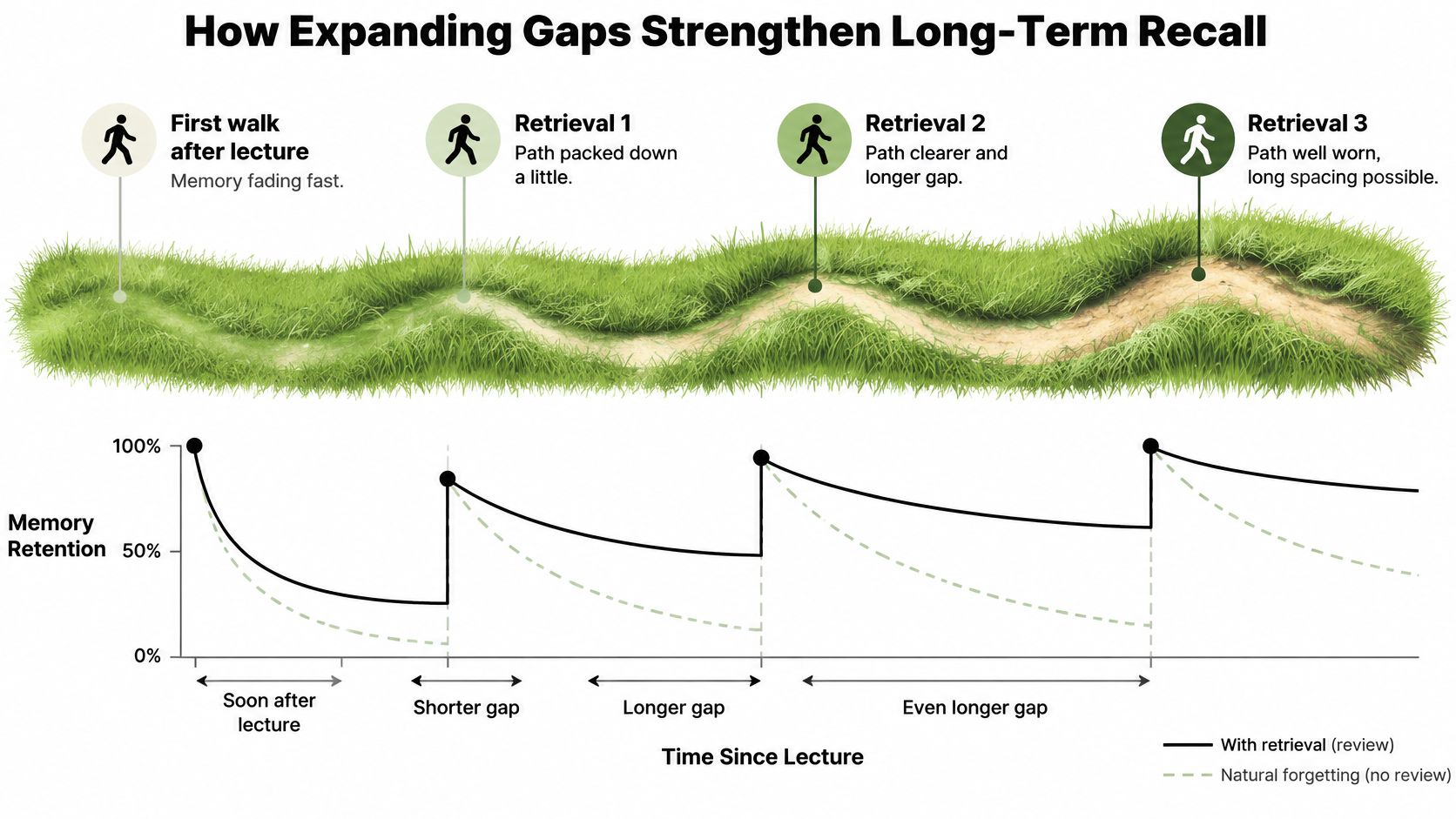
Think about a path across a lawn. The first walk after a lecture barely shows. Come back a week later and the grass has sprung up; the route is gone. Walk it again while the trail is still faint and it packs down a little. Two more passes on later days and the line is visible from the house, at which point you can leave it alone for a month and still find it.
Memory behaves the same way. Most of a new lecture is lost soon after class, which is why the first retrieval belongs within about a day, while later reviews can stretch. Each successful recall leaves a stronger trace, and a stronger trace decays more slowly, so the next review can wait.
Spacing is the when, retrieval is the what
Students blend two separate decisions and then wonder why the results are inconsistent.
- Spacing decides when you come back to an item.
- Retrieval decides what happens when you do: notes closed, answer produced from memory.
- Restudying the slide is a third thing entirely, another exposure that mostly rebuilds fluency.
A review where you read the answer isn't a spaced retrieval. It's a reread wearing a schedule.
A failed attempt still counts, as long as you then open the source and correct it. The correction is what gets stored, and the effort of reaching for an answer that isn't quite there is part of why the item sticks next time.
What the classroom evidence shows
Expanding intervals are a response to success rather than a fixed ladder. An accurate, easy recall earns a longer gap. A miss pulls the item back sooner. That's the mechanism behind the numbers.
A classroom-focused meta-analysis reported a moderate advantage for distributed practice, d = 0.54 with a 95% confidence interval from 0.31 to 0.77 and p < 0.001, meaning learners in distributed conditions performed more than half a standard deviation better than learners who massed their practice, as detailed in the 2025 review of spacing evidence. That analysis also found fixed seven-day intervals between re-exposures tended to generate the most consistently positive results, though optimal timing varies with the retention goal and subject.
Practical rule: an accurate, easy recall earns a longer gap. A miss brings the item back to you sooner.
The limit is worth stating plainly. The same total study time spread across several sessions beats one cram session, and how much better depends on the course, the test and the timing. Spacing is a schedule decision, not a guarantee.
Where Spacing Helps and Where It Falls Short
Spacing gets sold as a universal study hack. It isn't one. The size of the benefit moves with the subject, the question format and what the exam asks you to do, and that variation is the part most guides skip.
Ask yourself what the exam will demand, then choose the practice that rehearses exactly that. A term you must produce from a cue, an explanation you must build in your own words, and a procedure you must execute under time pressure are three different tasks wearing the same course code.
Match the practice to the exam task
| Exam task | Stronger practice | Weaker substitute | What the evidence suggests |
|---|---|---|---|
| Term or definition | Cued-recall flashcard | Rereading the slide | Spacing for cued recall about g = 0.23 |
| Explain it in your own words | Free recall or a short answer | Recognition quiz only | Free-recall spacing about g = 0.53; recognition often not significant |
| Math, accounting, or a procedure | Isolated worked problems, then a delayed reattempt | Definition cards or one crammed problem set | Spaced versus massed in math g = 0.28; isolated g = 0.43, in-course g = 0.24 |
| Multiple-choice exam | Recall first, multiple choice later | Only multiple choice from day one | Retrieval versus restudy in that math review was g = 0.18 and not robust |
Why the format changes the size of the effect
Nursing terminology, safety regulations and anatomy labels are cued recall jobs. A prompt narrows the search and you produce the word. The spacing effect for cued recall sits around g = 0.23, which is modest but reliable.
"Explain how this process works" is a different animal. Free recall shows the stronger effect at roughly g = 0.53, because you have to reconstruct the structure rather than recognize a term. Recognition-style questions sit at the weak end, and in broader meta-analytic evidence the spacing effect for recognition tests was not significant at all.
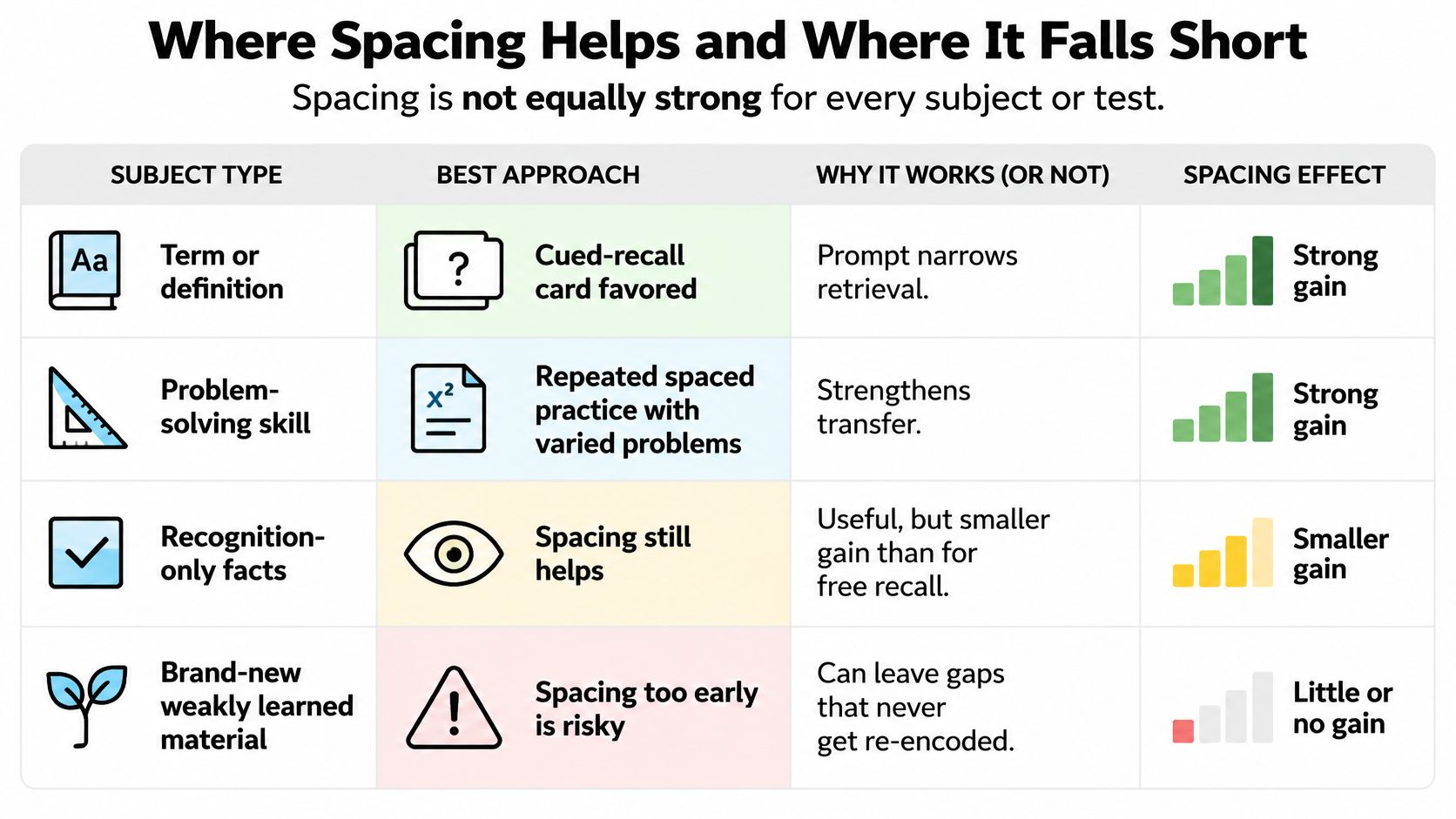
Quantitative subjects deserve their own warning. A 2025 meta-analysis of mathematics learning covering 27 studies and 53 effect sizes found spaced versus massed practice produced an overall g = 0.28, a small-to-medium advantage that grew to g = 0.43 when learners studied material in isolation and shrank to g = 0.24 when spacing was embedded in ordinary courses. The same review found retrieval practice versus restudying reached only g = 0.18 with a confidence interval crossing zero, so the testing effect wasn't statistically reliable in that evidence base, as reported in the ERIC record of the mathematics meta-analysis.
A construction student memorizing safety thresholds needs recall cards. An accounting student working through depreciation needs progressively harder problems, an explanation of each error, and a delayed reattempt days later. One crammed problem set teaches the shape of one question, not the procedure.
Multiple-choice deserves its own caution. Options do part of the remembering for you, so a run of correct answers can feel like mastery while the underlying recall stays untested. Answer first, then check the options.
That video walkthrough is a useful second pass once you've picked your row.

Before you generate a single card, take one item from one lecture and decide which row it belongs to. That decision shapes everything that follows.
How to Build a Review Set from One Lecture
A psychology lecture on memory can yield a focused review set: cards for encoding, retrieval cues, and consolidation, plus a prompt asking you to explain the difference between encoding failure and retrieval failure. The professor's story about a misremembered phone number may help illustrate a point, but it does not need a separate card if the concept is already covered.
Treat the recording as a source to check, not a study session by itself. Build a set small enough to finish in about ten minutes, then match each item to the kind of exam task it supports.
Seven steps for a single class
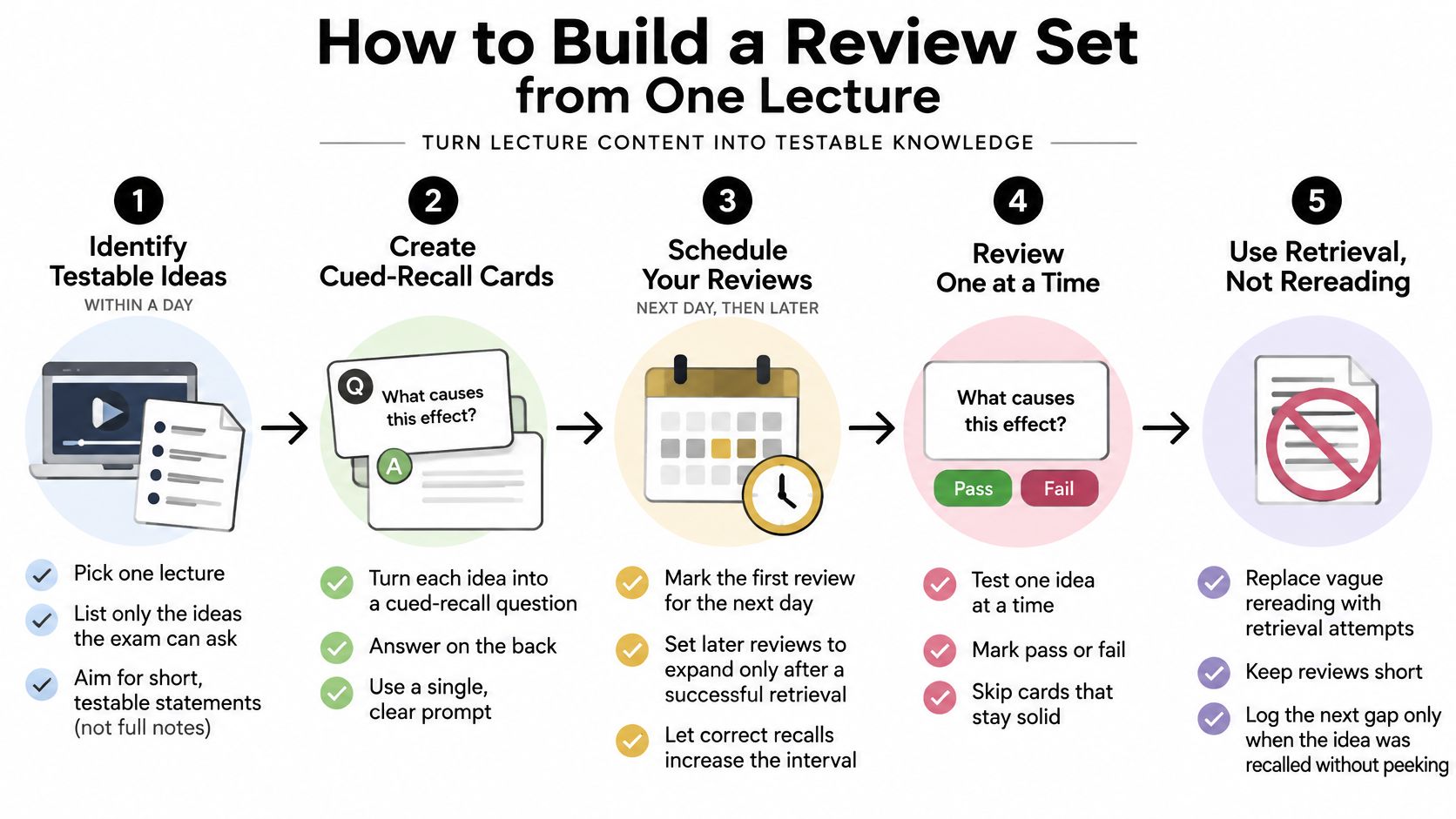
- Within a day, list what the exam could ask. Aim for 10 to 20 items from one lecture. A full transcript preserves what was said; a review set selects what you need to retrieve.
- Choose a practice format for each item. Use cued recall for terms and explanations. For procedures, plan a problem to solve after a delay.
- Write prompts that require an answer from memory. For example, “What does tachycardia mean?” or “What is the next step after measuring the run?” Keep the answer short enough to say aloud.
- For a procedure, add a worked problem and a likely error. The goal is to practise the steps and notice where your reasoning can go wrong.
- Attach a timestamp or page number. If an answer feels uncertain, you can return to its source instead of searching through the whole lecture.
- Try the prompt with notes closed, then check the answer against the source. Correct errors before adding the card to your spaced review queue.
- Set the next review based on the exam date. Give items more time between reviews when the exam is farther away, and shorten the gap as it approaches.
Skip slide titles, jokes, administrative announcements, and claims you cannot locate in the source. A card earns a place in the long-term queue only when its answer is clear and its source can be checked.
If drafting prompts is slowing you down, a LearningStudioAI quiz builder can generate questions from study material for you to edit. For more guidance on writing clear recall prompts, see this guide to the best way to make flashcards.
How to Rate a Half-Remembered Answer
Every review system has a weak point, and it isn't the algorithm. It's the student staring at four rating buttons deciding whether that answer counted. Students often mark Good because the answer looks familiar, then wonder why the same cards keep resurfacing or why their intervals feel wrong.
The rating buttons mean something specific. Rate the retrieval that happened, not the version you'd like to have managed.
Rules for the four ratings
| What happened | Rating to give | What to do with the card |
|---|---|---|
| Blank, then you remembered after the first words | Hard | Rewrite the prompt so the opening words are not a giveaway |
| Right answer, but you guessed | Again | Treat the lucky hit as not yet learned |
| Correct, and you could explain why | Good | Let the interval expand on the exam-horizon row |
| Instant, and you could teach it | Easy | Allow a longer gap than Good |
| Source unclear or the card looks wrong | Do not rate yet | Check the timestamp or page and fix the card before it enters the schedule |
| Huge backlog the night before the exam | Short cram set, separate from the long-term queue | Do not mark everything Again or later intervals collapse |
The most common mistake is the fourth row in disguise. A blank followed by recall after the first few words feels like a success, but the prompt did the work. Hard is correct there, and rewriting the prompt matters more than the rating.
A correct guess is not learning. Mark it Again and move on, because a lucky hit recorded as Good will push the item out of sight for weeks.
For medical, nursing and occupational-safety material, the fifth row is the important one. Memorizing an inaccurate card with confidence is worse than forgetting a correct one, because you'll act on it. Check the source passage before the card enters the queue. That's the same reason our own transcription isn't treated as perfect: speech recognition gets words wrong, so anything you'll rely on deserves a look at the source.
Handling the night-before backlog
Pulling a short cram set of items due soon is fine. Dragging semester intervals into the process isn't. If you mark every overdue card Again the night before an exam, next month's carefully spaced gaps collapse into a pile.
The boundary conditions are worth knowing. A recent meta-analysis found an average spacing effect of g = 0.20, with outcomes moderated by retention interval, the ratio between the spacing gap and the final test delay, posttest format and the comparison condition, and effects were significant for retention intervals beyond a week but not below one hour, per the 2025 analysis of spacing boundary conditions. Short-term cramming and long-term retention want separate schedules, and mixing them costs you the second one.
Rate the retrieval, not the feeling of familiarity.
If you want practice questions to check a weak topic before deciding a rating, this quiz generator for studying covers building them from your own materials.
Put This Week's Lectures on a Schedule
Three moves cover this week, and none of them require a system overhaul.
Find your row. Take the nearest exam and locate it in the interval table. That's your only scheduling decision today.
Build one set. Take today's lecture, and only today's, and run the seven steps. Do the first closed-book retrieval before tomorrow.
Leave the rest. Older lectures get a short daily pass of whatever is due. Anything tested within a day goes on a separate cram list.
Before any card earns a place, it passes two checks. The prompt demands recall or a real problem, and the answer matches the cited lecture moment or page. A card that fails either check is a note, not a review item.
For running that pipeline in one place, ClassLecture.ai records or accepts the lecture, generates flashcards linked to the exact moment in the recording, and builds study guides and scored quizzes from the material you select. Our flashcards use spaced repetition to strengthen recall, surface gaps and track exam readiness per class. Generated cards still need your rating rules and a check of the transcript against the audio.
If the scheduling logic itself is still fuzzy, this guide to a spaced repetition schedule walks through the intervals again at a slower pace.
ClassLecture.ai turns your own lectures, notes and textbooks into transcripts, flashcards linked to the exact moment in the recording, study guides and scored practice quizzes, all organized by class and term. If you want to run the routine in this article on real material this week, upload one lecture and build your first 10-to-20 item set before the next class. Visit ClassLecture.ai to start with a lecture you already have.
The ClassLecture.ai Team
We build ClassLecture.ai, the AI study assistant that turns your recorded lectures into transcripts, summaries, flashcards, and answers cited to the exact timestamp — so you learn faster from your own professor's words.
Keep reading
10 Effective Learning Techniques for Better Recall
Use these 10 effective learning techniques to retain lecture content, study smarter, and apply evidence-based methods to recordings and notes.
Read10 Study Flashcards Apps for Lecture-Based Learning
Compare 10 study flashcards app options for lecture-based learning, including features, pricing considerations, limitations, and transcript-to-card workflows.
ReadSpaced Repetition Flashcards: A Complete Guide for 2026
Master any subject with spaced repetition flashcards. Learn the science-backed strategy to improve memory and ace your exams in 2026.
Read