7 Cranial Nerves Flashcards Resources for Better Recall
Explore 7 cranial nerves flashcards resources, from lecture-based decks and mnemonics to spaced repetition, diagrams, and custom sets in ClassLecture.ai.
Browsing a large anatomy deck again and again isn't the same as knowing the cranial nerves. Recognition can make a card feel familiar while leaving you unable to name the nerve, recall its function, identify it on a diagram, or apply it to a clinical-style prompt. Cranial nerves flashcards work best as a system, because mastery requires several forms of retrieval: remembering the I through XII sequence, matching sensory, motor, and mixed functions, connecting nerves to nuclei or pathways when your course covers them, and distinguishing closely related findings such as CN III, CN IV, and CN VI deficits.
The best resource depends on the learning job in front of you. You may need an AI tool to build a deck from your lecture, a mnemonic resource for nerve order, source citations for confusing material, production-based prompts for exams, or scheduled review for long-term retention. The seven options below are complementary, not interchangeable. Use them to build a review loop that moves from initial recall to context, application, and maintenance.
Table of Contents
- 1. AI-Generated Flashcards from Lecture Content
- 2. Spaced Repetition Scheduling
- 3. Contextual Flashcards with Lecture Citations
- 4. Fill-in-the-Blank and Production-Based Flashcards
- 5. Conversational Q&A Integrated with Flashcard Review
- 6. Class-Wide Flashcard Organization and Exam Readiness Tracking
- 7. Mobile-Accessible and Offline-Capable Flashcard Practice
- Cranial Nerves Flashcards, 7-Point Feature Comparison
- Build a Cranial Nerves Review Loop
1. AI-Generated Flashcards from Lecture Content
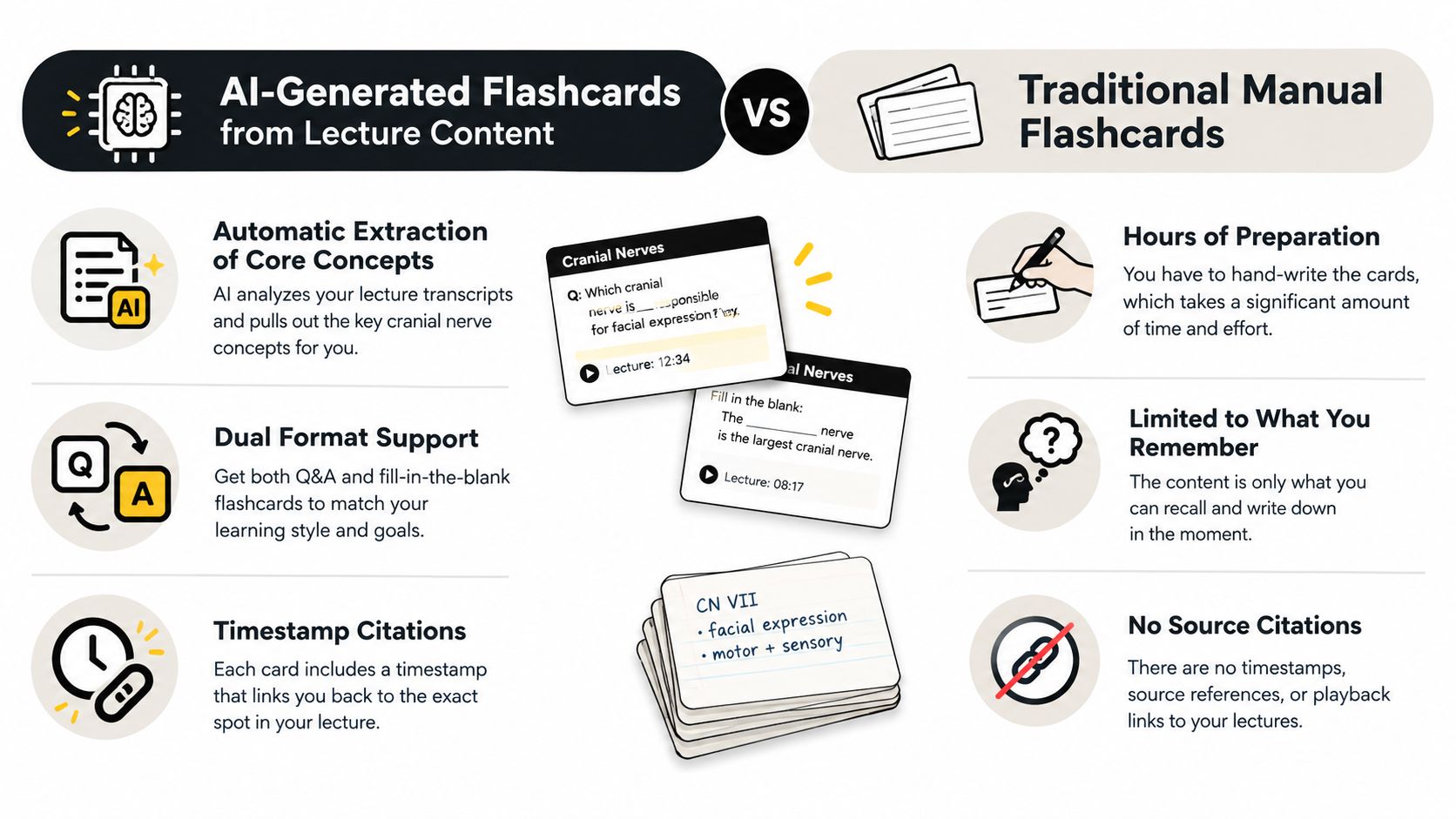
A general cranial nerve deck can teach the standard framework, but your instructor may emphasize different pathways, examination maneuvers, or lesion patterns. An AI-generated deck built from your own lecture captures that local emphasis. You can turn an anatomy recording, transcript, PDF, or set of notes into question-and-answer prompts such as “Which nerve carries facial sensation?” or “What finding might help distinguish a CN VII lesion pattern?”
The basic anatomy framework is stable. Modern teaching materials describe 12 pairs of cranial nerves, numbered I through XII, with functions concentrated in the head and neck and broader internal pathways associated with the vagus nerve. Historical sources commonly identify Samuel Thomas Soemmerring's 1778 work as a milestone in the standardization of the modern classification, which helps explain why the I through XII sequence remains central to anatomy education. Pearson's cranial nerve anatomy overview provides useful background before you generate course-specific cards.
Build from the source, then edit
ClassLecture.ai can generate flashcards from uploaded lectures and notes, including question-and-answer and fill-in-the-blank formats. Its guide to making flashcards online is relevant if you want to convert a recorded anatomy explanation into a study set without manually rewriting every slide.
AI-generated cards still need review. Check whether the prompt reflects what the lecturer said, remove vague questions, and correct terminology before relying on the deck. Timestamp references can also help you return to a confusing explanation instead of guessing what the card meant.
Practical rule: Use automation to create the first draft of a deck, not to replace anatomy verification.
A useful progression is to begin with identity and function, then add cards that connect each nerve to a maneuver or finding. For example, a basic card might ask for the primary role of CN XII. A stronger course-specific card could ask what you observe when a patient protrudes the tongue, provided that distinction was covered in your lecture and matches your instructor's guidance.
2. Spaced Repetition Scheduling
Cranial nerves are compact enough to review frequently, but they're also easy to confuse after the first study session. Spaced repetition solves a scheduling problem: instead of treating every card as equally urgent, the system brings difficult cards back sooner and allows well-recalled cards to return later. That makes it more practical to maintain nerve names, classifications, functions, and clinical distinctions across a demanding course load.
The research base for electronic flashcards in health professions education is substantial. A scoping review identified 64 studies, with 77% published from 2019 through 2024 and 66% focused on undergraduate medical education. The review also found that the literature concentrated on usage and outcomes, showing that digital flashcards are an established learning format rather than a novelty. The PubMed review offers the source for those findings.
Let performance shape the queue
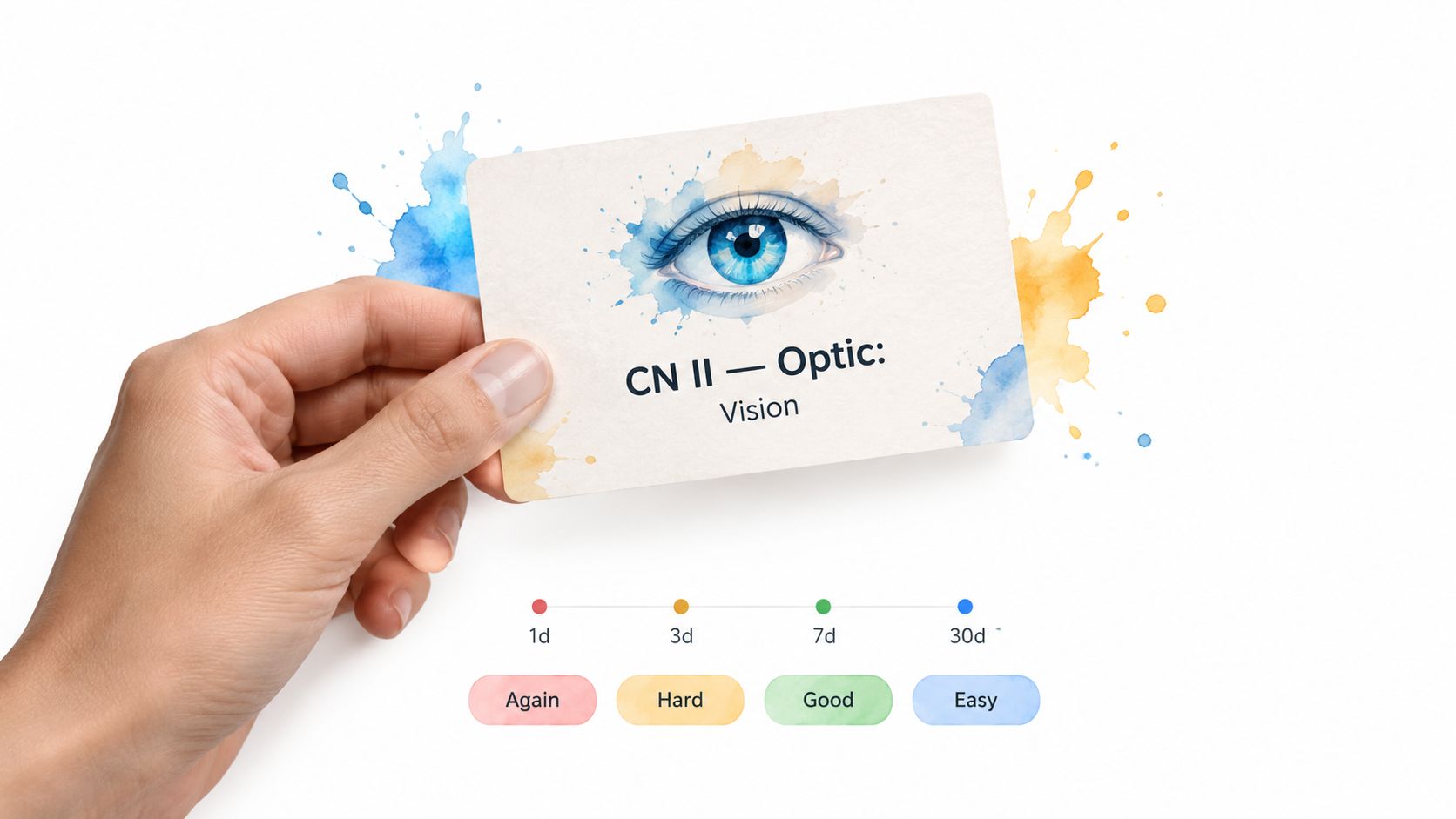
An FSRS-based system uses your ratings to adjust when a card should return. If you repeatedly miss the difference between CN IX and CN X in the gag reflex, that distinction should receive more attention than a nerve-function card you can answer instantly. Rate cards accurately. Marking a card “Easy” when you only recognized the answer can weaken the schedule.
ClassLecture.ai supports FSRS review with Again, Hard, Good, and Easy ratings. Its explanation of spaced repetition flashcards can help you understand how scheduled review fits into a broader study routine.
The method has limits. A schedule can decide when you see a prompt, but it can't determine whether the anatomy in a poorly written card is correct. It also won't automatically teach a pathway you never understood. Use spaced repetition after you've created clear cards, and pair difficult reviews with a diagram, lecture segment, or explanation.
A medical-student study included in the review found that 56% of enrolled students used the cards, users studied a median of 660 cards in 2.95 hours, 87% said the flashcards were helpful, and 83% would recommend them. Those results indicate strong satisfaction with a particular study workflow, not a guarantee that flashcards alone will improve every exam score.
3. Contextual Flashcards with Lecture Citations
A flashcard without context can expose a gap but leave you unsure how to repair it. A cited card gives you a direct route back to the original explanation. If a prompt asks about CN V and you confuse facial sensation with facial expression, a timestamp can take you to the exact lecture segment where the distinction was introduced.
Cranial nerve facts often depend on relationships. CN V concerns facial sensation and mastication, while CN VII concerns facial expression and additional functions. CN II and CN III appear together in the pupillary light reflex, and CN IX and CN X are both involved in the gag reflex. A short answer may be useful for retrieval, but the source context explains how those functions fit together.

Use citations when recall exposes confusion
Citations work best as a repair mechanism, not as a substitute for answering. Try to answer the card first. If you rate it “Again” or “Hard,” open the timestamp or page, identify the missing relationship, and then answer the card again in your own words.
A source-grounded workflow can support several kinds of material:
- Lecture timestamps: Return to the instructor's explanation of a nerve's function or examination.
- Document pages: Check a textbook diagram or course handout when a label or pathway remains unclear.
- Combined sources: Compare the lecture's emphasis with your uploaded notes, while keeping track of which source supports the answer.
- Exported references: Save a transcript or study document for review when you can't access the original recording.
ClassLecture.ai's source scope options let learners work from audio transcripts, uploaded notes and textbooks, or both together. That's useful when your lecturer uses a different mnemonic from your textbook or places more emphasis on clinical localization than the general reading does.
Citations don't prove that a generated card is correct. Verify questionable cards against your course materials and instructor guidance, especially when the prompt compresses a complicated pathway into a single sentence. The best card is short enough to test recall but connected to enough context that you can repair an error.
4. Fill-in-the-Blank and Production-Based Flashcards
Recognition is the easiest form of retrieval. You see “CN VII” and select or recognize “Facial,” but an exam may ask you to produce the nerve, function, or finding without displaying the answer. Fill-in-the-blank cards create that pressure in a controlled way.
Start with prompts that require one precise term:
- Identity: “The nerve responsible for smell is CN ___.”
- Function: “The ___ nerve carries facial sensation and supplies muscles of mastication.”
- Examination: “Shoulder shrug against resistance primarily tests CN ___.”
- Clinical distinction: “A peripheral CN VII lesion affects the ___, while a central lesion may spare it.”
The prompt should contain enough information to test one idea. Avoid hiding several unrelated terms in a single sentence. If a card asks for the nerve, classification, function, pathway, and bedside maneuver all at once, a missed answer won't tell you which relationship needs work.
Move from cues to production
Mnemonic phrases can help you recover the order of the nerves, but they shouldn't become the final answer. The historical sequence from earlier anatomical classifications to the modern 12-nerve system shows why order has remained a teaching focus. Earlier accounts described fewer pairs, while later systems expanded toward the sequence now used in medical curricula. BrainFacts' cranial nerve flashcard material provides that historical context and highlights the recurring organization around sequence, type, and function.
Begin a session with some straightforward question-and-answer cards, then introduce blanks for facts that must be produced under exam conditions. If you're studying CN III, CN IV, and CN VI, avoid a vague prompt such as “Which nerves move the eye?” Instead, ask for the specific movement or muscle associated with each nerve.
Flexible grading can prevent unhelpful frustration. Accept standard abbreviations when the learning target is the nerve identity, but don't accept an answer that changes the function or confuses an afferent and efferent limb. Production-based cards are most valuable when they resemble the response your exam requires.
5. Conversational Q&A Integrated with Flashcard Review
Some cards reveal a misunderstanding that a one-line answer can't resolve. You may remember that CN VII involves facial movement but still be unsure how its findings differ from a CN V problem. You may know that CN X participates in the gag reflex but forget whether it carries the sensory or motor limb. Conversational Q&A gives you a way to investigate the gap immediately.
A useful sequence is simple. Answer the card without assistance, rate it, and ask a focused follow-up when the rating is “Hard” or “Again.” Instead of asking “Explain cranial nerves,” ask, “How does CN VII differ from CN V in a facial examination?” A narrow question produces a more useful explanation and makes it easier to create a revised card afterward.
ClassLecture.ai describes an AI-powered study assistant that lets learners ask questions about their own uploaded materials, with answers tied to transcript timestamps and document pages. That source connection is valuable when you want clarification without losing the lecturer's terminology or emphasis.
Turn explanations into new prompts
Use conversation for understanding, then return to retrieval. After an explanation, write or generate a card such as:
A learner who confuses CN IX and CN X should test both the gag reflex roles and the evidence used to distinguish them.
You can also ask for different levels of explanation. A short summary may be enough before a quick review, while a deeper discussion can help when a lecture moved quickly through nuclei, pathways, or lesion patterns. Speaker-focused summaries may help you identify what the instructor emphasized, but they still need comparison with the actual source.
Q&A has an honest limitation. A fluent answer can sound persuasive even when the source material is incomplete or the card is poorly framed. Keep the conversation grounded in your lecture, notes, or textbook, and verify clinically important distinctions against approved course resources. Then convert the clarified idea into a prompt that you can answer without the chat.
6. Class-Wide Flashcard Organization and Exam Readiness Tracking
A strong cranial nerve deck can still disappear inside a crowded semester. Medical, nursing, and other health-professions students often study anatomy alongside several lecture-heavy subjects. If every course has its own isolated deck, you may spend more time locating the next task than deciding what to review.
Class-wide organization solves the navigation problem. Group cards by course, lecture, and document, then review the due cards across the class when you need a broad study session. A class dashboard can also help you notice that anatomy has many unresolved cards while another subject is already under control. That doesn't replace judgment, but it gives you a clearer starting point.
Use readiness data as a decision aid
A useful dashboard should answer practical questions:
- What's due now: Find the cards that need attention instead of browsing randomly.
- Where are the weak areas: Identify whether your difficulty is nerve order, sensory and motor classification, functions, or clinical application.
- Which course needs time: Allocate a study block based on due work and your upcoming assessment.
- What belongs together: Keep lecture cards, textbook references, and clarifying conversations connected to the same class.
ClassLecture.ai organizes materials by course information and includes class-wide review of due flashcards with an exam readiness widget. You can use that structure to keep an anatomy lecture on eye movements separate from a lecture on cranial nerve examination, while still reviewing both within the same course.
Avoid treating a readiness indicator as a prediction of your grade. It reflects activity and card performance within the system, not every skill your exam may assess. You still need diagrams, practical identification, written questions, and instructor-specific preparation when those are part of the course.
For cranial nerves, organization is especially useful when you split cards by learning job. Keep one group for I through XII order, another for sensory, motor, and mixed classification, and another for distinctions such as CN III versus CN IV versus CN VI. That structure makes weak areas visible without forcing you to rebuild the entire deck.
7. Mobile-Accessible and Offline-Capable Flashcard Practice
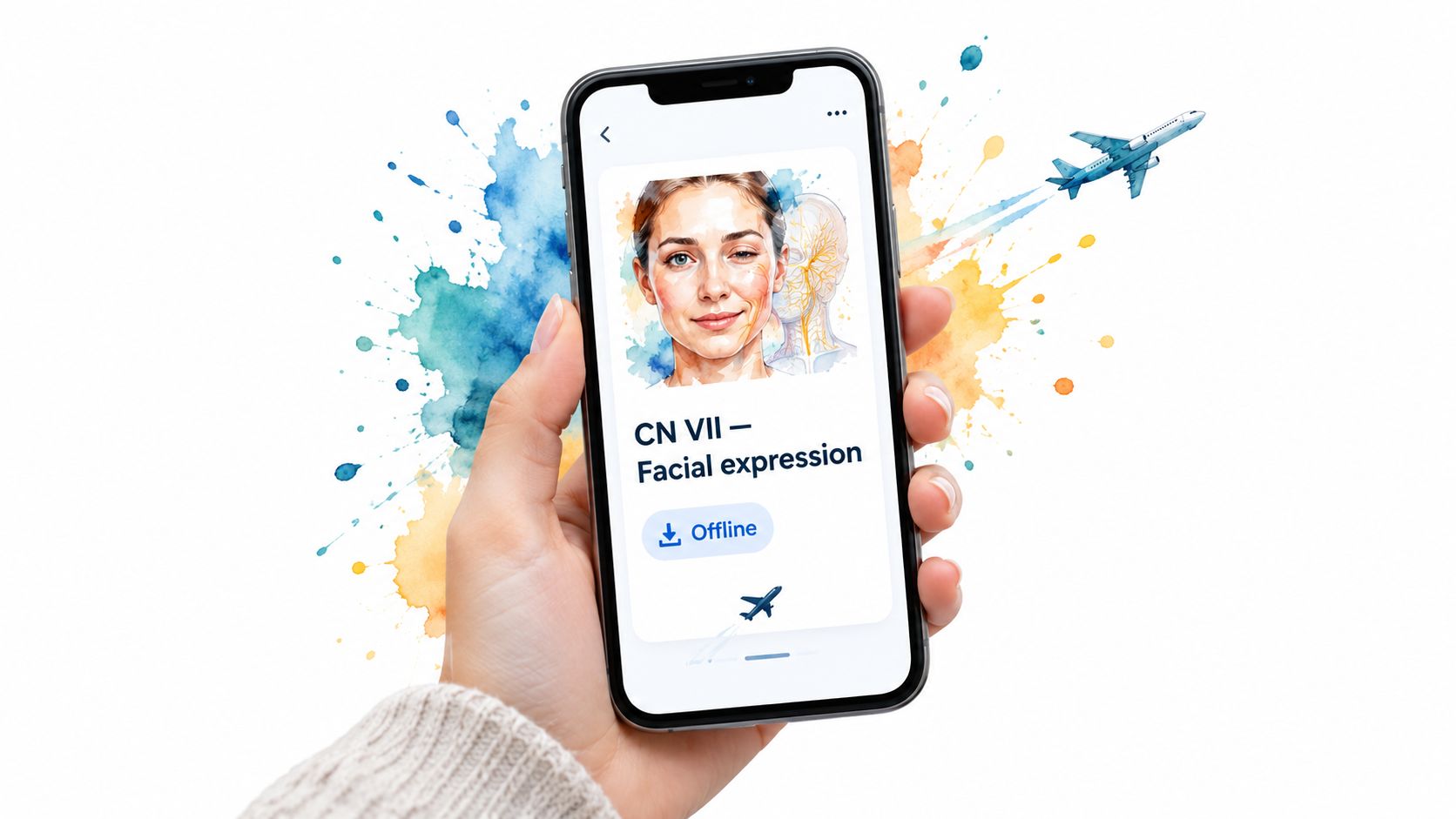
A review system only helps when you can reach it at the point you intend to study. Mobile access supports short review opportunities between classes, during a commute, or before a practical session. Offline capability is useful when the connection is unreliable, provided your cards have already synchronized and the app preserves your review progress.
Use the phone for retrieval, not for every study task. A small screen works well for answering a short prompt, recalling the nerve order, or distinguishing CN V from CN VII. A desktop or larger display is usually better for editing cards, checking a transcript, comparing a diagram, or asking a detailed source-grounded question.
Match the device to the learning task
A practical split looks like this:
- Mobile review: Recall nerve names, numbers, classifications, and short functions.
- Desktop editing: Fix ambiguous prompts, add lecture citations, and create fill-in-the-blank cards.
- Visual study: Use a larger screen for diagrams, pathways, and image-occlusion practice.
- Offline sessions: Review already downloaded cards, then synchronize before switching devices.
- Accessibility settings: Adjust font size, contrast, or audio options if they make repeated retrieval easier.
Short sessions can be productive when they test recall rather than invite passive scrolling. Don't open the deck only to reveal the answer. Say the nerve and function aloud or write them before checking the back of the card.
Offline review also has limits. It may not include the source transcript, an image, or a conversational explanation, depending on the tool. Treat it as maintenance practice, then return to the original lecture or textbook when a card remains unclear. A mobile deck is a convenient access point, not a complete replacement for anatomy instruction.
Cranial Nerves Flashcards, 7-Point Feature Comparison
| Feature (core) | UX / Quality ★ | Value / Pricing 💰 | Target Audience 👥 | Unique Advantage ✨🏆 |
|---|---|---|---|---|
| AI-Generated Flashcards from Lecture Content, auto-extract Q&A & fill-in-the-blank; timestamped links; batch generation | ★★★★☆, fast automation; dependent on transcript clarity | 💰 High value; saves hours; free tier + paid for more processing | 👥 Undergrad, grad, med/nursing, intl students | ✨ Cards built from your lectures (not generic); 🏆 highest course relevance |
| Spaced Repetition Scheduling (FSRS-Based), adaptive FSRS, 4-tier ratings, exam readiness widget | ★★★★★, evidence-backed retention when used consistently | 💰 Excellent ROI for long-term learning; included in platform | 👥 Students preparing for cumulative/licensing exams (NCLEX/USMLE, trades) | ✨ Integrates spacing with lecture-based cards; 🏆 maximizes long-term retention |
| Contextual Flashcards with Lecture Citations, bidirectional links, timestamps, page refs | ★★★★☆, resolves confusion; may slow quick review | 💰 Very valuable for complex subjects; needs media access | 👥 Med/nursing, construction/safety, international learners | ✨ Instant jump to original lecture/page; 🏆 closed-loop context lookup |
| Fill-in-the-Blank & Production-Based Flashcards, auto blanks, multi-answer support, progressive difficulty | ★★★★☆, stronger encoding but more effortful | 💰 High exam prep value; time-intensive per card | 👥 High-stakes exam takers (med, accounting, trades) | ✨ Producing answers mirrors exam tasks; 🏆 bridges recall to real test format |
| Conversational Q&A Integrated with Flashcard Review, seamless chat, context-aware answers, exportable transcripts | ★★★★☆, targeted clarification; depends on transcript accuracy & quotas | 💰 Moderate→High; free 10 Q/mo then premium for heavy use | 👥 Learners needing on-demand explanations; tutors & intl students | ✨ Immediate, timestamped clarifications from your materials; 🏆 closes the loop on misunderstandings |
| Class-Wide Flashcard Organization & Exam Readiness, course dashboard, mastery %, weak-area highlights | ★★★★☆, powerful overview; can feel overwhelming at scale | 💰 High value for multi-course load; reduces fragmentation | 👥 Students managing 3+ courses, med/grad students | ✨ Centralizes course materials and progress; 🏆 prevents scattered study across platforms |
| Mobile-Accessible & Offline-Capable Flashcard Practice, responsive UI, offline sync, audio support | ★★★★☆, very convenient; limited full-editing on mobile | 💰 High convenience value; essential for limited-connectivity learners | 👥 Shift workers, commuting students, clinical rotations, intl learners | ✨ Study anywhere with offline decks; 🏆 enables frequent short sessions for spacing |
Build a Cranial Nerves Review Loop
Start with a reliable anatomy source or your own lecture. Build a small initial set around the I through XII sequence, nerve names, sensory, motor, or mixed classification, and the main function of each nerve. Don't try to place every pathway and clinical association into the first version. A crowded deck makes it harder to identify what you remember.
Use mnemonics and diagrams as retrieval cues, not substitutes for retrieval. A mnemonic can help you reconstruct the order, while a labeled diagram can help you connect a nerve to a structure. After looking away from the cue, produce the answer yourself. Ask whether you can name the nerve, describe its function, and recognize the relevant finding without seeing the completed card.
Then add application prompts. A card about CN VII can ask about facial expression, but another can ask how a forehead finding changes the interpretation of a facial weakness pattern. A card about CN X can test its role in the gag reflex or palate examination. Keep each prompt focused so a wrong answer tells you what to repair.
Convert the most important facts into fill-in-the-blank cards. Production matters when your exam expects you to supply a nerve name, function, pathway, or clinical distinction. If your course includes nuclei, foramina, or lesion localization, create those cards from your instructor's material rather than assuming a general deck matches the syllabus.
Schedule review with FSRS once the cards are clear. Rate performance accurately, let difficult cards return sooner, and use your class-level review view to decide which subject needs attention. When a card stays unclear, consult its lecture timestamp or document page and use source-grounded Q&A to ask a narrow question. Afterward, edit the card so the explanation is less ambiguous.
ClassLecture.ai can support this workflow by accepting lectures, notes, textbooks, and other class materials, then generating custom question-and-answer or fill-in-the-blank cards tied to those sources. It also combines transcripts, cited Q&A, flashcards, and scheduled review in one study environment. You should still verify generated anatomy content against your course resources and instructor guidance, particularly for clinical distinctions and examination findings.
The goal isn't to collect the largest deck. It's to build a set that makes you retrieve the right information, reconnect it to the source when you're uncertain, produce it under pressure, and revisit it before it fades. That is what turns cranial nerves flashcards from a browsing habit into a deliberate learning system.
If you want to build that system from your own anatomy materials, ClassLecture.ai can turn uploaded lectures, notes, textbooks, and transcripts into source-grounded flashcards, fill-in-the-blank prompts, and conversational review. Create a custom cranial nerve deck tied to your course content, then visit ClassLecture.ai to try the study workflow.
The ClassLecture.ai Team
We build ClassLecture.ai, the AI study assistant that turns your recorded lectures into transcripts, summaries, flashcards, and answers cited to the exact timestamp — so you learn faster from your own professor's words.
Keep reading
Spaced Repetition Flashcards: A Complete Guide for 2026
Master any subject with spaced repetition flashcards. Learn the science-backed strategy to improve memory and ace your exams in 2026.
Read10 Flashcard Maker Free Tools for Smarter Study
Compare 10 flashcard maker free tools for lectures, notes, imports, exports, auto-generation, and spaced repetition, including ClassLecture.ai.
ReadHow to Study Flashcards the Smart Way
Learn how to study flashcards with spaced repetition, active recall, and better card design. A practical guide to faster, longer-lasting learning.
Read