Flashcards Study Method: How Active Recall Works
Learn how the flashcards study method works, from active recall and card design to spaced review of cards built from your class lectures and notes.
Say you finish a two-hour lecture on fluid and electrolyte balance, highlight eleven lines of the slide deck, and read them through twice that evening. Two days later someone in your study group asks what happens when aldosterone rises, and the explanation only comes back once you find the highlighted line on the page. Nothing failed except the method. Rereading built recognition, and recognition is not the same as being able to produce an answer.
The flashcards study method runs on the opposite principle. You look at a cue, produce an answer from memory, and check only afterwards. A card is not a summary you flip through. It's a small test you designed, and the design decides how much you learn from it.
Table of Contents
- How Active Recall Turns Cards Into Memory
- Card Types and Prompts That Test Understanding
- How to Build a Deck From Your Lecture Material
- Checking AI-Drafted Cards Before You Memorize Them
- Review Intervals That Keep Cards Sticking
- Fixing Cards That Stop Working
- Start Your First Ten-Minute Review Today
How Active Recall Turns Cards Into Memory
A card removes the option to recognize. It works in four moves, and each one matters more than it looks.
- Read the cue on the front. One line, no hints folded in, no context that gives the answer away.
- Answer from memory before you turn it over. Say it out loud. A silent "yeah, I know that" is a guess wearing a confident voice.
- Check the back and name the gap. Not "close enough". If you dropped the second half of the mechanism, say which half you dropped.
- Rate how hard the recall was. Again, Hard, Good or Easy. That rating decides when the card comes back.
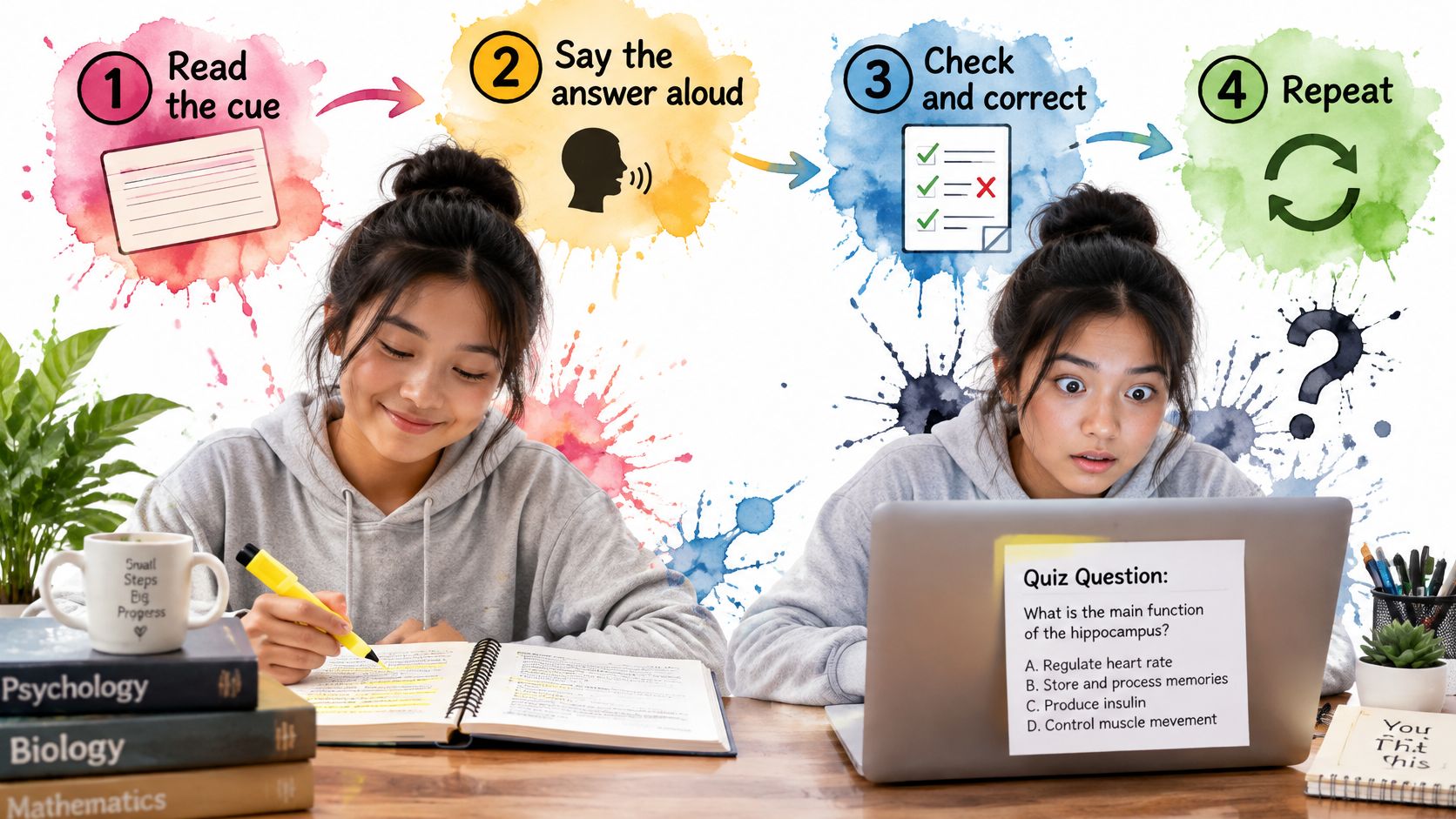
A coach makes players run the play before showing the replay. Rereading is watching the replay. Reading the cue, answering, and only then checking is running the play. The effort of producing an answer is the training; the answer printed on the back is feedback, not the lesson.
That effort has a long paper trail. A 2021 review of more than a century of retrieval-practice research reported that a meta-analysis of laboratory experiments found information was, on average, 2.5 times more likely to be recalled on a later test when it had been reviewed through retrieval practice rather than restudied. The advantage held across delays from minutes to weeks, and across formats including flashcards, multiple-choice questions and short-answer prompts.
Educational psychologists call this the testing effect, meaning the improvement in later recall caused by being tested rather than shown the material again. The same review described vocabulary experiments in which learners who used retrieval practice recalled significantly more foreign-language translations than learners who only restudied, tested at 5 minutes, 1 week and 4 weeks.
A good prompt asks you to rebuild reasoning, not label a phrase. The LSAT Lab breakdown of PT10 Q14 works that way: the explanation only pays off after you've committed to an answer, which is why attempting the question cold beats reading the solution first.
Tonight's self-check: if you can't answer without flipping, the card is working. If you flipped before trying, you were rereading.
Card Types and Prompts That Test Understanding
A card is a test you write for yourself, and the quality of the test caps what you can learn from it. The rule that does the most work is one card, one retrievable unit, phrased as a question.
Operant conditioning on the front of a card gives you nothing to retrieve. It's a topic label. "What makes a consequence a reinforcer?" forces a claim, and the claim is what gets stored.
The structure isn't cosmetic. In a controlled experiment from Purdue's learning lab, repeated retrieval produced substantially better delayed recall than repeated studying; in conditions with roughly 80 additional retrieval trials, long-term retention improved by more than 150%. The same work recommends building each card around a single unit, a definition, mechanism, diagnostic distinction or procedural decision, rather than a long paragraph.
Five card types and the prompts that make them work
| Card type | Prompt pattern | Example card |
|---|---|---|
| Definition | What does X mean? | What is reinforcement? Any consequence that increases the likelihood of the behavior it follows |
| Mechanism | How does X lead to Y? | How does a variable-ratio schedule produce steady responding? |
| Comparison | How does X differ from Y? | How does classical conditioning differ from operant conditioning? |
| Decision rule | When do you use X instead of Y? | When is a one-tailed test preferred over a two-tailed test? |
| Application | Given this case, what is the most likely X? | A patient shows these symptoms; which disorder does the lecture link to them? |
Decision-rule cards are the ones that pay off under time pressure, because a test asks you to choose a course of action without re-deriving it. The same skill drives test-day advice for Ontario learner drivers, where the rule has to be applied correctly to a scenario you haven't seen before.
Four rules that keep each card honest
- No yes-or-no prompts. A coin flip is a 50% score you didn't earn.
- Never paste a paragraph on the back. If the answer needs a paragraph, the card needs splitting.
- Cue on the front, answer plus one supporting detail on the back. Detail is what lets you tell a near-miss from a hit.
- One card per exception the lecturer stressed. Exceptions are where exams hide the discrimination questions.
Split a lecture point into separate cards when it has more than one answer, when the lecturer distinguishes two cases, or when a wrong answer wouldn't show you which part to review. A worked example from class stays as one card only if its final answer is a single retrievable claim; otherwise write one card per step.
Run two questions past every card you write. Can you answer it without reopening your notes, and would a wrong answer tell you exactly what to go back and review?
How to Build a Deck From Your Lecture Material
A deck built from your own lecture beats a purchased one, because your lecturer signals what they consider testable. Five steps do the work, and two of them are usually skipped.
The sequence, end to end, before the detail.
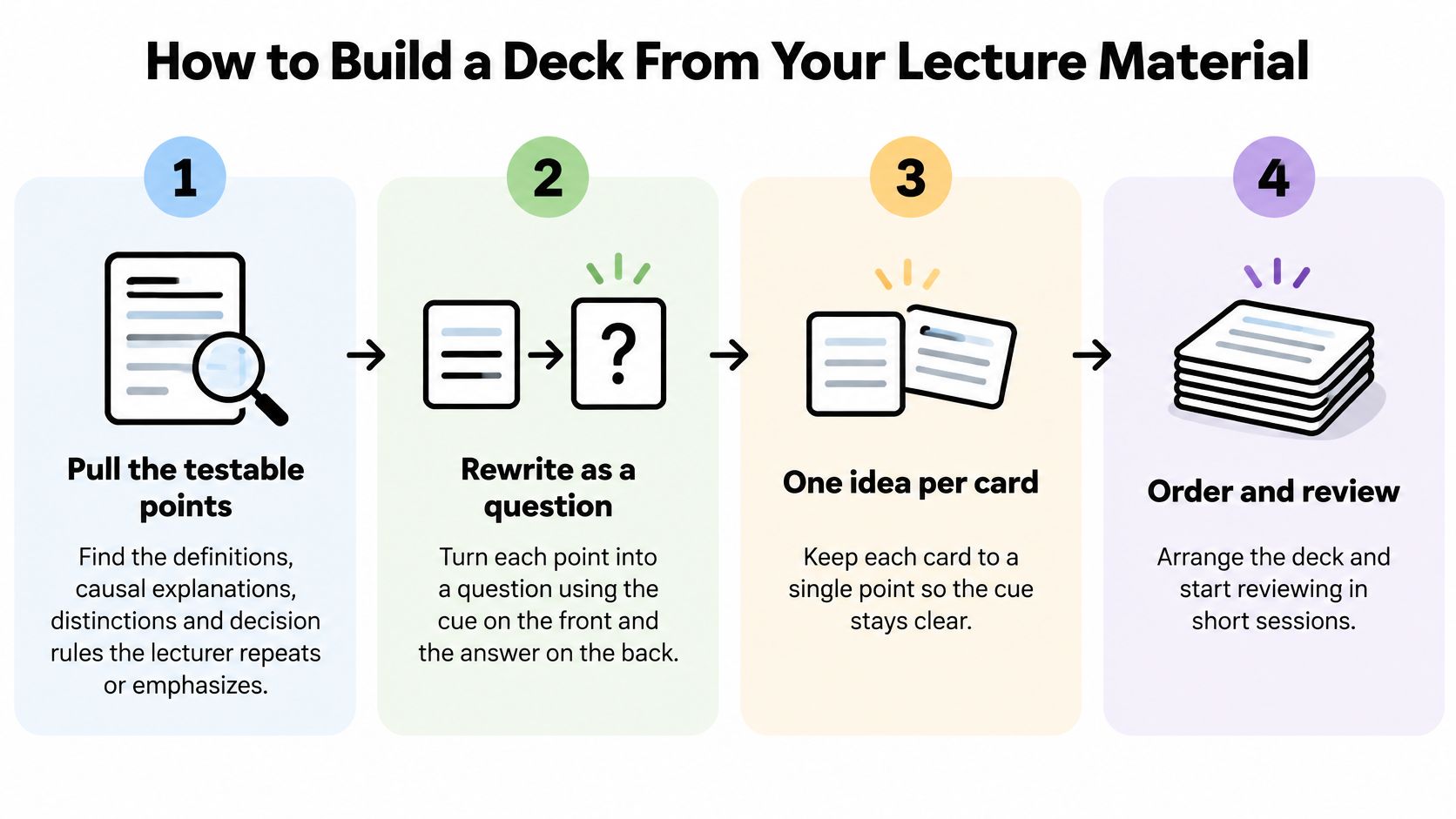
- Pull the testable points. Each lecture leaves behind a handful of definitions, causal explanations, distinctions and decision rules, usually the ones the lecturer repeats or slows down for. Those are your raw material. Nothing else goes in.
- Rewrite each point as a question. Use the prompt patterns above. If you can't turn a point into a question, you probably don't know what it's for yet, and that's worth knowing before the exam.
- Attach the source. Write the slide number, textbook page or lecture timestamp beside the answer. A card without a source is a claim you can't check, and an unchecked wrong card is an error you'll rehearse until exam day.
- Group by course and topic. Keep separate decks for separate lectures, then review across them. Reviewing the right material before a midterm is a sorting problem, not a willpower problem.
- Mark the cards that lean on a worked example or diagram. These often need the original recording to make sense, so flag them instead of guessing at the missing piece.
A searchable, timestamped transcript shortens steps 1 and 3 more than any other tool: instead of scrubbing a two-hour recording, you jump to the moment a definition was given and copy the wording exactly. If your notes are the weak link, this comparison of different types of note-taking methods shows which formats leave behind the distinctions you need to turn into cards.
Here's the process in motion.
Eight to twelve cards per lecture is enough to start. A deck of forty from one class usually means you wrote summaries instead of questions. If you can't say where each answer came from, the deck isn't ready.
Checking AI-Drafted Cards Before You Memorize Them
Speed is the wrong test for a card. A generated card that reads cleanly and states something your lecturer never said will be memorized with the same confidence as a correct one, and you'll find out which kind it was during the exam.
The evidence doesn't support a shortcut. In a pre-clerkship medical-student study of AI-generated Anki flashcards, use of the cards was not significantly associated with exam-score differences in genetics or pharmacology; the pharmacology group was small and those students started from lower baseline performance, which limits how far the finding stretches. A 2025 review cited in that work describes AI quiz questions and flashcards as useful for on-demand self-assessment, but treats them as substitutes for teacher- or textbook-created materials rather than proven learning gains.
Practical reading: AI accelerates draft creation, and you remain responsible for the checking. Four checks catch nearly everything.
- Confirm the support. Every card should show the sentence, timestamp or page it came from. If you can't reach the source in seconds, the card doesn't go in the deck.
- Label stated versus inferred. Directly stated answers are safe. Inferred ones need a second look, because an inference can be logical and still not be what your course teaches.
- Flag cards too broad to answer in one line. Those are summary sentences wearing a question mark.
- Re-check high-stakes claims against the original recording or textbook. Drug mechanisms, safety thresholds and legal limits are exactly where a plausible card does the most damage.
The same discipline applies to generated practice questions, since a quiz generator for studying is only as useful as the answers you're willing to verify.
The contrarian point: a card being fast to produce says nothing about whether it's right. Convenience and learning gains are different measurements, and only one of them shows up on the exam.
Review Intervals That Keep Cards Sticking
The night-before cram is the most common way to waste a good deck. Fifteen passes on Tuesday night make the material feel permanent, and by the following Monday it's gone.
Spacing beats volume, and the difference is measurable. In three experiments using GRE-type word pairs, learners who studied one large, interleaved stack recalled 49% of items versus 36% for learners who studied four smaller stacks in a massed pattern, an effect size of d = 0.48. The spaced group also learned more per minute of study, 0.81 items per minute against 0.34.
Why the gap does the work
The mechanism is what researchers call desirable difficulty. A card you reach for after two days is harder to answer than one you saw ten minutes ago, and that extra effort is what makes the memory durable. Immediate repetition feels fluent because the answer is still sitting in your short-term store.
Delayed retention is also the only honest score. In a 2016 controlled experiment, retrieval practice produced 67.2% correct recall after a 5-minute delay against 51.4% for restudying. After 7 days, the same groups scored 26.2% and 18.0%. Both dropped; retrieval stayed ahead. Testing yourself right after studying flatters you, which is why the schedule matters more than the score.
Setting intervals from your rating
| Rating | When to choose it | Next review (example) | Why |
|---|---|---|---|
| Again | Could not recall, or guessed | Same day or next day | Retrieval failed, so the card needs another attempt soon |
| Hard | Recalled, but only with real effort | About 2 days | The memory is present but fragile, so review before it fades |
| Good | Recalled correctly after some thought | About 4 days | Recall succeeded, so the gap can grow |
| Easy | Recalled instantly with no effort | About 10 days | The card is secure, so push it further out |
Those intervals are examples to adjust as the exam approaches, and a proper spaced-repetition schedule shortens everything in the final fortnight. Three rules keep the system working.
- Mix new cards across lectures. Interleaving stretches the delay between exposures, which is the point.
- Shorten the interval after any error, even one you fixed in your head two seconds later.
- Keep the routine running for weeks. A single long session trains nothing that survives.
Fifteen to twenty minutes a day is realistic, because you're reviewing the cards that are due, not the whole deck. On a heavy week, cut the new cards rather than the daily session.
Fixing Cards That Stop Working
Decks fail in recognizable ways. Each failure below has a fix, and most fixes are a rule from earlier in this method applied at the right moment.
- You recognize the card but can't produce it. You read the back too early. Cover the answer and force a full attempt out loud before you look.
- A card stays easy for weeks. The prompt is too vague, or everything gets Good. Split the card and rate what happened.
- The deck grows faster than you review it. Cut low-value cards and keep only the ones testing a decision or a mechanism.
- Daily reviews slip into a backlog. Shrink the batch. Twenty cards cleared beats two hundred abandoned.
- Duplicate cards appear from different lectures. Merge them into one card and list both sources, the way the deck-building steps say.
- Cards still carry topic labels. Rewrite them as questions using the five prompt patterns.
Honest ratings carry the whole system. Rating a card Good after a lucky guess pushes it out to an interval you haven't earned, and the first sign of trouble is a lapse three weeks later on material you thought was solid.
Volume doesn't rescue a weak deck either. A review of active-recall interventions notes that sustained, structured retrieval over weeks or months is more consistently associated with improved outcomes than isolated or short-term review. More cards are not automatically better; the ones that test a decision or a mechanism are worth repeated practice, and the rest can go.
The signal to watch for is fewer lapses and quicker, confident recall across several weeks. When that shows up, the deck is doing its job.
Start Your First Ten-Minute Review Today
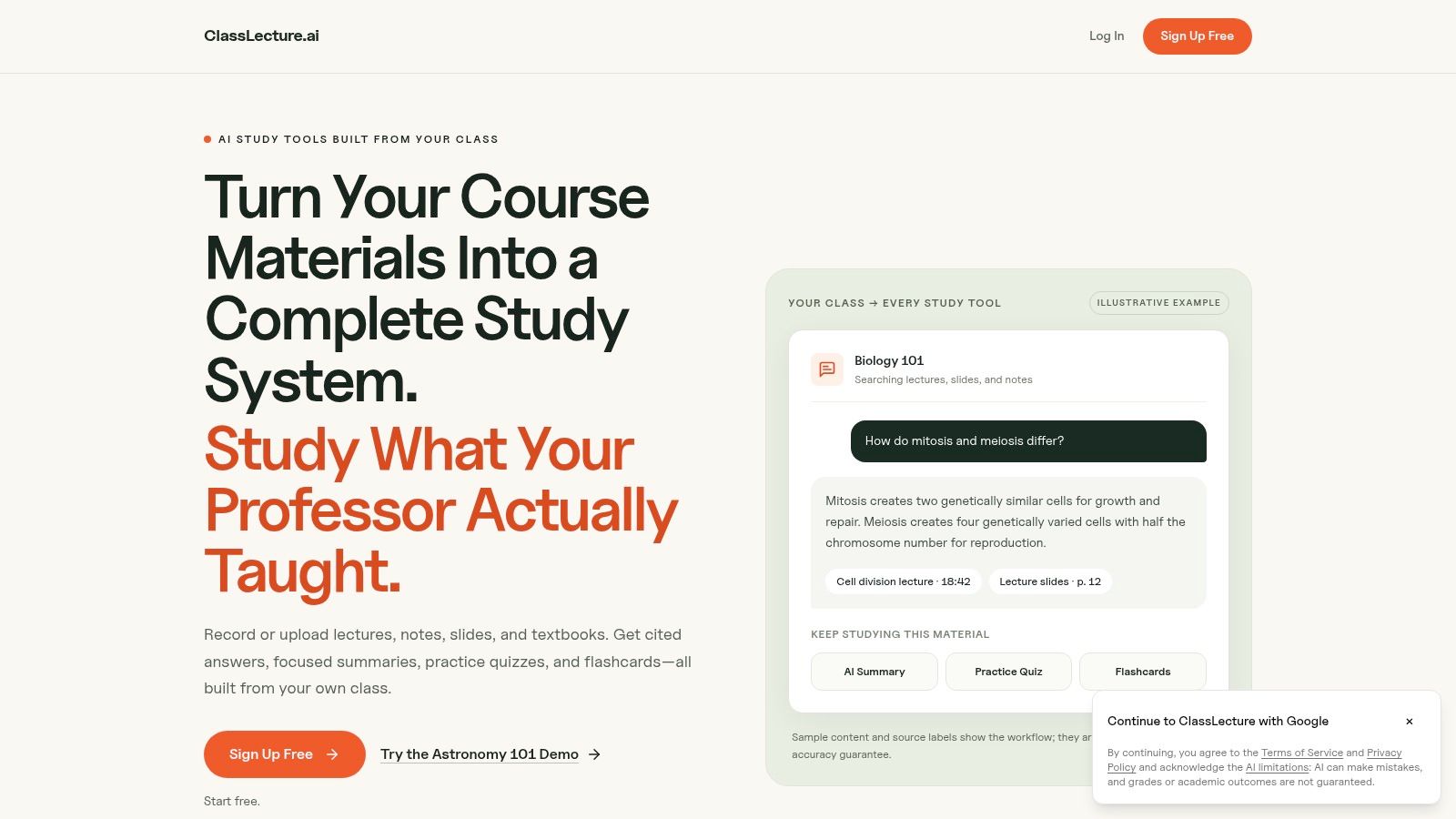
A short session tonight still counts if every card is treated as a retrieval test with a covered answer. The screenshot below shows where reviews live once cards exist.
- Pick one lecture from this week and open its transcript or your notes.
- Draft eight to ten cards with the question patterns, then run the four source checks on every one.
- Review them once: cover the back, answer from memory, check the source, rate your recall.
- Book the next review using your rating, and put it on tomorrow's calendar before you close the laptop.
The method works through repeated sessions. Ten minutes tonight plus ten tomorrow beats a three-hour Sunday because each session forces another retrieval attempt while the material is still reachable.
If the readings behind the cards keep getting postponed, build a reading habit with Badger so raw material keeps coming.
ClassLecture.ai can generate flashcards from lecture recordings and class materials, link each card back to the exact lecture moment, and schedule reviews with spaced repetition, so the same steps run inside the study app. Visit ClassLecture.ai to upload a lecture and start your first review.
Commit to the next three review sessions this week before you judge whether any of this works.
The ClassLecture.ai Team
We build ClassLecture.ai, the AI study assistant that turns your recorded lectures into transcripts, summaries, flashcards, and answers cited to the exact timestamp — so you learn faster from your own professor's words.
Keep reading
Active Recall and Spaced Repetition for Lecture Courses
Active recall and spaced repetition—the two study techniques with the strongest evidence—explained and applied to lecture-heavy courses.
Read8 Study Guide Examples for Your Own Course Materials
Explore 8 study guide examples across subjects, then learn how to adapt each one to your own lectures, notes, and textbooks for smarter exam prep.
ReadHow to Study From Recorded Lectures: A Proven System (2026)
Rewatching recorded lectures is nearly worthless. Here's the research-backed system that turns any recording into real exam performance.
Read