8 Study Guide Examples for Your Own Course Materials
Explore 8 study guide examples across subjects, then learn how to adapt each one to your own lectures, notes, and textbooks for smarter exam prep.
An 80-minute recorded lecture is sitting in one tab. A 40-page textbook chapter is open in another. The exam is nine days away, and rewriting every slide into a neat summary still is not a plan. The same study guide fails in different courses because the material is not the same kind of thing. A definition-heavy psychology lecture wants cues you can hide and recall. A depreciation chapter wants questions you answer before you touch the problems. A safety unit wants every line traced back to the page your instructor assigned.
These study guide examples are built for that difference. Each one is tied to a real subject, then paired with a concrete rule for swapping in your own lecture, textbook, or slides. Passive rewriting feels productive and still leaves you blank on exam day. The formats below force you to retrieve, explain, or connect ideas, then check the result against the source.
Table of Contents
- 1. Cornell Note-Taking Study Guide
- 2. SQ3R Reading and Study Method
- 3. Feynman Technique Study Guide
- 4. Leitner System Flashcard Guide
- 5. Concept Map Study Guide
- 6. Outline-Based Study Guide
- 7. Retrieval Practice Question Guide
- 8. One-Page Summary Sheet
- How the eight study guide formats compare
- Turn Any Course Into Your Own Study Guide
1. Cornell Note-Taking Study Guide
A psychology student sits down with a cognitive lecture on learning. In the wide column they write the definition of classical conditioning, the sequence of neutral stimulus, unconditioned stimulus, and conditioned response, plus one classroom example the professor used. Within a day, the narrow left column gets a cue such as classical conditioning. The bottom of the page gets two or three sentences in their own words. At review, they cover the wide column and answer the cue out loud.
That page is the Cornell note-taking system. Walter Pauk, an education professor at Cornell University, built it as a lecture method with three jobs on one sheet: capture, question, and summarize. It works because the cue column turns notes into a quiz instead of a script you reread.
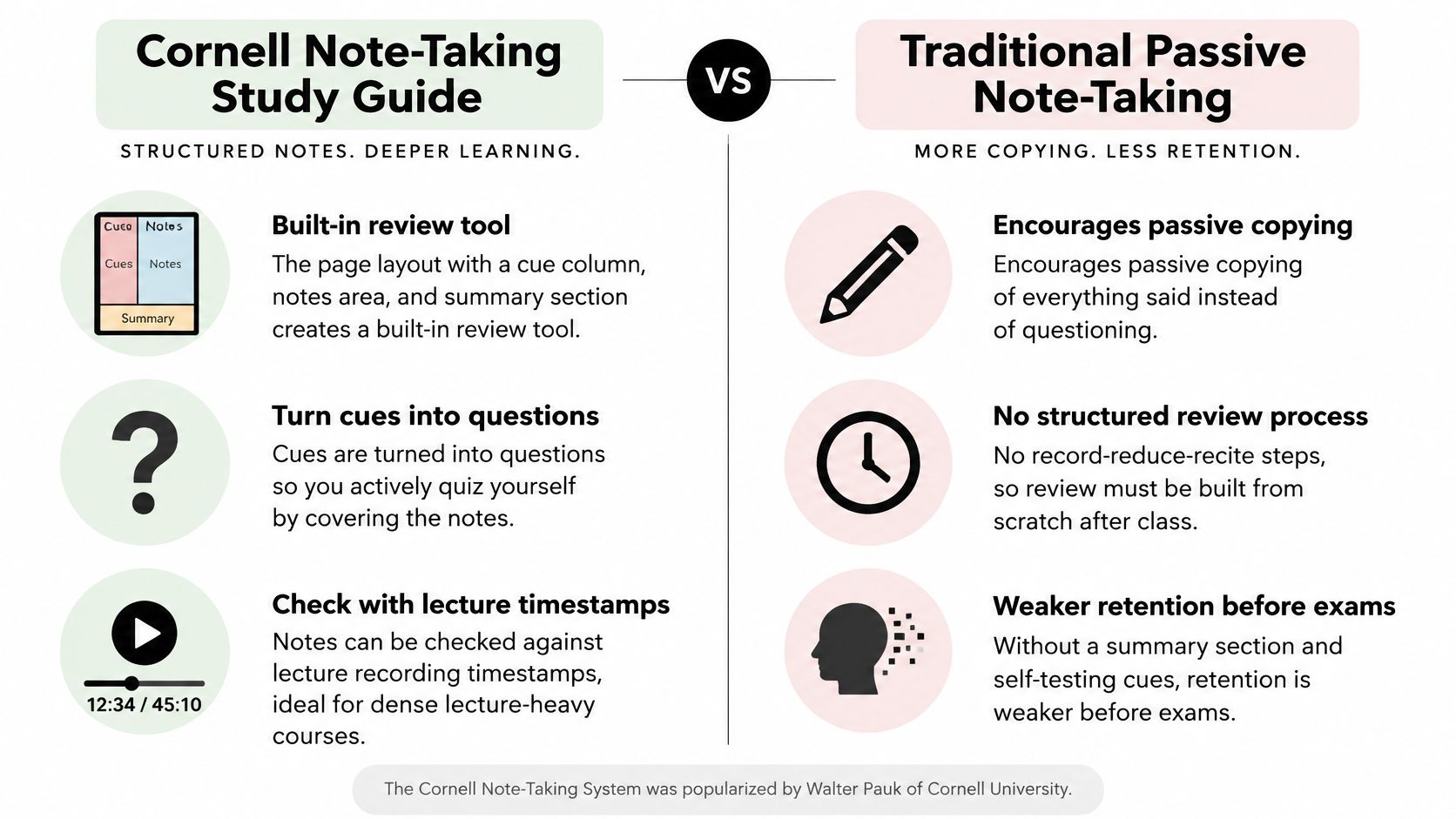
Taking notes is nearly universal, and that is the trap. Recent educational research notes that more than 95% of students report taking notes, while effective studying also requires testing yourself and spacing that work across days. A full notebook with an empty cue column is still passive review.
A community college biology student can run the same page on a recorded lecture. They write the notes while the video plays, pause when a term is fuzzy, and jot the timestamp next to that line. Later they open only that minute, fix the cue, and write the summary before the exam. If you want other page layouts beside this one, a note taking guide for students is a useful comparison, and the breakdown of different types of note-taking shows where Cornell fits next to outlines and maps.
Cues Within a Day
Practical rule: Write the cue column within 24 hours, using the instructor's terms, not a cleaner phrase you invented later.
What to put in each zone:
- Notes column: Only what the lecture or chapter said, including the example the instructor chose.
- Cue column: A term, a short question, or a "why" prompt you can answer with the notes covered.
- Summary: Two or three sentences that would still make sense if the rest of the page disappeared.
- Timestamp or page: Beside any line you do not trust, so you can reopen that minute or paragraph.
Swap rule: Replace "classical conditioning" with the first bold term on your own slide or transcript. If your lecture has no bold terms, use the words the instructor repeated or wrote on the board.
Cornell is a poor fit when the exam is one long calculation with almost no vocabulary. Use it for lecture-heavy courses where the professor's wording is what the test will echo. Do not copy the slide deck into the wide column and call that studying. The cue, spoken with the notes hidden, is the study guide.
2. SQ3R Reading and Study Method
Heavy reading is a different problem from a fast lecture. You already paid for the book. In the 2024–2025 academic year, students spent an average of $341 on required course materials, according to the National Association of College Stores' Student Watch report. Buying a second commercial outline on top of that chapter rarely beats using the chapter you have.
SQ3R is Survey, Question, Read, Recite, Review. Francis P. Robinson introduced it in his 1941 book Effective Study. It is still the right spine for textbook-heavy courses because it stops you from starting on page one and highlighting until the ink runs out.

Say you are in introductory accounting and the chapter is depreciation. Spend two or three minutes surveying the headings, the summary box, and the list of methods. Turn each heading into a question in the margin: "How does straight-line differ from declining balance?" Read only far enough to answer that question. Close the book and recite the method in one or two sentences. Then try a problem. Review the missed method the next day, not by rereading the whole chapter.
A graduate student facing a qualifying exam can run a thinner version on journal articles. One question per section is enough. Recite the answer before you move to the next paper. Ten articles with one solid question each beat one article you highlighted in four colors.
Recite Before the Problems
Survey is not studying. Recite is. If you cannot say the answer with the book closed, you do not have it yet.
Swap rule: Take the next unread heading in your own chapter or PDF and write it as a question before you read that section. If the heading is vague, use the first sentence of the section's summary instead.
SQ3R is slow on the first pass and faster on every pass after that. It fails when you skip Recite and jump to problems, because then the chapter is still a wall of text. It also fails on slide-only courses with no real reading. Use Cornell or retrieval questions there. For a PDF or EPUB, survey the headings inside the file, write the questions in a doc beside it, and only then read the paragraphs that those questions point to.
3. Feynman Technique Study Guide
A physics student has to explain Newton's third law to a younger sibling. They say, "If you push the wall, the wall pushes back." The sibling asks what that has to do with a book sitting on a table. The student stalls. That stall is the study guide. They go back to the section on action-reaction pairs, fix the gap, and explain it again in shorter words.
The Feynman technique is four moves. Pick one concept. Explain it on paper as if the reader has never taken the course. Mark every place you used a jargon word you cannot unpack. Return to the lecture or textbook and simplify again. People attach the name to physicist Richard Feynman. The label came later. The move is older than the brand: teach it, or you do not know it.

A nursing student can do the same with one antihypertensive. They write, in plain language, what the drug changes in the body, who it is for in the lecture's example, and one effect the professor said to watch. They do not add side effects from memory or from a random webpage. If a sentence needs a term they cannot define, that sentence goes back to the pharmacology notes.
I recommend a spoken version when writing feels too polished. Record a two-minute explanation. Play it once. Every time you said "basically" and skipped a step, that step is the gap. If you are studying in a second language, explain it in the simpler language first. Simple wording exposes holes that formal course language hides.
Swap rule: Choose one heading from today's lecture, not the whole unit. Write the explanation using only words you could say to a new classmate. Then open the recording at the minute that heading was taught and delete any sentence the instructor did not support.
This format is a bad cram tool for formula sheets and a bad way to memorize long lists. It is the right tool when you can recite a definition and still cannot say why it is true. Do not ask a chat tool to write the simple explanation for you and then memorize its paragraph. Write yours first. If you use a chat over your own notes, use it only to point at lines you left fuzzy, then fix those lines from the source.
4. Leitner System Flashcard Guide
Flashcards fail in a predictable way. Students make eighty cards the night before, flip them until they look familiar, and still miss the same ten on the exam. The Leitner system fixes the schedule, not the stationery. Sebastian Leitner, a German science journalist, laid it out in the 1970s with physical boxes. Cards start in box one. A correct answer moves the card to the next box, which you see less often. A miss sends it back to box one. Later boxes are not a reward pile you ignore. They are a slower review.
A medical student learning anatomy can run five boxes. Box one is daily. Box five might be weekly. Each card is one structure, one relation, or one clinical term from that week's lab, not a paragraph. A language student can use the same logic inside an app. The box is the idea. Paper or software does not matter if a miss returns the card to the short interval.
Quotabl's forgetting curve tool is a quick way to see why a card you "knew" on Monday is shaky by Friday. The flashcards study method is the practical companion: one fact per card, then a schedule that brings misses back before the exam.
One Fact, Then the Box
Build the deck this way:
- One concept per card: "Name the origin of the biceps brachii" beats a card that asks for origin, insertion, and action at once.
- Your wording on the back: Copy the lecture or lab manual, not a prettier definition from somewhere else.
- Misses stay in the session: If you miss it, say the right answer once, then see that card again before you stop.
- Later boxes get longer gaps: Daily for box one, then stretch only after a real correct recall.
Swap rule: Pull cards only from terms your syllabus, slides, or lab list names. If a generated deck adds a term you cannot find in the lecture, park it. Do not study it until you confirm it belongs in the course.
Digital spaced repetition such as FSRS scheduling is the same box logic with intervals that move when you rate a card Again, Hard, Good, or Easy. More cards are not better. A fat deck of recognition prompts ("have you seen this word?") trains you to nod, not to answer. I would rather have forty cards you miss than two hundred you flip because the first words look familiar.
Leitner is weak for essays, proofs, and "compare these three theories" questions. Pair it with a retrieval guide when the exam wants explanation, and keep the cards for the terms those explanations depend on.
5. Concept Map Study Guide
A sociology student has three lectures that keep using the same words in different orders: socialization, norms, and institutions. An outline makes them look like three separate topics. A concept map puts each idea in a node and forces a phrase on the arrow between them. "Norms are enforced by" is a different claim from "norms are created inside." That phrase is the study guide. The bubble is only a label.

Joseph Novak and his colleagues at Cornell University developed concept mapping in the 1970s to show how learners structure knowledge. The format earns its place when the exam asks how ideas depend on each other. It wastes time when you need a list of isolated definitions.
A construction trades learner can map load types, structural elements, and safety factors from the course pack. Each arrow should be a claim they can point to in the official materials. "Dead load is carried by" only stays on the map if the module says so. A plausible arrow you invented in the margin is how a trades exam goes wrong. Keep national pathways separate in your own notes. A CSLB item, a Red Seal item, and a UK CITB or SMSTS item do not belong on one unverified map.
Cap the first map at 10 to 15 concepts. Past that, the page becomes decoration. Write a linking phrase on every arrow, because a bare line hides whether you know the relationship at all. Then check each phrase against the transcript minute or the textbook page. If you cannot find the sentence, erase the arrow.
A shorter map you can defend from the reading beats a poster that looks complete and cites nothing.
Swap rule: Start from three terms that appear together in one lecture objective. Add a node only when your notes already connect it to one of those three. Do not import a textbook diagram from a different edition and assume the arrows match your instructor.
Build at a slow pace, one link at a time. Read each arrow aloud and ask whether the reverse also holds. "Institutions enforce norms" can be true where "norms enforce institutions" is not, and the direction is part of the answer.
Maps are a weak last-night tool and a strong mid-unit one. A tidy map can still leave every arrow unlearned, so cover the nodes and explain each link from memory. That recall pass is the step that shows up on the test.
6. Outline-Based Study Guide
A history student can outline the Industrial Revolution by era, then by cause, then by consequence, with one concrete detail under each consequence. The indent does the work: it shows which idea owns which fact. That order fits lectures that move topic to subtopic and essay prompts that ask for causes before effects.
An online student can start from a generated outline of a recorded lecture and then rough it up. Add the professor's example, the date they stressed, and a question beside each Roman numeral. The draft is a table of contents. The finished page has to be yours.
Verify the Draft Line by Line
Treat any generated outline as unverified notes. A 2025 review of generative AI in academic work flags misinformation, hallucinated content, and fabricated citations as growing risks when students do not check the output. Assume a draft can invent a reference, drop a qualifier, or place a real detail under the wrong heading. A history outline that invents a citation damages the argument. A nursing or safety outline that invents a step can mislead practice.
How to finish an outline you can trust:
- Main heading: One lecture objective or one chapter section, in the instructor's order.
- Subheading: A cause, a case, a formula, or a definition that heading contains.
- Question in the margin: Something you answer with the outline covered.
- Source mark: A timestamp or page in small text beside any line you did not write from memory.
Swap rule: Delete every bullet you cannot match to a slide, a transcript line, or a page. Then add one detail the draft missed, taken from the recording. If your course tool links an answer back to an exact lecture moment or document page, use that link to check the line, then read the original once before you keep it.
Outlines fail when they become transcripts with indentation. If every bullet is a full sentence copied from the slides, you have a prettier passive guide. They also fail for dense cause-and-effect webs. That material wants a concept map. Use the outline when the course has a sequence, a statute-like list of elements, or a lecture that already moves from topic to subtopic. Put a question beside the heading so the page makes you produce the answer, not just nod at it.
7. Retrieval Practice Question Guide
Retrieval practice means you answer before you look. A nursing student writes twenty questions from one pharmacology lecture. They close the notes. They answer in short paragraphs. They mark misses. They do not "review" by reading the answer key first.
That is a different product from a summary with questions printed underneath the explanation. If the answer is visible, you are recognizing it. Recognition is what makes a guide feel finished an hour before you can produce the idea.
In two experiments with about 200 Purdue University students, researchers comparing retrieval practice with concept-map study found that both groups recalled roughly similar amounts right after reading science texts. One week later, students who had practiced recalling the material showed approximately 50% better long-term retention than students who had created concept maps. Jeffrey Karpicke and Janell Blunt reported that result in 2011. Summaries and maps are not useless. They are the wrong last step if the exam is delayed.
Classroom quizzing points the same direction, without promising you a grade. A 2011 study of middle-school classrooms, summarized in a physiology education review, used low-stakes quizzes on real course content. Across reported experiments, the proportionate performance gains associated with quizzing were 47% and 44% in two experiments, and the researchers reported improvements equivalent to roughly a letter grade on some assessments. Your course, your questions, and your timing will not copy those numbers. The design lesson is stable. Generate the answer, then check it.
A CPA candidate doing conceptual review can write one short-answer question per chapter section and check it only against the assigned text. That is conceptual practice, not tax advice and not a substitute for the official materials.
Why active recall beats rereading is the habit in one line. A quiz generator for studying helps when you would rather start from your own transcript than from a blank page, as long as you still attempt the item before you open the citation.
Swap rule: Write questions from your lecture objectives and the terms the instructor repeated. Reject a question you cannot tie to a timestamp or a page. Revisit misses on a later day, not in one same-night pile.
Yes-or-no questions are too cheap. Ask "why," "how does this differ," or "what happens if." When you miss, read the source sentence, cover it, and answer again later. A guide you completed is not evidence you are exam-ready. Repeated correct recall of the missed set is.
8. One-Page Summary Sheet
The one-page sheet is a prioritization tool, not a miniature textbook. A community college student heading into an anatomy practical builds one sheet per body system. Definitions they mix up, one process in order, one example from the lab, and the mistake they made on the last quiz. If it does not fit, it is not on this page. It lives in the outline or the deck.
A safety course learner can do the same for regulatory definitions and hazard categories, but only after each line is checked against the official course text. NEBOSH-style revision and site-safety courses punish confident paraphrases. If the regulation's term is specific, the sheet uses that term. National pathways stay in their own notes. Do not blend Safe Pass, CSCS, and SMSTS language onto one unverified page.
Write It From a Blank Sheet
Write the page from memory first. Then open the notes and mark every gap in another color. That first blank draft is more honest than editing an AI summary until it looks complete. A generated summary can be the second pass. You still edit every line. Put a tiny page number or timestamp under any line you might want to reopen at 11 p.m.
Keep only what the exam can ask in a glance:
- Definitions you confuse: The pair you swap, written so the difference is visible.
- Processes or formulas: The sequence, not the paragraph around it.
- One example: Taken from class, so you remember the instructor's version.
- Common miss: The error you made, not a generic warning.
Swap rule: List the unit's learning objectives in the margin. Every line on the sheet must serve one of those objectives. If a line does not, cut it, even if it sounds smart.
I would not walk into an exam with only this page unless the rest of the week already included retrieval. A one-page sheet supports a last review. It does not create memory by itself. It also goes stale if you build it in week two and never correct it after later lectures. Rebuild it once in the final week from memory, then check it. That rebuild is the work. The neat page is the leftover.
How the eight study guide formats compare
| Item | Best For | Core Method | Main Limitation |
|---|---|---|---|
| Cornell Note-Taking Study Guide | Undergraduates and online learners in lecture-based courses | Record notes, add cue questions, and summarize each page | Requires extra time after class |
| SQ3R Reading and Study Method | Students with heavy textbook or research reading loads | Survey, Question, Read, Recite, and Review | Takes longer than casual reading |
| Feynman Technique Study Guide | Students studying conceptual or theory-heavy topics | Explain a concept simply, find gaps, and refine the explanation | Time-intensive for large amounts of factual content |
| Leitner System Flashcard Guide | Students memorizing terms, definitions, or facts | Move flashcards between boxes based on recall accuracy | Manual sorting can become tedious |
| Concept Map Study Guide | Students studying interconnected topics | Link concepts with labeled arrows to show relationships | Large maps can become cluttered |
| Outline-Based Study Guide | Students with long lectures or structured courses | Organize main topics, subtopics, and details hierarchically | May encourage passive copying |
| Retrieval Practice Question Guide | Students preparing for recall-focused exams | Answer questions from memory, check answers, and revisit missed items | Creating good questions takes time |
| One-Page Summary Sheet | Students doing final-week revision across courses | Condense key definitions, processes, and examples onto one page | Can oversimplify complex topics |
Turn Any Course Into Your Own Study Guide
Pick one format for the material in front of you, not eight formats for the same chapter. Use a concept map when lectures overlap and the exam asks how ideas affect each other. Use SQ3R when the grade lives in a long reading. Use retrieval questions when the test will make you produce an explanation with the notes shut. Cornell cues fit definition-heavy lectures. Leitner boxes fit terms you must keep for weeks. The Feynman page fits the idea you can define and still cannot explain. The outline fits a lecture that already has a sequence. The one-page sheet is the last filter, after those other passes exist.
Then adapt the format to your own lectures and notes. Swap the sample topic for the heading, objective, or board term in your course. Keep the rule that came with the example. Cover the answer. Speak it. Check it.
Check every answer against the original recording or page before you rely on it. That matters more in nursing, medicine, construction, and occupational safety, where a fluent wrong detail sends revision in the wrong direction. A shorter guide with a timestamp or a page number is safer than a long guide that sounds finished. AI transcripts, summaries, flashcards, answers, and citations can be incomplete or wrong. You still verify important lines against the original.
ClassLecture.ai can sit in that checking step. You record or upload the lecture, get a searchable timestamped transcript, and study from the materials you selected for that class. Answers include citations that link back to the exact lecture moment or document page. When a topic is not in those materials, the product is designed to say so. Flashcards use spaced repetition so you can see gaps instead of guessing you are ready. The free plan includes 3 AI summaries, 3 quizzes, 3 flashcard decks, and 3 questions per month, which is enough to test the workflow on one real lecture before you rebuild the rest of the course.
ClassLecture.ai turns the lecture, textbook, or notes you already have into summaries, practice questions, and flashcards tied to the exact moment or page, so these study guide examples start from your course instead of a generic template. Upload a recording or a PDF, ask questions against that source, and keep the citations when you audit the guide. Try it on your next class at ClassLecture.ai.
The ClassLecture.ai Team
We build ClassLecture.ai, the AI study assistant that turns your recorded lectures into transcripts, summaries, flashcards, and answers cited to the exact timestamp — so you learn faster from your own professor's words.
Keep reading
7 Best AI Powered Study Materials for 2026
Transform your notes and lectures with the best AI powered study materials. Explore tools for auto-summaries, quizzes, flashcards, and interactive Q&A.
ReadActive Recall and Spaced Repetition for Lecture Courses
Active recall and spaced repetition—the two study techniques with the strongest evidence—explained and applied to lecture-heavy courses.
ReadHow to Study From Recorded Lectures: A Proven System (2026)
Rewatching recorded lectures is nearly worthless. Here's the research-backed system that turns any recording into real exam performance.
Read