10 Trig Identities Flashcards Resources for 2026
Compare 10 trig identities flashcards resources, including interactive decks, printable aids, spaced repetition, study tips, and sample cards.
The best deck is the one you can retrieve from, not the one you can reread most comfortably. Flipping through formulas creates recognition, but exam questions demand a different skill: identifying the right identity, changing its form, handling signs and restrictions, and using the result without losing the algebra.
This list compares trig identities flashcards by the actual study job they support. Some resources help you find a ready-made deck quickly. Others are stronger for adaptive review, course-specific explanations, transformations, printable backup, or game-based practice. The comparison considers identity-family coverage, quality control, customization, explanations, access limits, and fit with different workflows.
Use flashcards to test retrieval, not to replace derivation or problem solving. Core families remain stable across standard mathematics education, including reciprocal, quotient, and Pythagorean identities such as (\sin^2\theta+\cos^2\theta=1), (\tan\theta=\sin\theta/\cos\theta), and (\csc\theta=1/\sin\theta) (Cram's trig identities deck). The strongest study system connects those formulas to decisions, transformations, and the exact material taught in your course.
Table of Contents
- 1. ClassLecture.ai
- 2. Quizlet
- 3. Brainscape
- 4. Anki and AnkiWeb Shared Decks
- 5. Knowt
- 6. Study.com Flashcards
- 7. Quizizz Flashcards
- 8. StudyStack
- 9. Cram.com
- 10. Pearson+ Study Prep
- Top 10 Trig Identities Flashcard Tools Comparison
- Build a Deck You Can Use Under Exam Pressure
1. ClassLecture.ai
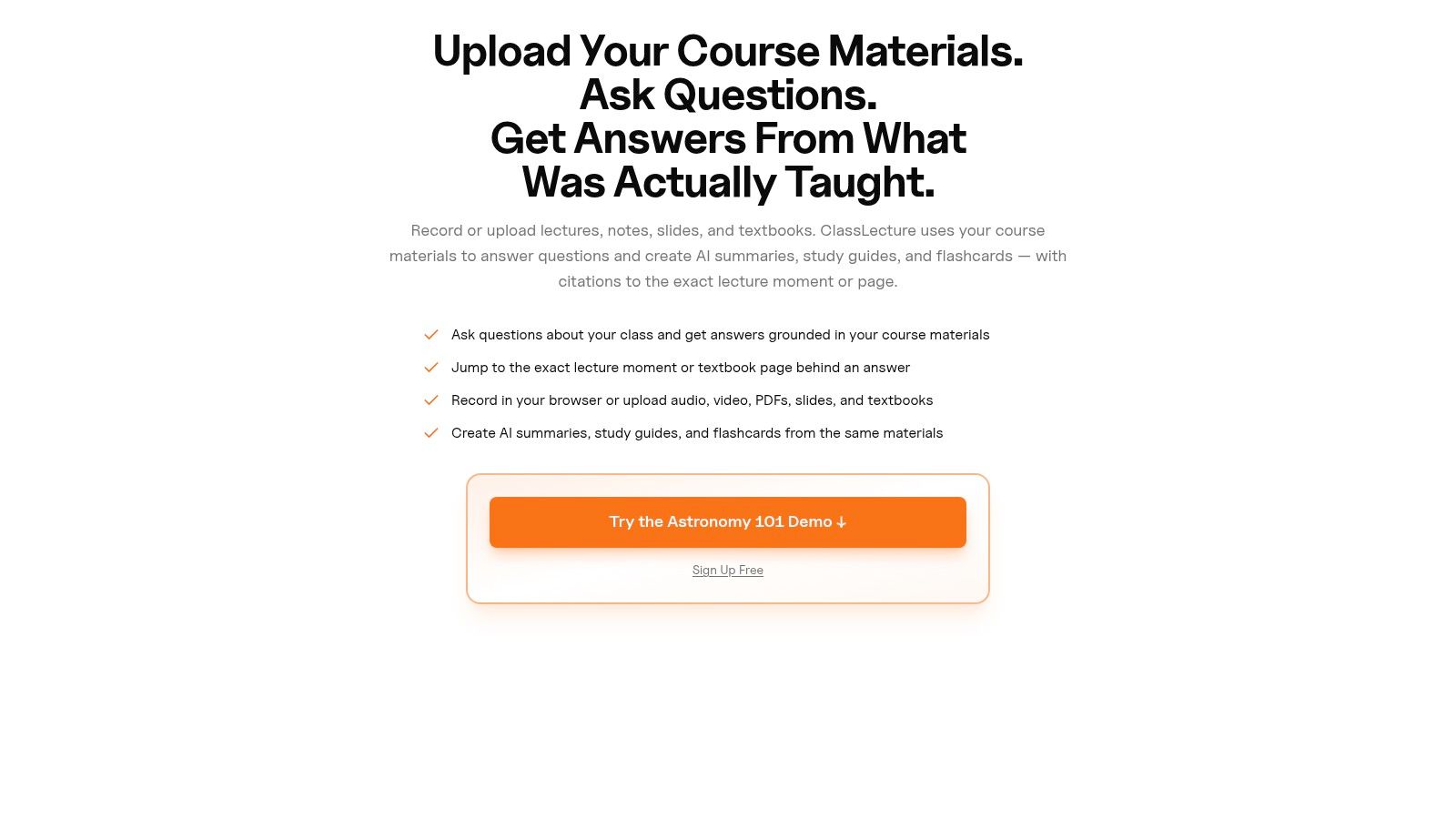
A ready-made deck is often the wrong starting point when your instructor uses different notation or emphasizes a particular proof. ClassLecture.ai lets you build the course-specific layer first by uploading or recording lectures, notes, slides, or textbook pages, then turning that material into searchable study resources.
Its main advantage is context. Answers can be grounded in uploaded content, with clickable timestamps for audio and page references for documents. If your lecturer explains why (\sin^2\theta+\cos^2\theta=1) matters in a proof, you can review that explanation instead of relying on disconnected formula cards.
The platform can record lectures or meetings in the browser, accept audio and video uploads, and produce transcripts, summaries, study guides, and flashcards. Cards can use question-and-answer or fill-in-the-blank prompts. FSRS scheduling organizes reviews through Again, Hard, Good, and Easy ratings. The free tier includes 3 hours of transcription per month, limited questions and uploads, and sample courses that do not require an account. Paid plans start at $17 per month when billed yearly, or $20 per month, according to ClassLecture.ai's study assistant.
Best use and important limits
Use it when your class has unusual notation, focuses on a specific proof method, or moves quickly from identities into equations and calculus. Prompts such as “Which identity family fits this expression?” and “What restriction should I check before dividing by (\cos\theta)?” turn passive formula review into transformation practice. Verify every generated card against your notes before relying on it.
The trade-off is review time. Transcription quality depends on recording clarity, and the vendor cites about 90 to 95 percent accuracy on clean audio on its product information page. Noisy recordings or overlapping speakers can produce incorrect wording and weak cards.
Practical rule: Use ClassLecture.ai to capture your course's explanations, then check each formula and transformation against a trusted reference or instructor solution before adding it to your main review deck.
2. Quizlet
Quizlet is useful for discovery, but a ready-made deck is not automatically a reliable study plan. Its searchable community library offers sets covering Pythagorean, reciprocal, quotient, cofunction, sum and difference, double-angle, and half-angle identities. That breadth helps when you need material quickly or want to compare how different courses present the same formula families.
Its Flashcards, Learn, Match, and Test modes support a quick shift from recognition to basic retrieval. Classes, folders, mobile apps, and extra AI-powered features through Quizlet Plus can also keep several course decks organized. The trade-off is that these features do not correct weak source material.
Quality control remains your responsibility. User-created sets may use inconsistent notation, omit restrictions, duplicate cards, or give a formula without explaining its conditions. Many decks ask only, “What is this identity?” rather than, “Which identity should I choose for this expression?” A verification-focused trig identities flashcard collection can help you check coverage, but verify every formula against class notes or an instructor-approved reference.
How to use Quizlet without wasting review time
Search for your exact course level, inspect the identity list, and test several cards before adopting a set. Choose decks that group identity families and show equivalent forms. If the prompts only test recognition, add transformation cards yourself.
Use this guide to making flashcards online to rewrite weak cards into retrieval prompts. Ask yourself to rewrite (1+\tan^2\theta) in terms of secant, identify the target form of a simplification, or choose between a double-angle and Pythagorean transformation. These prompts train the selection step that exam problems require.
Quizlet works best for finding a starting deck and completing quick revision. Pair it with verified notes and a separate review schedule when course alignment, transformation practice, or long-term recall matters more than speed.
3. Brainscape
Brainscape is useful when your main trig problem is review consistency, not finding another formula list. Its confidence-based spaced-repetition system asks you to rate how well you know each card, then uses that feedback to shape later practice. Weak identities can return more often, while familiar formulas take less of your review time.
The platform offers user-created and curated trigonometry collections, including curriculum-style material for A-Level Mathematics. That structure helps when your course follows a recognizable syllabus and you want a ready-made sequence instead of searching through unrelated decks. Check notation and coverage before adopting any collection, since user-created cards may still need correction.
Brainscape supports web and mobile study, and its collections can be easier to browse or print than a heavily customized system. Some premium content and features require Brainscape Pro, and plan availability can change. Review the current options on the Brainscape flashcards platform before making a paid collection the center of your workflow.
Where Brainscape earns its place
Use Brainscape for targeted repetition after you understand the identities. Select or build a deck covering reciprocal and quotient identities, then rate each card accurately. Choosing the easiest rating just to finish sooner weakens the schedule. Regular returns give missed cards more opportunities to reappear.
Brainscape does not teach identity transformations by itself. Confidence ratings strengthen recall, but they do not decide whether an expression calls for factoring, combining fractions, converting to sine and cosine, or applying a Pythagorean identity. Add decision prompts manually, or turn worked class examples into retrieval cards with flashcards for study notes.
A practical workflow combines sources: use a verified note set to confirm meaning, Brainscape to schedule repeated recall, and a printable backup for offline review. This makes the platform most helpful for students who need adaptive repetition without configuring a technical spaced-repetition system. Its trade-off is clear: less setup than Anki, but less control over mathematical card design and transformation practice.
4. Anki and AnkiWeb Shared Decks
Anki is the best choice for students who want complete control over mathematical notation and long-term deck maintenance. You can import shared trigonometry decks from AnkiWeb, edit them, and add your own cards using LaTeX, cloze deletions, custom templates, and reverse prompts.
That control matters for trig identities because one formula often needs several retrieval angles. A single card can ask for the identity, but a stronger deck may also ask you to recognize its family, reconstruct a missing term, identify a valid rearrangement, or explain a sign choice. Anki makes those variations possible without forcing every card into the same simple format.
The desktop and Android versions are free, and AnkiWeb provides syncing across supported devices. The interface is less friendly than Quizlet or Knowt, though, and new users need time to understand decks, note types, card templates, tags, and scheduling. The iOS app, AnkiMobile, is a separate paid purchase. Review the current options through AnkiWeb.
Build cards for transformations, not just formulas
A rigorous deck should include prompts such as:
- Formula recall: State the quotient identity for (\tan\theta).
- Reverse recall: Which identity rewrites (\sin\theta/\cos\theta)?
- Cloze practice: Complete (\sin^2\theta+___^2\theta=1).
- Strategy selection: Which family is suggested by (1+\tan^2\theta)?
- Error checking: What domain restriction matters before dividing by (\cos\theta)?
Anki works particularly well when you maintain the deck over a full course. It's excessive if you only need a quick review before tomorrow's quiz. For students new to the platform, this study flashcards app guide can help clarify how to separate simple recall cards from application prompts.
5. Knowt
Knowt suits students who need a ready-made trig identity deck and more practice than a static worksheet. Its community decks cover reciprocal, quotient, Pythagorean, sum and difference, double-angle, and half-angle relationships. Learn, Practice Test, Matching, and Spaced Repetition modes let you change the task without rebuilding the cards.
The main trade-off is control. Knowt is easier to start than Anki, especially if you want to import class material, but it offers less control over card templates and transformation prompts. Its Know and Don't know sorting works well for a short review session, while browser and mobile access support study across class and independent work.
Use a shared deck as a starting point, not as a syllabus guarantee. Check whether it asks for both directions, separates an identity from a rearranged equation, and explains restrictions before division. Advanced features, school or district tools, and licensing arrangements may have separate pricing, so check the Knowt learning platform for current access details.
When Knowt is the right compromise
Choose Knowt for a first pass through the major identity families or when you need a deck quickly. After reviewing, move missed cards into a smaller personal set. Rewrite some prompts around selection and transformation, such as choosing the identity family that can simplify an expression or completing a missing term.
A correct recognition response does not prove proof-ready recall. Pair Knowt with worked examples from class, and attach explanations to formulas that remain unclear. For long-term scheduling and detailed card design, Anki is stronger. For a printable backup, export or copy the identities into a document, then use Knowt to test recall before working without prompts.
6. Study.com Flashcards
Study.com suits students who need explanation before recall. Its Study Prep materials connect instructor-curated trig identity flashcards with video lessons and quizzes, so a formula does not have to stand alone. That makes the resource useful for relearning a topic or checking what an identity means before attempting transformations.
The trade-off is control. A guided sequence is easier to follow than a large user-generated library, but it gives you less freedom to design prompts around the exact errors you make. Review an identity group, watch the related lesson when the formula remains unclear, then use the quiz to test application rather than recognition alone.
Study.com is most useful for understanding how identity families fit together. Common groups include Pythagorean, reciprocal, quotient, sum and difference, double-angle, and half-angle forms, as summarized in Cram's overview of identity families. A lesson can explain relationships among equivalent forms, whereas a basic card may only display the final equation.
Who should choose it
Choose Study.com when instruction is the bottleneck. Start with a lesson if you are rebuilding the topic, then use the flashcards to retrieve formulas without looking. Students who already understand the identities and need rapid exam rehearsal may find the membership more structure than they need.
Access to much of the material requires a Study.com membership, and available plans can vary by region and time. Check Study.com Study Prep before depending on a particular access tier. After reviewing, write or simplify an identity from memory. For transformation practice, add prompts that ask which identity family applies and what step should come next. Pairing those prompts with source-grounded notes from ClassLecture.ai can preserve the lesson's explanation while giving you a smaller deck for targeted recall.
7. Quizizz Flashcards
Quizizz is most useful for a defined practice setting, not for proving that a deck covers every transformation skill. Use it when a teacher has assigned the material, when classmates share a course-aligned set, or when a short game-like session will help you start reviewing. Its library supports searches by resource type, including Flashcards, and can surface trigonometry sets for independent or classroom use.
The practical advantage is context. Teachers can assign a set, students can practise alone, and available classroom dashboards can show performance. Search and standards filters may also narrow results to a particular course. The trade-off is that a trigonometry set may test vocabulary, graphs, ratios, or one identity family instead of asking you to verify or transform an equation.
Check the level before studying. Trigonometric identities appear in materials for Class 8, Class 10, AS/A Level, and IB mathematics, as shown by Wayground's Class 10 trigonometric identities flashcards. That range makes the library useful for finding a starting deck, but the label alone does not confirm that its notation or difficulty matches your course.
Best classroom and solo workflow
Open a candidate set and inspect its answers first. Confirm that it uses your course's notation, includes equivalent forms, and targets the identity group you need. If the deck only asks you to recognize a formula, add a follow-up prompt from your notes or source-grounded material in ClassLecture.ai, such as “Which form would simplify this expression?”
Use the session to identify gaps, not to chase speed. After a missed or guessed card, rewrite the identity in another form and state what expression it can simplify. That written step turns recognition into transformation practice.
Teacher analytics and creation features may require paid plans, and access to a shared resource depends on how it was published. Check Quizizz's library before building your study plan around a specific feature.
8. StudyStack
StudyStack suits students who need a free, printable practice layer with little setup. Its community-created stacks cover trigonometric identities, and one set can be reviewed through matching, hangman, crosswords, and other games. The editor also lets you create, revise, and share cards quickly.
Each mode supports a different study job. Matching reinforces recognition, while crossword and recall activities require retrieval without displaying the complete answer. Printing helps when you want screen-free practice, a handout for a study group, or a backup for last-minute review.
The trade-off is quality control. Some stacks list formulas without explaining when to use them, omit equivalent forms, or combine identity notation with general trigonometry vocabulary. The games make repetition less tedious, but they do not check whether the mathematics is correct or whether the prompts require transformation.
Use it as a practice layer
Check a stack against your textbook or class notes before relying on it. Then edit vague prompts into tasks that resemble exam work, such as “Rewrite (\tan\theta) using sine and cosine” or “Which sign applies to (\cos(\pi-\theta))?” Explicit sign questions matter because (\cos(\pi-\theta)=-\cos\theta) and half-angle identities require the correct sign for the given interval. Use a verified reference, such as the Knowt's trigonometric identities collection, to check formulas before printing or sharing a revised stack.
Choose StudyStack for quick retrieval practice, low cost, and paper access. Pair it with ClassLecture.ai-generated, source-grounded prompts when you need more identity-meaning or transformation practice. Choose Anki or Brainscape when scheduled long-term recall matters more than games or printability.
9. Cram.com
Cram.com suits students who need a ready-made trig deck quickly, rather than a carefully engineered long-term system. Its community archive covers mathematics topics, including trigonometry and identities, so you can browse existing cards and begin reviewing with little setup. Core functions are simpler to configure than a spaced-repetition app such as Anki.
Study modes, mobile access, and printing or downloading make Cram useful for a backup deck. Printing also lets you annotate formulas by hand or keep a copy available when your usual study app is not convenient.
Quality control is the main trade-off. A deck titled “trig identities” may target another course level, use unfamiliar notation, or test formula recognition without asking you to transform an expression. Treat the archive as a source for candidate cards, not as a verified course resource.
A fast curation method
Open a deck and inspect its identity families before studying every card. Check for reciprocal, quotient, and Pythagorean identities first. Add sum and difference, double-angle, or half-angle forms only when they match your syllabus. These families organize a long formula list, but the cards should also show relationships and transformations instead of presenting disconnected equations.
Rewrite weak prompts as exam-style tasks. Ask yourself to express tangent through sine and cosine, select the correct sign for a related angle, or choose an identity that advances a simplification. Verify formulas against your instructor's notes before printing or sharing the revised deck.
Cram works best for quick retrieval, printable backup material, and prompts you plan to rebuild elsewhere. Pair selected cards with ClassLecture.ai-generated, source-grounded questions when you need practice explaining identity meaning or carrying out transformations. Use Cram's identity flashcards for a starting point, then check important cards against course materials.
10. Pearson+ Study Prep
Pearson+ Study Prep fits courses built around Pearson textbooks, eTextbooks, or Pearson+ Channels. Its “Trigonometric Identities” materials combine definitions, examples, video explanations, flashcards, and quizzes. That makes it a publisher-organized path for students who need to move from understanding an identity to recalling and applying it.
The main advantage is textbook continuity. Notation, terminology, and worked examples are more likely to resemble assigned lessons, which reduces confusion when equivalent identities appear in different forms. The trade-off is access. Pearson+ features may depend on a subscription or course bundle, and availability and pricing can vary by region, so check what your course includes before building your study plan around the platform.
Choose it for textbook continuity
Use Pearson+ when an assessment follows Pearson lessons and examples. Watch the explanation to clarify meaning, use the flashcard for recall, then take the quiz to test application. If your instructor uses another textbook, compare notation before adding Pearson cards to your personal deck.
Publisher consistency does not replace transformation practice. Add prompts that ask you to identify a target expression, choose an equivalent form that advances simplification, or explain why a denominator restriction matters. Those tasks better match verification and simplification problems than formula-recognition cards alone.
For longer-term recall, transfer the strongest cards into your regular spaced-repetition system. Pair them with ClassLecture.ai-generated questions grounded in your course materials when you need to explain an identity or complete a transformation. Pearson+ supplies continuity; your added prompts supply the exam-style work.
Top 10 Trig Identities Flashcard Tools Comparison
| Product | Core Features ✨ | Unique Selling Point ✨ | Quality/Experience ★ | Price/Value 💰 | Best for 👥 |
|---|---|---|---|---|---|
| 🏆 ClassLecture.ai | Transcripts, timestamped Q&A, AI summaries, auto flashcards, in-browser & meeting recording, bulk uploads | Source-grounded answers with clickable timestamps; end-to-end capture→study pipeline ✨ | ★★★★☆ (fast transcription, ~90–95% on clean audio) | 💰 Free tier (3h/mo); Paid from $17/mo (annual) | 👥 College & grad students, instructors |
| Quizlet | Massive flashcard library, Learn/Match/Test modes, classes | Huge community decks; quick ready-made trig sets ✨ | ★★★★☆ (varies by user-created decks) | 💰 Free basic; Quizlet Plus for AI/extras | 👥 General students & teachers |
| Brainscape | Confidence-based spaced repetition, curated libraries, apps | Adaptive confidence SRS for targeted repetition ✨ | ★★★★☆ (strong SRS) | 💰 Free core; Brainscape Pro for premium content | 👥 Learners focused on SRS & curriculum-aligned study |
| Anki + AnkiWeb | Powerful SRS, cloze/LaTeX support, community decks, sync | Deep customization and formula-friendly formatting ✨ | ★★★★★ (very powerful; steeper learning curve) | 💰 Free desktop/Android; AnkiMobile (iOS) paid | 👥 Advanced learners, long-term retention seekers |
| Knowt | Multiple study modes, import tools, free core studying | Easy imports from other tools; Quizlet-like workflow ✨ | ★★★☆☆ (consistent, simple UX) | 💰 Generous free core; paid for advanced/school features | 👥 Students wanting free, quick imports |
| Study.com Flashcards | Instructor-curated sets, integrated videos & quizzes | Lesson-aligned flashcards with guided explanations ✨ | ★★★★☆ (consistent quality) | 💰 Subscription needed for full access | 👥 Students prepping for exams / course-aligned learners |
| Quizizz (Flashcards) | Library filters, solo & classroom modes, teacher dashboards | Classroom-ready resources and teacher analytics ✨ | ★★★☆☆ (K–12-focused UX) | 💰 Free basic; paid educator tiers | 👥 K–12 teachers & students |
| StudyStack | Auto-generated study games (matching, hangman), printable sets | Quick game-based study from one deck ✨ | ★★★☆☆ (free, simple) | 💰 Free, ad-supported | 👥 Casual learners & game-style revision |
| Cram.com | Large archive of community decks, multiple study modes | Simple browsing and quick start for math/trig decks ✨ | ★★★☆☆ (wide but variable quality) | 💰 Free core features | 👥 Learners needing quick review |
| Pearson+ Study Prep | Publisher-curated flashcards + video explainers | Textbook-aligned flashcards & integrated practice ✨ | ★★★★☆ (publisher consistency) | 💰 Requires Pearson+ / bundle | 👥 Students using Pearson course materials |
Build a Deck You Can Use Under Exam Pressure
Choose the resource according to the study job, not the feature count. A curated platform such as Study.com or Pearson+ is useful when you need explanations and consistent terminology. Quizlet, Knowt, Quizizz, and Cram are efficient when you need to find or test a ready-made deck. Brainscape is a better fit when regular review is the problem, while Anki is the stronger option when notation, card structure, and long-term control matter. StudyStack is valuable for printable or game-based practice.
The best workflow usually combines more than one layer. Start with a verified source, then build retrieval prompts around the identity families your course uses. A compact foundation might include reciprocal identities, quotient identities, and Pythagorean identities such as (\sin^2\theta+\cos^2\theta=1), (\tan\theta=\sin\theta/\cos\theta), and (\csc\theta=1/\sin\theta). Add sum and difference, double-angle, and half-angle cards only when they appear in your syllabus or problem sets.
Formula-to-name recall is only the beginning. Study the reverse direction too. If the front shows “quotient identity,” retrieve (\tan\theta=\sin\theta/\cos\theta), and if the front shows (\sin\theta/\cos\theta), retrieve the name and useful interpretation. Then add at least one transformation prompt that asks what to do with an expression, not merely what an identity says.
A practical card set should include:
- Direct recall: State the identity accurately.
- Reverse recall: Identify the family or name from the formula.
- Fill-in-the-blank: Reconstruct a missing term or sign.
- Strategy selection: Choose the identity that moves an expression toward its target.
- Error diagnosis: Explain why a tempting rearrangement is invalid.
- Restriction awareness: State what must be nonzero before dividing or cancelling.
Don't skip the sign question. Cofunction identities, quadrant relationships, and half-angle formulas can require a positive or negative branch depending on the interval or angle. Revision materials commonly present forms such as (\sin(\pi/2-x)=\cos x), (\cos(\pi-\theta)=-\cos\theta), and half-angle formulas with plus-or-minus signs, but isolated presentation can leave students unsure which version applies (Knowt's identity flashcards). Put the reason on the back of the card, not just the symbol.
Before adding any card, verify it against your lecture, textbook, or instructor solution. If a generic deck doesn't match your course, use ClassLecture.ai to upload the relevant lecture, notes, or textbook pages and generate source-grounded flashcards tied to the original context. Review missed cards on the platform's spaced schedule, but also solve written identity problems so retrieval becomes selection and transformation under pressure.
A flashcard should make you do something before it shows you something.
The final test is simple. Can you see a mixed expression, identify the likely identity family, choose a form that reduces complexity, and explain any domain or sign condition without opening the answer? If not, the deck needs better prompts, not merely more cards.
ClassLecture.ai can turn your own trig lectures, notes, recordings, and textbook pages into citation-backed Q&A, summaries, study guides, and question-and-answer or fill-in-the-blank flashcards with spaced review. Upload your course material and visit ClassLecture.ai to build a deck that matches the notation and proof methods you'll face in class.
The ClassLecture.ai Team
We build ClassLecture.ai, the AI study assistant that turns your recorded lectures into transcripts, summaries, flashcards, and answers cited to the exact timestamp — so you learn faster from your own professor's words.
Keep reading
Flashcards for Study Notes That Actually Stick
Learn how to turn class notes and recordings into flashcards for study notes that boost recall with manual and AI workflows, spacing, and review tips.
Read10 Study Flashcards Apps for Lecture-Based Learning
Compare 10 study flashcards app options for lecture-based learning, including features, pricing considerations, limitations, and transcript-to-card workflows.
Read10 Functional Group Flashcards for Organic Chemistry
Compare 10 functional group flashcards and study aids for organic chemistry, with active-recall tips and ways to connect cards to lecture notes.
Read