10 Name for the Group Ideas for Class and Study Teams
Browse 10 creative options for a name for the group, sorted by tone and purpose, plus quick naming tips and prompts for class projects.

You're sitting with a pile of lecture recordings, scattered notes, and messages from classmates asking what the group should be called. The name may seem like a small decision, but it can shape how people show up. A playful label can make meetings feel welcoming. A source-focused label can remind everyone to check the recording before sharing an answer.
The best name for the group does more than sound good. It signals a working habit. Members know whether they're expected to recap lectures, build flashcards, verify sources, or discuss difficult questions. The ten ideas below move from broad and friendly to focused and evidence-driven. Each name comes with a practical rule that can guide your study sessions.
Table of Contents
- 1. Lecture Lab
- 2. Study Squad
- 3. Recap Crew
- 4. Flashcard Forge
- 5. Timestamp Team
- 6. Exam Ready Collective
- 7. Question Club
- 8. Transcript Trio
- 9. Source Syndicate
- 10. Virtual Seminar Circle
- Top 10 Group Name Comparison
- Choose a Name, Then Build the Habit Behind It
1. Lecture Lab
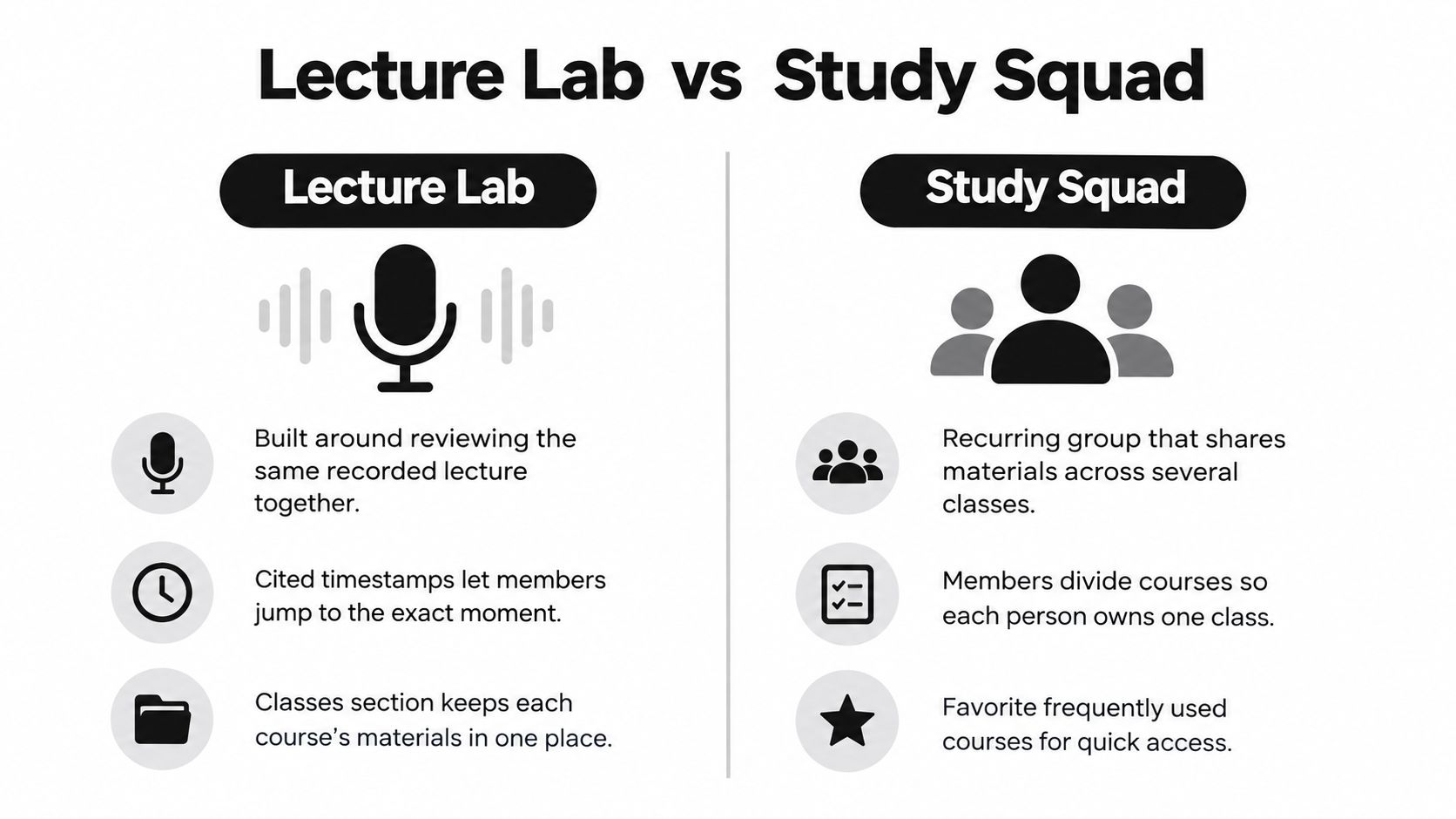
Lecture Lab suits students who want to study the material that was taught, not just a generic version of the subject. The group reviews recorded lectures together, compares notes, and checks explanations against the original audio or video. "Lab" suggests hands-on work. Members aren't only reading summaries. They're testing their understanding.
A pre-med group might upload each biology lecture to ClassLecture.ai, read the generated study guide, and compare it with personal notes. If the summary leaves out a qualification, the group can return to the transcript and find the relevant timestamp. A psychology cohort could first use the Psychology 101 sample course to practise its workflow, then apply the same process to its own recordings.
The operating rule
Each member should arrive with evidence from the lecture. One person can upload the weekly recording, while everyone else reviews the study guide before the meeting. During the session, each learner brings two questions with timestamps. That keeps the discussion tied to the source rather than memory alone.
Use the source scope selector when the group needs to separate materials. Compare answers based on transcripts only with answers based on uploaded textbooks only. This distinction helps the group notice whether a disagreement comes from the lecture, the textbook, or an incomplete note.
A useful rhythm looks like this:
- Upload consistently: Add the relevant lecture before the group meeting.
- Review independently: Read the summary and mark unclear sections.
- Question precisely: Bring timestamps instead of broad questions such as “What was that about?”
- Compare carefully: Check personal notes against the transcript before deciding that one version is correct.
Lecture Lab works especially well for medical, nursing, construction, and safety learners who need to trace a procedure or definition back to the teaching material. The name tells members to investigate, not just gather.
2. Study Squad
Study Squad is the broadest and friendliest option on the list. It works for a recurring group that shares materials, quizzes one another, and protects a regular study schedule. The name doesn't lock the group into one course or method, so it's useful for undergraduates managing several lecture-heavy subjects at once.
Consider four students taking different courses in the same term. Each person prepares one study guide per week and shares it with the others. Their meetings might include a biology recap, an accounting question, and a short review of a construction safety lecture. The group remains useful because its identity is based on shared accountability rather than one academic subject.
Keep ownership visible
Create a shared document with each member's name, course, and current responsibility. Rotate ownership each term. A student who manages a psychology class this term might take responsibility for a different subject later, which prevents the group from depending on one person as the permanent expert.
ClassLecture.ai can support the group's shared archive. Members can organize materials under classes by course code, school, term, and year. If a student misses a library session or online meeting, the group can use Record Meeting in Chrome or Edge to capture a Zoom or Google Meet study session for later review.
Practical rule: A Study Squad should always know who owns the next task, when it's due, and where the resulting material will be stored.
The name also leaves room for different study preferences. One member may learn through flashcards. Another may prefer a transcript and structured summary. A third may need to ask questions aloud. The group can support all three without changing its identity.
Use Study Squad when the group needs flexibility, especially at the start of a term. Add a short working rule beneath the name, such as “Share one useful study resource before every meeting.” The label stays welcoming, while the rule makes participation concrete.
3. Recap Crew
Recap Crew fits learners who understand lectures during class but lose the thread a day later. The group meets for short, regular reviews. Members revisit the transcript, read the AI summary, and confirm the main points before new material piles up.
A nursing cohort might hold a short recap call within 24 hours of each lecture. One student reads a summary point, another checks the corresponding transcript timestamp, and a third explains the idea without looking at the notes. Community college students could post one key takeaway per lecture in a shared channel, giving everyone a compact record of the course.
Make the recap active
A recap shouldn't become a quiet reading session. Give each meeting a simple sequence:
- Reconstruct the lecture: Each member states one idea they remember before opening the summary.
- Check the source: One person verifies a summary point against its transcript timestamp.
- Find the gap: The group identifies a term, step, or example that remains unclear.
- Test recall: Finish with three self-quiz questions based on the Q&A.
The timing matters because the group is trying to interrupt the habit of postponing review. A short session soon after class gives members a chance to correct misunderstandings while the lecture is still familiar. It also creates a repeatable expectation. People don't have to wait until an exam is close to discover that an important concept was never understood.
For an online course, the group can use a new conversation for each lecture topic. That keeps questions focused and makes it easier to return to a particular discussion later. Members can also export a useful Q&A session as a PDF when someone can't attend the recap.
Choose Recap Crew if the group values consistency over long meetings. Its working rule is clear: review promptly, verify one point, and ask questions before moving on.
4. Flashcard Forge
A class that keeps losing time to passive review needs a different habit. Flashcard Forge points to active building. Members do not just collect study material. They shape it into cards, revise it, and test themselves with it. The name fits courses full of definitions, steps, categories, or technical terms.
A graduate exam group might open the shared deck each morning and trim weak cards before anyone starts studying. A nursing group could turn textbook uploads into fill-in-the-blank cards, then adjust the wording so it matches the course language. Generated cards can save time, but the group still has to check accuracy and fit.
Build cards that earn a place in the deck
One card should test one idea. If a generated card mixes several procedures or leaves out an important condition, rewrite it. If a card does not reflect the lecture, textbook, or instructor emphasis, remove it. A large deck is only useful when each card earns its place.
That habit also shapes how the group studies. Instead of treating cards as a pile to get through, members use them as a shared checklist. ClassLecture.ai supports question-and-answer and fill-in-the-blank formats, along with scheduled review through FSRS. A 2025 meta-analysis of spacing and retrieval research reported a small-to-moderate overall benefit for spaced practice compared with massed practice, with Hedges' g = 0.28 across 27 studies and 53 effect sizes. The point is not that every card will work equally well. The point is that repeated retrieval gives the group a better chance to keep the material active.
For groups that build cards online, how to make flashcards online offers a useful process for turning notes into study material.
Use a shared review routine:
- Edit before adoption: Check each new card against the source material.
- Review when due: Keep the group on the same review schedule.
- Discuss difficult cards: Explain why an answer is correct, not just wrong.
- Treat readiness cautiously: Read the exam widget as a guide, not a promise.
For practical subjects, attach each card to a source location. A safety term should point back to the relevant manual page or lecture timestamp. That keeps memorisation tied to evidence.

5. Timestamp Team
A study group working through a lecture replay needs more than memory. Timestamp Team gives that habit a name. Every answer has to point back to a place someone else can check, such as a timestamp or a page number.
A construction trades cohort might compare a safety step with the exact page in an uploaded manual. An online class could attach the lecture time to each question. When someone asks, “Where did that come from?”, the team checks the record instead of defending a guess.
Verification is the group's default
Require every shared answer to include one of these details:
- Recording location: Add the relevant timestamp from the lecture or meeting.
- Document location: Include the page number from the textbook, manual, or notes.
- Scope information: State whether the answer came from the transcript, documents, or both.
- Correction note: If the source and a generated response differ, record what the group changed.
ClassLecture.ai's conversational Q&A can provide cited timestamps and document page references. Members can compare the audio-only scope with the documents-only scope when a lecture and a textbook use different examples or terms. Export strong Q&A sessions as a PDF to keep a shared reference file for later revision.
Knowledge becomes easier to trust when another student can trace it without asking who remembered it first.
The name fits medical, nursing, construction, and occupational-safety learners especially well. In those settings, a plausible explanation is not enough. The group needs to know whether the answer came from the instructor's recording, an uploaded manual, or a student's interpretation.
The habit also makes meetings more efficient. Instead of spending the first part of a discussion hunting for the right passage, members arrive with the evidence attached. The conversation can stay on meaning, application, and the parts that still need review.
6. Exam Ready Collective
Exam Ready Collective works like a training camp before a match. The name tells every member what the group does: it prepares for a specific exam, licensing test, or course assessment. It suits students who want to coordinate practice without pretending that any tool can guarantee an outcome.
A graduate cohort might meet weekly to review weak topics, due flashcards, and practice questions. Real estate prelicensing students could work through their own state-specific course materials and separate general study help from official requirements. In both cases, the name keeps attention on preparation, not on a predicted result.
The working habit behind the name is simple. Turn the target into weekly work.
Start with the material the group already has. List the lectures, chapters, manuals, and practice areas that members need to review. Then set weekly milestones based on lecture coverage or assigned content. Don't set a pass target based on an AI-generated estimate.
ClassLecture.ai's exam readiness widget can be one input among several. Pair it with practice-question performance, instructor feedback, missed-card patterns, and the official exam outline. Confirm current exam content and requirements with the issuing body. The platform's study materials should help members work with their own sources, not replace the authority responsible for the assessment.
A typical meeting runs in four moves. Each member names the topic they worked on. The group studies missed questions and explains the mistake. Members verify disputed points against course materials. Everyone then chooses a specific topic or review task for the next meeting. That last step matters most, because it converts the meeting into a commitment.
The name is motivating because it points toward action. It shouldn't create false certainty. A student can be better organised and still need more practice. The group should say "ready to review this topic" rather than "guaranteed to pass."
Use this name when members share an exam horizon and want a structured plan. Keep the working rule visible: prepare from the official requirements, practise from the group's materials, and treat progress indicators as guidance.
7. Question Club
Some students read a lecture three times and still freeze when the exam asks "why." Question Club exists for them. The name signals one working habit: members take turns asking the hardest questions about a lecture, then argue toward an answer together. It suits people who learn by explaining, challenging, and refining ideas rather than reading.
Picture a Tuesday session. One member opens with a question about a recorded seminar, citing the timestamp where the argument appears. Two others disagree about the evidence. The group replays the passage, checks the notes, and settles on a defensible interpretation. That conversation teaches more than an hour of silent review, because every member has to articulate a position out loud.
A psychology group could rehearse the method on the Psychology 101 sample course first, practising how to write strong questions before pointing them at its own lectures.
Let the question lead
Assign one member to write the opening question for each session. A weak question asks for a definition anyone can copy from the notes. A strong question asks why a process has a particular step, how two concepts differ, or what evidence supports an interpretation.
Start a new conversation for each major topic. That keeps the thread focused and preserves the original context. ClassLecture.ai's Q&A modes let the group ask follow-up questions over the same lecture or document, then export a strong discussion as a PDF for absent members.
A good question has three parts working together. Name the precise subject, the concept, passage, procedure, or example. State the genuine uncertainty, what seems confusing or incomplete. Add the source reference, the timestamp or page where the issue appears.
Speed should never earn the reward. Ask the person responding to explain their reasoning, then invite another member to challenge or improve it. This surfaces misunderstandings early, while they are still cheap to fix, instead of during the exam.
Research on study habits points the same direction. Students who used generative AI constructively, by questioning, augmenting, and reflecting on their understanding, showed stronger learning outcomes than those who accepted generated material at face value. That distinction is the whole point of the name. The group uses the tool to prompt thinking, never to replace it.
For ideas on turning source material into discussion prompts, see how to make quiz questions.
8. Transcript Trio
Transcript Trio fits a small group that wants clear roles. The name points to a shared task, not a decorative label. Each member helps with reviewing, correcting, and annotating lecture transcripts, so the group works like three editors checking the same class material from different angles.
A simple classroom setup makes the habit easy to see. One student takes the week one recording, another handles week two, and a third reviews week three. Each person listens for key terms, definitions, and lines that sound off. A coaching cohort can use the same pattern for weekly Zoom classes before the next meeting.
Divide complete sections
Give each person a full lecture or a full week. That keeps the context intact. A transcript is easier to fix when one person follows the whole thread instead of chasing scattered minutes across several files. After the first pass, the group merges corrections and turns the cleaned transcript into summaries, flashcards, or questions.
A clear routine helps the work stay consistent:
- Assign ownership: Give each person one complete lecture or week.
- Mark uncertainty: Flag names, technical terms, definitions, and lines that may be wrong.
- Correct against audio: Replay unclear sections before changing the transcript.
- Share the finished section: Make the reviewed transcript available before the next meeting.
ClassLecture.ai can turn uploaded recordings into searchable transcripts and study resources. New users can try the free Psychology 101 or English 101 sample courses before adding their own material. For a practical guide to the process, read how to make transcripts.
The name also sets a rule for the group. No one should become the unpaid transcription service. Each member owns a section, writes down corrections, and explains the choice when the group checks the final version. That habit keeps the work shared and the transcript easier to trust.
Transcript Trio works well for recorded courses where students may need to find a term later. A corrected transcript gives the group a stronger base for Q&A and study-guide creation. The original recording stays useful for double-checking any uncertain line.
9. Source Syndicate
Source Syndicate suits groups that pool documents, notes, textbooks, and research papers into a shared library. The word “source” makes the group's standard visible. Members are expected to distinguish between an instructor's lecture, a textbook explanation, a research paper, and a personal interpretation.
A graduate seminar might upload several papers and ask cross-paper comparison questions. An international student group could share a glossary built from textbooks used in different languages of instruction. The group's value comes from making its collective material searchable and easier to compare.
Build a clean library
Label every document before uploading it. Include the instructor, course, edition, and topic where relevant. Without labels, students may compare two sources that use different terminology or describe different versions of a procedure.
ClassLecture.ai supports notes and textbooks in formats including PDF, DOCX, EPUB, TXT, Markdown, HTML, and XML. The source scope selector can help members verify textbook claims using documents only, rather than blending the textbook with a lecture that may use a different framework.
Before sharing anything, confirm that the group has permission to use it. Course materials, research papers, workplace documents, and proprietary training content may have restrictions. Don't upload a document just because one member can access it. The right to view a file isn't automatically the right to redistribute it to a study group.
Shared library rule: Every document needs a clear label, a legitimate sharing basis, and a reason for being in the group.
Source Syndicate also encourages respectful disagreement. If two sources conflict, preserve both references and state the difference. Don't rewrite one source to match the other. A student preparing for occupational-safety training, for example, should know whether a point came from the course manual, an instructor's explanation, or an external paper.
Choose this name when the group's main challenge is fragmented material. It turns the shared library into part of the study method rather than a storage folder no one revisits.
10. Virtual Seminar Circle
Virtual Seminar Circle fits online groups that meet through Zoom, Google Meet, or Microsoft Teams. The name suggests conversation and reflection, not just a call where one person speaks while everyone else multitasks.
A professional coach could record a weekly Zoom class, share a summary and flashcard set with participants, and hold a follow-up discussion over the transcript. An online study group might meet each week, review the recording the next day, and identify questions that deserve a second conversation.
Record responsibly
Everyone needs to know that the session will be recorded. Get explicit consent before capturing a meeting, and check whether institutional rules, local law, or workplace policy impose additional requirements. Recording classmates, instructors, patients, clients, or proprietary training sessions without permission can create serious privacy problems.
ClassLecture.ai's Record Meeting tool captures tab or system audio from live sessions in Chrome or Edge, with optional microphone mixing. Test the audio capture before the first live meeting. A failed recording can't be reconstructed accurately from memory, so make the technical check part of the group's routine.
After each session:
- Confirm the recording: Check that the audio is usable before ending the workflow.
- Review the transcript: Correct obvious issues and flag unclear sections.
- Publish a summary: Share the main ideas in the group's agreed location.
- Create questions: Post quiz prompts within 24 hours so members can review while the discussion is still familiar.
The name also helps online participants feel that the meeting has an academic purpose. A seminar circle gives members permission to pause, ask for clarification, and return to a source. It isn't just a chat room with a recording button.
When a group uses this format, define access clearly. Decide who may view the transcript, whether exports can be shared, and how long recordings will remain available. A thoughtful workflow protects the people in the recording as well as the usefulness of the study material.

Top 10 Group Name Comparison
| Group | Implementation (🔄) | Resources (⚡) | Expected outcomes (⭐📊) | Ideal use cases (💡) | Key advantages |
|---|---|---|---|---|---|
| Lecture Lab | Moderate 🔄, coordinated uploads and review workflow | Recordings, transcripts, AI study guides; medium bandwidth ⚡ | High source-aligned comprehension and dispute resolution ⭐📊 | Verify lecture content; catch-up recaps after missed class 💡 | Source-anchored discussion; timestamp citations |
| Study Squad | Low–Moderate 🔄, role division and schedule coordination | Shared summaries, flashcards, simple org tools ⚡ | Broader coverage across courses; distributed workload ⭐📊 | Undergraduates juggling several lecture-heavy classes 💡 | Easy recruitment; workload distribution |
| Recap Crew | Low 🔄, short, regular meetings with minimal prep | Auto summaries, transcripts; low prep time ⚡ | Improved short-term retention and quick consolidation ⭐📊 | Rapid post-lecture reinforcement; learners with recall struggles 💡 | Fast recaps; low preparation overhead |
| Flashcard Forge | Moderate 🔄, card creation, review cadence, curation | Flashcard formats, FSRS spaced repetition, daily review time ⚡ | Strong long-term recall through scheduled reviews ⭐📊 | High-volume recall exams (licensing, quals, med/nursing) 💡 | Spaced repetition; shared class-wide decks |
| Timestamp Team | High 🔄, stringent citation and verification practices | Transcripts, timestamped Q&A, extra verification time ⚡ (slower workflow) | Highly verifiable answers and traceable claims ⭐📊 | Technical/procedural training; source-validation cultures 💡 | Verification-first habits; reduces source confusion |
| Exam Ready Collective | Moderate 🔄, structured milestones and tracking | Exam readiness widget, practice questions, flashcards ⚡ | Clear progress markers and targeted weak-area identification ⭐📊 | Graduate/professional exam cohorts and qualifying tests 💡 | Goal-oriented tracking; readiness metrics |
| Question Club | Low–Moderate 🔄, discussion facilitation recommended | Conversation threads, Q&A modes, facilitator time ⚡ | Enhanced critical thinking and deeper understanding ⭐📊 | Seminar-style learning; interpretive or debate-focused groups 💡 | Encourages questioning; creates reusable Q&A records |
| Transcript Trio | Moderate 🔄, divided transcription and annotation tasks | Bulk upload, transcript editing, assigned sections ⚡ | Thorough annotated transcripts with manageable per-person load ⭐📊 | Courses with many recordings; small committed teams 💡 | Efficient division of labor; detailed transcripts |
| Source Syndicate | High 🔄, manage multiple document types and rights | Document uploads (PDF/DOCX/EPUB/etc.), search/indexing ⚡ | Searchable shared library and cross-source comparisons ⭐📊 | Graduate seminars, literature reviews, multi-source courses 💡 | Aggregates sources; page-level verification |
| Virtual Seminar Circle | Moderate 🔄, recording consent and technical setup | Meeting recording tools, transcript generation, browser support ⚡ | Archived live sessions turned into searchable materials ⭐📊 | Remote coaches, international groups, time-zone–distributed teams 💡 | Converts live sessions to study assets; supports remote participation |
Choose a Name, Then Build the Habit Behind It
Pick the name that matches your group's main working habit. If members review recorded lectures against their notes, choose Lecture Lab. If they need a broad structure for several courses, Study Squad may fit better. Students who keep forgetting material after class might benefit from the prompt built into Recap Crew, while exam-focused learners may prefer Exam Ready Collective.
Write the operating rule beside the name in the group's shared space. The rule should tell members what to do, not merely describe the mood. “Bring two timestamped questions to every meeting” gives Lecture Lab a clear routine. “Review due cards before the session and edit unclear cards” turns Flashcard Forge into a real practice rather than a decorative title.
The name should also match the group's source habits. A Timestamp Team needs citations in its shared answers. A Source Syndicate needs labelled documents and permission to share them. A Virtual Seminar Circle needs consent before anyone records a meeting. If the name suggests a standard that the group won't follow, choose a simpler name or change the routine.
Test the choice for two weeks. Notice whether newcomers understand the group's purpose, whether members complete the expected task, and whether the name still fits once real coursework becomes busy. A group can rename itself without losing progress. The purpose is to make participation easier, not to create another rule students feel guilty about breaking.
Ask these questions before finalising the name:
- Which course or project do we share? Name the actual subject, term, or exam context.
- Which single habit matters most? Choose recapping, verifying, questioning, flashcards, or another observable action.
- Would a newcomer understand the purpose? Avoid a clever label that gives no clue about the work.
- Where will materials live? Decide whether recordings, transcripts, notes, and exports belong in ClassLecture.ai, a shared drive, or another approved space.
- Do we have permission? Confirm consent for recordings and sharing rights for every document.
The strongest group name acts as a small reminder during a busy week. A student sees “Recap Crew” and knows the lecture still needs review. A member of “Timestamp Team” knows that an unsupported answer isn't ready to post. A participant in “Question Club” arrives with something worth discussing.
Choose a name, write its rule, and try the routine with one upcoming lecture. If members can follow the habit without repeated explanation, the name is doing useful work. If they can't, revise the rule before changing the label. The goal isn't to sound impressive. It's to help people study together with clearer expectations, stronger source awareness, and less wasted effort.
Before sharing any recording or document, confirm that every participant has permission and that the material can be used in the group. That step belongs to every name, even the most casual one.
ClassLecture.ai turns your lectures, meetings, textbooks, and notes into searchable transcripts, cited Q&A, study guides, flashcards, and structured review materials. Visit ClassLecture.ai to try a practical workflow for your study group and build the habit behind its name.
The ClassLecture.ai Team
We build ClassLecture.ai, the AI study assistant that turns your recorded lectures into transcripts, summaries, flashcards, and answers cited to the exact timestamp — so you learn faster from your own professor's words.
Keep reading
English 101 and 102: Key Differences, Goals, and Tips
Compare English 101 and 102 to understand their goals, assignments, and how to study effectively for both courses.
ReadAP Art History Notes: 10 Resources for Better Study
Find AP Art History notes, flashcards, timelines, and study guides for the AP 250, plus ways to turn lectures and readings into better revision materials.
Read10 Check in Questions for Classes and Meetings
Discover 10 check in questions for classes and meetings, grouped by well-being, comprehension, and progress, with example phrasing and async tips.
Read