Biology Final Exam Study Guide: 2026 Success Plan
Use this biology final exam study guide to review key topics, practice questions, and proven strategies so you walk in confident and ready to score high.
Practice testing and distributed practice are the strongest broadly supported learning techniques, while summarization and underlining are less effective. A biology final exam study guide should therefore make you retrieve and apply ideas, not just reread them.
That sounds obvious until you look at how many students prepare. They highlight pathways, reread lecture slides, and recognize every term on the page, then freeze when an exam asks them to predict a phenotype, interpret a graph, or explain why an experiment supports one mechanism over another. Biology rewards reconstruction and transfer, not familiarity alone.
A useful guide turns each course objective into a question, schedules that question across several review sessions, and records the reasoning behind wrong answers. It also uses your own lectures, lab reports, notes, and textbook pages as the source material, because a generic summary can't reproduce the examples or emphasis your instructor uses.
Table of Contents
- Why Most Biology Review Plans Fail Before the Exam
- The Spaced Retrieval Schedule for Cumulative Review
- Turning Lectures Into Active Recall Assets with AI
- How to Detect and Fix Misconceptions in Biology
- Sample Practice Questions Focusing on Graphs and Experiments
- Building Your Final Exam Readiness Checklist
Why Most Biology Review Plans Fail Before the Exam
Rereading can make weak preparation feel successful. Familiar vocabulary and visible pathways create recognition, but recognition does not show that you can reconstruct a mechanism or apply it without cues.
That gap appears in common exam tasks. You may define promoter, transcription factor, and phenotype, yet struggle to predict the result of an inactive regulatory gene. You may identify the Calvin cycle in a diagram, then lose the carbon pathway when the labels disappear. Biology exams test transfer, the ability to move a concept into a new experiment, graph, or scenario.
A meta-analysis covering 242 studies, 1,619 effects, and 169,179 participants identified practice testing and distributed practice as the strongest broadly supported learning techniques, while summarization and underlining were less effective (Frontiers in Education review). The practical lesson is clear: productive study often feels harder than rereading because it requires you to generate an answer before seeing one.
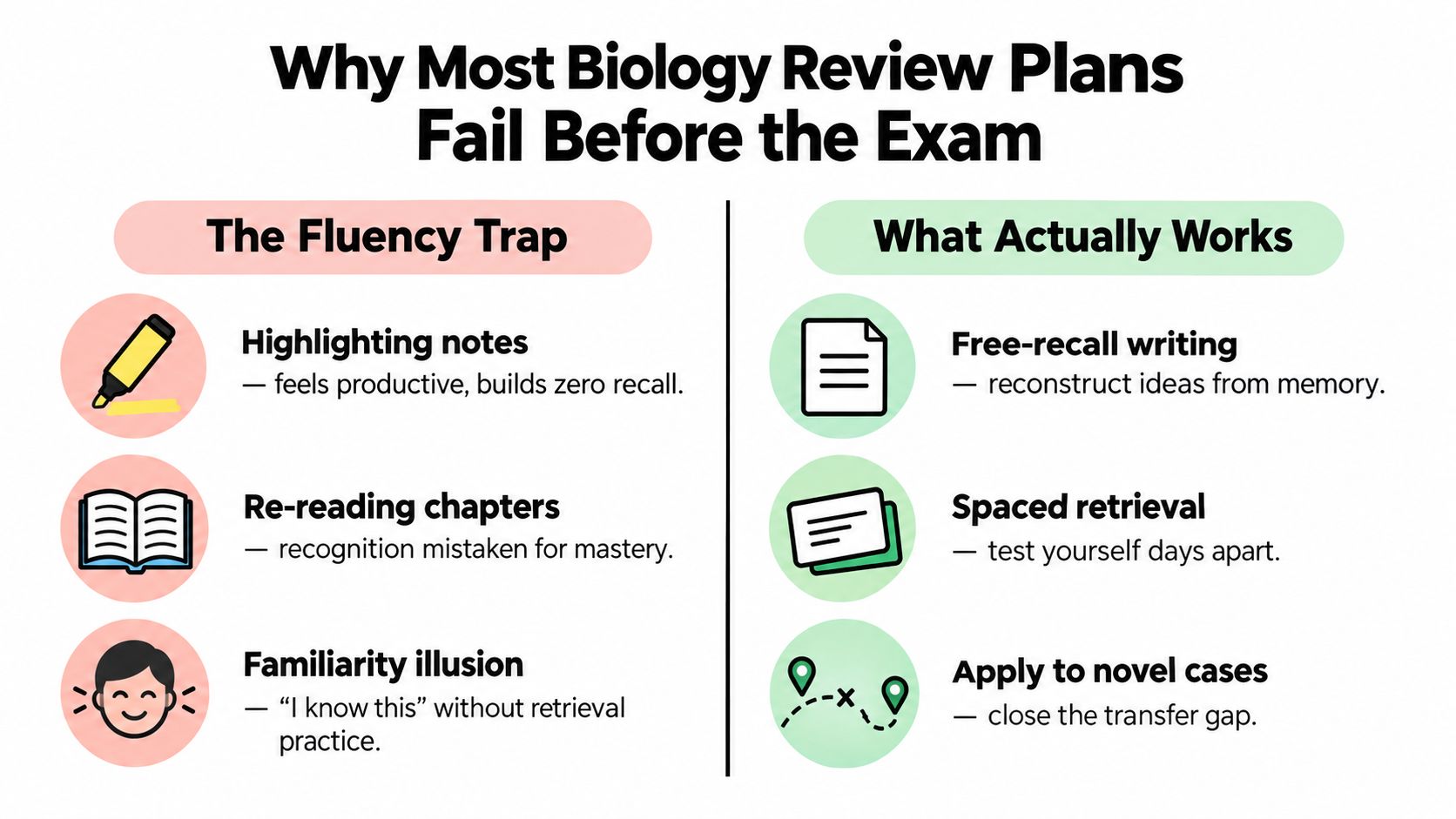
Recognition is not retrieval
Passive review supplies the answer first. Retrieval practice makes you produce a mechanism, definition, pathway, or prediction from memory, then compare it with a reliable explanation. That sequence exposes missing links instead of hiding them behind familiar wording.
Build questions that demand reasoning:
- Regulation: Predict the phenotype if a regulatory gene is inactive, then identify the disrupted step.
- Metabolism: Trace carbon through the Calvin cycle and explain where energy enters.
- Enzymes: Explain how temperature changes enzyme activity and what happens when structure is disrupted.
- Inheritance: Infer an inheritance pattern from unfamiliar family data and cite the evidence.
Write, speak, draw, or calculate before checking the answer. ClassLecture.ai can turn uploaded lectures and notes into question sets that preserve course-specific examples, then organize prompts around likely misconceptions rather than generic summaries. The tool supports the workflow, but your attempted answer remains the diagnostic evidence.
Immediate feedback prevents an incorrect explanation from becoming a practiced response. For every missed question, record the correct reasoning, the misconception behind your answer, and a second attempt.
Practical rule: If your study guide shows correct answers without explaining why tempting alternatives fail, it is incomplete.
That error record reveals the transfer gap directly. A student who can recite a definition but cannot predict an outcome needs mechanism-based questions, not another pass through the glossary.
The Spaced Retrieval Schedule for Cumulative Review
A three-hour cram session can create recognition without reliable recall. Spaced retrieval works better because each shorter session asks you to rebuild an explanation after some forgetting has occurred. That effort exposes the transfer gap: knowing a term is different from applying its mechanism to an unfamiliar graph, experiment, or prediction.
Evidence synthesized across roughly 300 spacing studies produced an average effect around 0.60. Research across nine introductory STEM courses also found a significant spacing effect when the courses were analyzed together, although the result varied by discipline (ERIC research summary). Treat those findings as a reason to distribute practice, not as a rigid formula.
A workable biology calendar
Schedule each major concept for at least three retrievals:
- First retrieval: Test yourself soon after learning. Use lecture objectives, diagrams, and lab observations to write questions that require an explanation.
- Second retrieval: Return several days later without opening your notes first. Mark which steps, relationships, or predictions disappeared.
- Cumulative retrieval: Mix the concept with older material during final review. Change the context so you must identify the governing principle before answering.
Biology rewards cumulative review because concepts depend on one another. Cell structure supports later physiology. DNA replication supports gene expression and inheritance. Energy transformations connect molecular reactions with organisms and ecosystems.
Avoid arranging every session by chapter order. Mix molecular, cellular, genetic, physiological, and ecological questions, then decide which principle applies. A feedback-regulation question might involve an enzyme pathway, a hormone system, or an ecological interaction. That variation trains transfer instead of sequence memory.
Keep an error log beside the schedule
Before answering, rate your confidence. After answering, record whether the reasoning was correct. A confident mistake needs more attention than a lucky guess, while a low-confidence correct answer may need another retrieval soon.
Concept inventories in introductory, genetic, molecular, cellular, and developmental biology are built around causal diagrams, data interpretation, and prediction items rather than definitions (ERIC research summary). Use that emphasis in your own log. Label every question by topic, confidence, error type, and next review date.
A flashcard system can manage due reviews through spaced repetition for flashcards. Keep the cards tied to reasoning, though. A definition card earns its place when it leads to an explanation, comparison, prediction, or application. ClassLecture.ai can support this schedule by turning course material into prompts, but your attempted answer remains the evidence that determines what to review.
Turning Lectures Into Active Recall Assets with AI
The raw material for a course-specific guide is usually already available. It may be spread across recorded lectures, slide decks, textbook chapters, lab instructions, and handwritten notes. The useful workflow is to convert those materials into questions tied to the exact concepts your instructor taught.
Start with your own sources
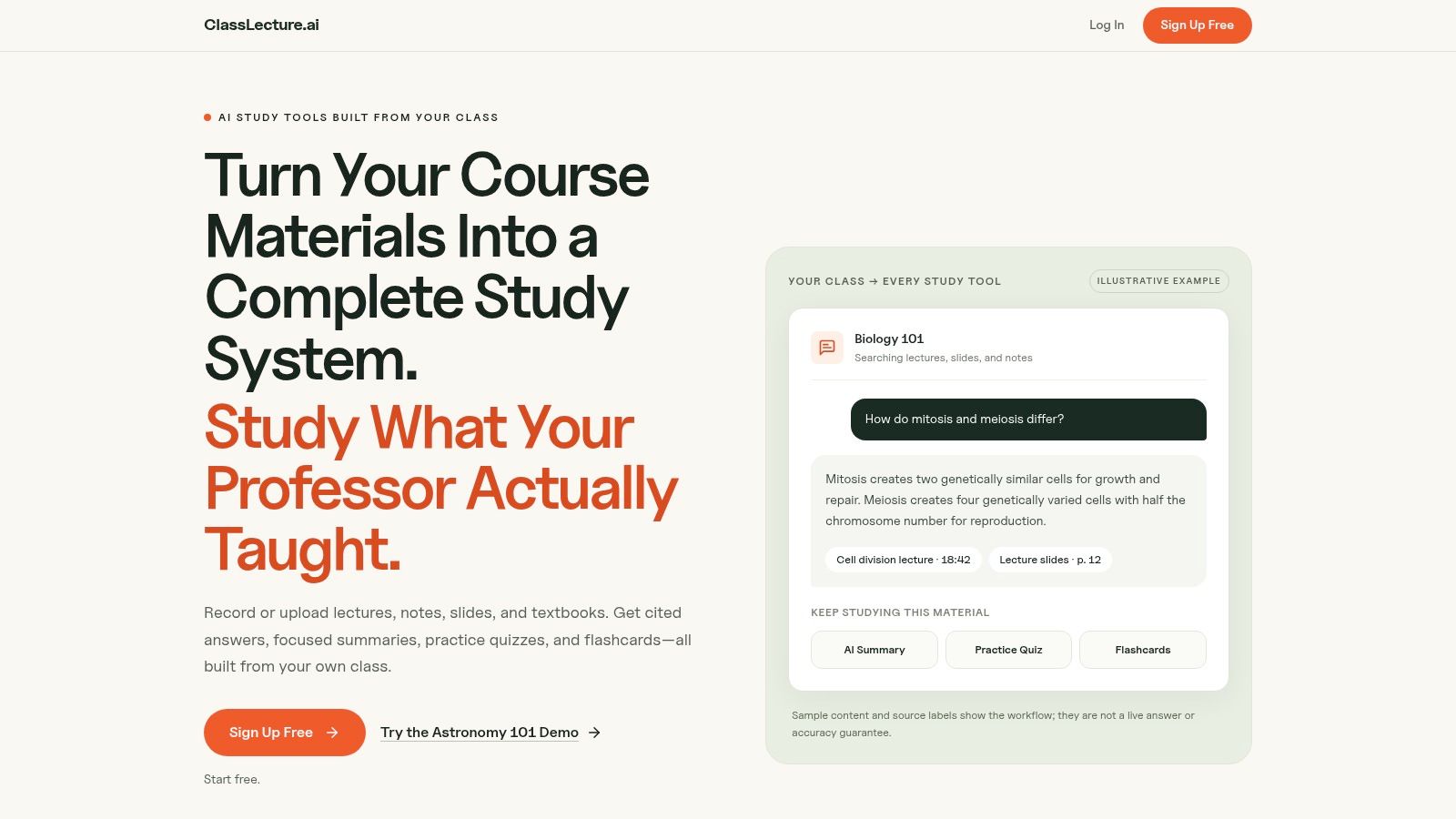
Upload the lecture recording, PDF slides, notes, or textbook extracts into ClassLecture.ai, then use the transcript and source-linked chat to locate explanations and references. The platform supports audio and video uploads, including MP3 and MP4 files, as well as PDF materials, and it can generate flashcards and structured study guides from uploaded course content. Its bulk upload workflow supports up to 80 audio or video files at once, with the first ten prioritized for faster transcription.
The important choice is the prompt. Ask for material that forces retrieval rather than a polished summary:
- “Create questions from the learning objectives in this lecture.”
- “Quiz me on the key concepts from slide 12, one question at a time.”
- “Ask me to predict the result before explaining the mechanism.”
- “Generate a short-answer question using the example from this lecture.”
- “Show why each distractor is wrong, then let me try again.”
This approach preserves your instructor's terminology and examples. It also helps you find where the lecture, textbook, and notes disagree or use different levels of detail. For more ideas about converting recordings into usable review material, see AI lecture notes workflows.
Use the conversation as a testing session
Don't read the generated explanation first. Answer on paper or aloud, then ask the tool to evaluate your reasoning against the uploaded source. Request page references or timestamps when a claim matters, and check the original slide or textbook if the explanation seems too broad.
A practical sequence looks like this:
- Upload a lecture and its related slides.
- Review the transcript for missing terminology or transcription errors.
- Generate questions grouped by mechanism, vocabulary, experimental design, and data interpretation.
- Answer without opening the explanation.
- Compare your reasoning with the source-linked response.
- Add missed concepts to the spaced review queue.
- Ask for a new question using a different biological context.
The tool should support your thinking, not replace it. A fluent answer can still be incomplete, overly general, or inconsistent with your instructor's model. Treat every generated explanation as a draft that must be checked against the course source.
Here is a short product demonstration that shows the general study workflow:
How to Detect and Fix Misconceptions in Biology
Knowing a term is the lowest level of biology mastery. The transfer gap appears when a student can define natural selection but says organisms develop traits because they need them, or can define correlation but treats a relationship between variables as proof of biological causation.
Your study guide should expose those errors directly. For each major idea, create a misconception check that asks you to choose between a tempting explanation and a causal one. Then require evidence.
A 2025 study of 241 upper-secondary students found that using ChatGPT for evolution produced only a slight improvement in subject expertise compared with traditional internet searching, while increasing students' willingness to use AI (University of Kassel report). The lesson isn't to avoid AI. It is to stop confusing enthusiasm, speed, or polished wording with understanding.
Turn wrong answers into targeted tests
Ask questions that make the hidden reasoning visible:
- “What would a student who confuses natural selection with need predict here?”
- “Give me a plausible but incorrect explanation for this pathway.”
- “Create a scenario where correlation is present but causation is unsupported.”
- “Explain why energy, rather than matter, is lost between trophic levels.”
- “Give me two competing explanations and ask what evidence would distinguish them.”
Then answer before requesting feedback. Have the system identify the exact step where your reasoning diverged from the source, not merely label the response correct or incorrect. If the answer depends on an assumption, ask it to name that assumption.
Use question-writing methods for study quizzes to vary the prompt type. A multiple-choice item can reveal which distractor attracts you, while a short-answer item shows whether you can build the mechanism without cues.
The test of a summary is not whether it sounds accurate. It is whether you can use the idea when the labels, order, and example change.
Source checking remains essential. AI may omit a condition, flatten uncertainty, or combine two mechanisms that your course keeps separate. Compare explanations with the relevant slide, page, or lab instruction, and keep a record of corrections in your error log.
Sample Practice Questions Focusing on Graphs and Experiments
A strong biology final exam study guide must include data work. Definitions won't prepare you to identify a control, interpret a trend, distinguish observation from inference, or decide whether an experimental conclusion is justified.
Use questions like these as models, then adapt the variables and examples to your own labs.
Question one, enzyme activity
An experiment measures reaction rate at several temperatures. The rate rises as temperature increases, then falls sharply at the highest temperature. What mechanism best explains the pattern, and what additional observation would support your explanation?
Reasoning: Separate the observation from the inference. The observation is a changing rate across temperature conditions. A defensible inference is that moderate warming increases molecular collisions, while excessive heat disrupts enzyme structure and reduces activity. A useful supporting observation would be loss of catalytic function under the high-temperature condition, especially if returning the sample to a lower temperature doesn't restore the original rate.
Don't answer with “temperature affects enzymes” and stop. State the direction of the effect, the likely molecular cause, and the evidence that would distinguish structural disruption from another explanation.
Question two, experimental controls
Researchers test whether a fertilizer affects plant growth. They give fertilizer to one group and water to another, but the fertilizer group receives more sunlight. What is the main design problem?
Reasoning: Sunlight is a confounding variable. Because the groups differ in more than fertilizer exposure, a growth difference can't be attributed confidently to the fertilizer. A better design keeps light, water, soil, container size, and starting plant condition comparable, with fertilizer as the intended independent variable.
The control is not just “the group that doesn't get the treatment.” It must provide a meaningful comparison while holding other relevant conditions steady.
Question three, interpreting inheritance data
A family pedigree shows affected offspring born to unaffected parents, with the trait appearing in different sexes. What inheritance pattern might you consider, and what additional information would you need before concluding?
Reasoning: Unaffected parents producing an affected child can be consistent with a recessive pattern, but the pedigree alone may not settle the question. You would inspect whether the trait skips generations, whether affected individuals cluster by sex, whether consanguinity is present, and whether the pedigree includes enough relatives to distinguish competing models.
The correct response avoids certainty unsupported by the data. “Recessive” may be a hypothesis, not a final conclusion.
Question four, calculating and explaining a rate
A culture begins with a measured cell count and ends with a higher count after a stated time interval. Calculate the average change per unit of time, then explain why that average may not describe every moment in the culture.
Reasoning: First identify the change, divide by the elapsed time, and include the appropriate units. Then distinguish an average rate from the underlying growth pattern. Cells may grow slowly during one phase, rapidly during another, and slow again when nutrients become limited.
For course-specific practice, ask ClassLecture.ai to create a question from the results in a particular figure of your uploaded lab report. Require it to preserve the variables, units, and conclusion limits from the source. You should still verify the generated item against the original figure before using it.
Building Your Final Exam Readiness Checklist
Readiness isn't the number of pages you've covered. It is your ability to retrieve a concept without prompts, explain its mechanism, interpret unfamiliar evidence, and correct your own reasoning under time pressure.
Build the final week around evidence from your practice rather than around the amount of content remaining.
The content system
Start with your course objectives and divide them into mechanisms, vocabulary, pathways, experiments, and data skills. A useful guide should contain different question types for each category:
- Mechanism prompts: Explain how a change at one step affects later steps.
- Prediction prompts: State what phenotype, graph, or pathway result you expect before checking.
- Diagram prompts: Reconstruct a pathway or feedback loop from memory.
- Data prompts: Interpret axes, trends, controls, rates, and limitations.
- Misconception prompts: Explain why a plausible answer is wrong.
- Transfer prompts: Apply a familiar principle to an unfamiliar biological system.
Your uploaded lectures and notes should provide the terminology and examples. Your questions should then force you to use those materials rather than copy them.
The review rhythm
Use a simple rotation:
- After learning: Create the first questions and answer them without notes.
- Several days later: Mix new questions with earlier weak areas.
- During cumulative review: Combine units and remove chapter-order cues.
- Before the exam: Use timed mixed sets, then review reasoning rather than just scores.
Distributed practice is more useful when every session includes older material. Don't spend the final evening rereading the first units from the beginning. Retrieve them in mixed order and let your errors determine what returns to the queue.
The feedback record
Keep one page or digital table with these columns:
| Field | What to record |
|---|---|
| Concept | The mechanism or skill tested |
| Your answer | What you initially predicted |
| Error type | Vocabulary, mechanism, calculation, evidence, or transfer |
| Correct reasoning | Why the supported answer works |
| Source | Lecture timestamp, slide, page, or lab figure |
| Next review | When you'll retrieve it again |
This record prevents a common failure mode: repeatedly practicing questions you already know while ignoring the same unresolved misconception.
The source-checking rule
AI-generated material is useful only when it remains anchored to your course. Check terminology, pathway order, experimental conditions, units, and exceptions against the uploaded lecture or textbook. If the source doesn't support a claim, mark it as uncertain instead of memorizing it.
A 2025 study of high-school biology learners in Ho Chi Minh City reported that students mainly used AI for exam preparation and homework, preferred AI quizzes over open-ended chat, and identified limited experimental capability plus accuracy and privacy concerns as barriers (Eurasia Journal of Mathematics, Science and Technology Education study). That supports a structured, evidence-first workflow. Quizzes can prompt useful retrieval, but they still need source checking and feedback.
The final readiness test
You are closer to ready when you can do the following without opening your notes:
- Explain the major mechanisms in plain language.
- Predict the effect of changing an important variable.
- Reconstruct key pathways from memory.
- Interpret graphs and identify relevant controls.
- Distinguish an observation from an inference.
- Explain why common distractors fail.
- Connect a new scenario to a principle from another unit.
- Identify which answers are guesses and schedule them for review.
Don't measure preparation by how polished your summary looks. Measure it by whether you can produce and defend an answer when the exam removes the familiar wording.
ClassLecture.ai lets you upload or record lectures, notes, textbooks, and other course materials, then work with transcripts, source-linked questions, flashcards, and study guides built around those materials. For a biology final exam study guide that targets your own lectures and lab content, upload your course files and try the workflow at ClassLecture.ai.
The ClassLecture.ai Team
We build ClassLecture.ai, the AI study assistant that turns your recorded lectures into transcripts, summaries, flashcards, and answers cited to the exact timestamp — so you learn faster from your own professor's words.
Keep reading
Flashcards for Study Notes That Actually Stick
Learn how to turn class notes and recordings into flashcards for study notes that boost recall with manual and AI workflows, spacing, and review tips.
Read10 Study Strategies for College Students That Work
Master study strategies for college students with 10 actionable methods for lectures, notes, exam prep, active recall, and AI-assisted review.
Read10 Best AP Government Flashcards for 2026 Exam Prep
Explore 10 AP Government flashcards from top study platforms, with import tips, usage guidance, and spaced-repetition practice for 2026 exam review.
Read