Calculus BC Study Guide: Master Every Unit & Ace the Exam
Get the ultimate calculus BC study guide to master every unit and pass the AP exam with confidence in 2026.

You've opened your AP Calculus BC notes, counted the units still needing review, and realized that “study everything” isn't a workable plan. The pressure gets worse when BC-only topics such as parametric motion, polar coordinates, and infinite series appear beside the AB foundations you're still expected to use fluently.
A better calculus BC study guide doesn't give every chapter equal attention. It shows you which ideas connect, which BC units deserve priority, how your score goal should shape your review, and how to practice in the digital environment you'll use. AP Calculus BC is demanding, but its structure is more predictable when you study by conceptual links, exam weighting, and response habits rather than by random chapter order.
In 2025, 160,436 students took AP Calculus BC, and 78.6% earned a score of 3 or higher. The mean score was 3.82, with 44.0% earning a 5, 21.9% a 4, 12.8% a 3, 15.2% a 2, and 6.2% a 1, according to the College Board AP Calculus BC score distribution. Those figures don't make the exam easy, but they do show that success is achievable at scale. Your task is to prepare deliberately, not to spend identical hours on every topic.
Table of Contents
- Introduction to Your Calculus BC Study Guide
- How Calculus Concepts Connect From Limits to Series
- Where to Focus First Based on Exam Weighting
- Essential Formulas and Linked Representations You Must Know
- Mastering BC Only Topics With Worked Examples
- Digital Exam Strategy for the Bluebook App Era
- How to Turn Lectures and Notes Into Lasting Recall
- Your Focused Plan for Exam Day Success
Introduction to Your Calculus BC Study Guide
Start with a student who has a few weeks left. They can differentiate familiar functions, but they hesitate when a problem asks them to interpret a table, justify an answer, or connect a derivative to a changing quantity. Series feels like a separate language, and digital testing adds another concern: even correct mathematics can become difficult to enter clearly under pressure.
That situation is common because BC combines all AB content with additional material, while expecting students to move quickly between algebraic, graphical, numerical, and verbal representations. A formula may be only the first step. You may also need to explain what the formula means, identify the relevant quantity on a graph, or use a table to support a conclusion.
This guide uses a priority-based approach:
- Build the connected foundation: Treat limits, derivatives, integrals, and accumulation as one developing story.
- Prioritize high-yield BC material: Give early attention to integration and accumulation, series, and the parametric, polar, and vector topics that distinguish BC from AB.
- Practice decisions, not just procedures: Learn why a convergence test, integration method, or motion formula fits a problem.
- Rehearse the digital workflow: Practice equation entry, calculator use, navigation, and free-response explanations in the Bluebook environment.
- Turn class materials into retrieval practice: Use your own lectures and notes to create questions, summaries, and repeated review opportunities.
If your goal is a 3, you need a dependable command of the AB foundation and enough BC fluency to collect additional points. If you're aiming for a 4 or 5, you'll need to make BC-only topics a central part of your preparation rather than leaving them for the final review days.
Study principle: Don't ask, “Which chapter should I finish?” Ask, “Which connected skill can I use accurately in several representations?”
The sections that follow are designed to be used over multiple study sessions. Read the conceptual explanation, work the examples without looking at the solution, then return to your notes and practice the same idea in a different representation.
How Calculus Concepts Connect From Limits to Series
Calculus becomes less intimidating when you see it as a chain of questions.
A limit asks what a function approaches as the input moves toward a value. That idea matters because the instantaneous slope of a curve can't be found by choosing two visibly separate points. You use a difference quotient, then let the interval shrink toward zero. The limit turns an average rate of change into a derivative.
You can think of this as zooming in on a curve. At ordinary scale, the graph bends. As you examine a sufficiently small neighborhood, the local behavior becomes increasingly close to a line, and the derivative describes that local slope.
A derivative then answers questions about motion, growth, and sensitivity. If position changes with time, its derivative describes velocity. If velocity changes with time, its derivative describes acceleration. In a different context, a derivative can describe how output responds when an input changes. The algebra changes from problem to problem, but the interpretation remains tied to rate.
An integral reverses that perspective. Instead of starting with a rate and asking how fast something changes, you begin with a rate and ask how much total change accumulates. A definite integral adds infinitely many thin contributions, such as small distances traveled or narrow strips of area.

The Fundamental Theorem as the bridge
The Fundamental Theorem of Calculus connects accumulation and antiderivatives. If a function records a rate, integrating it over an interval gives the associated total change. If you find an antiderivative, evaluating it at the endpoints lets you compute the accumulated amount without adding every thin slice individually.
The same relationship appears in several forms:
- Graphical: The integral represents signed area or accumulated change.
- Numerical: A table can provide values that support an approximation or accumulation calculation.
- Algebraic: An antiderivative or derivative rule produces an exact expression.
- Verbal: A response explains what the result means in the situation.
The official AP Calculus BC course overview emphasizes this connected reasoning across limits, derivatives, definite integrals, the Fundamental Theorem, and series. That means you shouldn't memorize each unit as a sealed container. A motion problem can require derivatives, integrals, units, and interpretation in one sequence of work.
Why series belong in the same story
A series extends the idea of approximation. Instead of using a finite expression alone, you study what happens when terms continue indefinitely. A power series can behave like an infinite polynomial, and a Taylor polynomial uses nearby information about derivatives to approximate a function.
The connection is subtle but important: limits control what happens as intervals shrink, while series examine what happens as the number of terms grows. In both cases, calculus asks whether an approximation approaches a meaningful value and how accurately you can describe it.
Where to Focus First Based on Exam Weighting
A ten-unit course can tempt you into a ten-part schedule, with the same number of study sessions assigned to every unit. That approach feels fair, but it isn't necessarily efficient. The College Board gives different units different exam weightings, so your review time should reflect the opportunities each area offers.
The official AP Calculus BC course information identifies Integration and Accumulation of Change at 15%–20%, Infinite Sequences and Series at 15%–20%, and Parametric Equations, Polar Coordinates, and Vector-Valued Functions at 10%–15%. These ranges make the priority order clear, especially because the latter group represents some of the content that separates BC from AB.
A practical triage map
| Priority Tier | Unit | Exam Weighting |
|---|---|---|
| Tier 1 | Integration and Accumulation of Change | 15%–20% |
| Tier 1 | Infinite Sequences and Series | 15%–20% |
| Tier 2 | Parametric Equations, Polar Coordinates, and Vector-Valued Functions | 10%–15% |
| Tier 3 | Remaining AP Calculus BC units | Refer to the official course weighting |
Treat Tier 1 as your first serious review block. You should be able to interpret accumulation graphs, connect rates to total change, select integration methods, and explain why a series converges or diverges. These skills also reinforce other areas, so time spent here often strengthens your performance beyond one isolated unit.
Tier 2 deserves focused practice rather than a quick formula read. Parametric and vector questions require you to distinguish a coordinate description from an ordinary function of (x). Polar questions require you to recognize how radius and angle describe a region. Those differences become easier when you solve several problems that ask for both calculation and interpretation.
Tier 3 still matters. Don't abandon limits, differentiation, differential equations, or applications just because their listed weightings may not be your first priority. Instead, maintain them with mixed practice after your highest-priority gaps are addressed.
Decision rule: If time is limited, secure the AB foundation, then devote concentrated practice to series, accumulation, and the parametric, polar, and vector topics instead of skimming every chapter equally.
Use a simple diagnostic. For each major skill, mark it as master, maintain, or repair. A master skill can be solved and explained without prompts. A maintain skill is reliable but needs occasional mixed questions. A repair skill causes repeated setup, notation, or interpretation errors. Your schedule should be built around the repair column.
Essential Formulas and Linked Representations You Must Know
A formula sheet is useful only when you know what a formula is measuring and when its conditions apply. On AP Calculus BC, the stronger habit is to pair every important expression with a picture, a numerical interpretation, and a sentence.
Limits and continuity
For a function to be continuous at (x=a), three ideas must agree:
- (f(a)) exists.
- (\lim_{x\to a} f(x)) exists.
- (\lim_{x\to a} f(x)=f(a)).
A graph may show a hole, jump, or vertical behavior. A table may suggest an approaching value. An algebraic expression may require simplification before the limit becomes visible. These are different windows into the same question.
Core connection: Continuity describes whether a function behaves without a break. Differentiability describes whether it has a well-defined local slope. A differentiable function must be continuous, but a continuous function need not be differentiable.
Differentiation rules
Know the rules, but attach a use case to each one:
- Product Rule: Use when two changing factors are multiplied, ((fg)'=f'g+fg').
- Quotient Rule: Use when one changing quantity is divided by another, (\left(\frac{f}{g}\right)'=\frac{f'g-fg'}{g^2}).
- Chain Rule: Use when one function is nested inside another, (\frac{d}{dx}f(g(x))=f'(g(x))g'(x)).
- Implicit Differentiation: Use when (x) and (y) appear together and (y) isn't isolated.
The graphical meaning stays stable: each result gives a slope. The verbal meaning depends on the context. A positive derivative might represent increasing population, rising position, or an increasing cost, so always include units and interpretation when the prompt asks for them.
Integration and accumulation
The substitution method works when you can identify an inner expression and its derivative. Integration by parts is useful for products where differentiating one factor makes it simpler while integrating the other remains manageable. Partial fractions helps decompose certain rational expressions into pieces with familiar antiderivatives.
For a rate function (r(t)), accumulated change over an interval is represented by
[ \int_a^b r(t),dt. ]
If (R'(t)=r(t)), the Fundamental Theorem gives
[ \int_a^b r(t),dt=R(b)-R(a). ]
The graph helps you see signed area. The equation computes it. The verbal response explains whether that area represents net change, total distance, or another quantity.

Series decisions
For a geometric series
[ \sum_{n=0}^{\infty} ar^n, ]
the series converges when (|r|<1), and its sum is
[ \frac{a}{1-r}. ]
For other series, the central skill is choosing a test that fits the structure. A comparison argument, ratio reasoning, integral reasoning, or alternating-series reasoning may be appropriate, but the test isn't interchangeable. State the conclusion and justify it using the conditions of the test.
When a Taylor polynomial approximates a function, ask three questions:
- What center is being used?
- What degree of approximation is required?
- How is the error bounded or interpreted?
A correct answer should connect the symbolic polynomial to the interval or input where the approximation is being used.
Mastering BC Only Topics With Worked Examples
A student preparing for a 5 should approach BC-only topics differently from a student still securing AB skills. Start with worked examples that expose the setup, because the calculation is often the shorter part. Parametric, polar, vector, and series questions use unfamiliar notation, yet they still ask about slope, motion, area, approximation, or accumulated change.

Parametric, polar, and vector motion
Suppose a curve is defined by (x=f(t)) and (y=g(t)). To find its slope, keep the parameter and use
[ \frac{dy}{dx}=\frac{dy/dt}{dx/dt}, ]
provided (dx/dt\neq 0). For motion, the velocity vector is
[ \langle x'(t),y'(t)\rangle, ]
while speed is its magnitude,
[ \sqrt{(x'(t))^2+(y'(t))^2}. ]
A component measures change in one coordinate. Speed combines horizontal and vertical change, like the length of a diagonal path rather than one side of a rectangle. Label the requested quantity before calculating so that (x'(t)) is not reported as speed.
For a polar curve (r=f(\theta)), area is
[ A=\frac12\int_{\alpha}^{\beta}[f(\theta)]^2,d\theta. ]
The setup deserves as much attention as the integral. Sketch the curve, mark the angle interval, and check whether the interval traces the region once. If a loop or shaded region is ambiguous, a quick graph can prevent an otherwise correct formula from producing the wrong area.
Series and error bounds
Consider
[ 1+\frac12+\frac14+\frac18+\cdots. ]
Here (a=1) and (r=\frac12), so the series converges to
[ \frac{1}{1-\frac12}=2. ]
A partial sum gives only part of the total. The omitted tail is the error, so a question asking for accuracy requires more than finding the limit. For a geometric series, use the first omitted term and the ratio to determine how many terms meet the requested bound.
For an alternating series, the first omitted term bounds the error when the required conditions hold. State the bound and interpret it: the partial sum lies within that amount of the limiting value. A complete response usually follows this sequence:
- Identify the series type or test.
- State the condition being checked.
- Compute or compare the relevant expression.
- Give the convergence or error conclusion in a sentence.
Score goals should shape the order of practice. A student targeting a 4 or 5 should bring BC-only skills into regular timed work rather than postponing them. A student targeting a 3 may secure dependable AB methods first, then add focused BC questions. Use the College Board score distribution data as context, not as a promise that one topic guarantees a particular score.
Turn worked explanations into retrieval prompts with this guide to making quiz questions. Ask yourself why a formula applies, what the symbols represent, and what the result means.
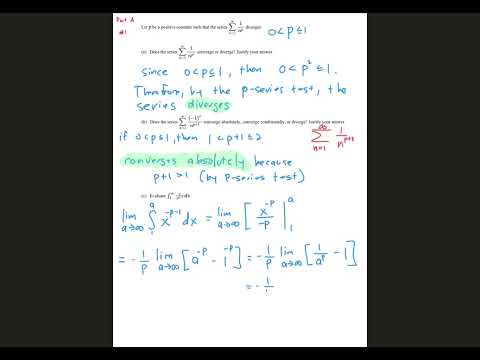
Here's a visual walkthrough to watch after attempting the examples:
Digital Exam Strategy for the Bluebook App Era
Paper practice can create false confidence if you never rehearse the digital workflow. Recent coverage of the exam changes explains that AP Calculus BC is administered in the Bluebook app, with an on-screen equation editor and no built-in graphing calculator, so students need to prepare for both mathematical reasoning and screen-based execution in the Bluebook-focused exam update.
Practice the tools, not just the problems
Use the equation editor while entering fractions, exponents, roots, integrals, and derivative notation. Slow entry can interrupt your reasoning, so practice until the symbols you use frequently feel familiar. You should also rehearse how you'll write a free-response explanation, including definitions, units, interval references, and conclusions.
A calculator workflow deserves its own routine. Decide when you'll use a graph, numerical table, derivative function, integral function, or algebraic work. Don't reach for the calculator before identifying what quantity the problem asks you to find. A fast calculation of the wrong quantity is still wrong.

Use a repeatable rehearsal
During practice, recreate the conditions that cause avoidable mistakes:
- Enter symbolic work: Use the same equation-entry method you expect to use during the exam.
- Check navigation: Practice moving between parts without losing your place or leaving a response incomplete.
- Write explanations digitally: Type concise justifications instead of relying on handwritten shorthand.
- Review calculator decisions: After each problem, record why you used a particular function or graph.
- Leave a verification pass: Check signs, bounds, units, and whether your final sentence answers the actual prompt.
International and first-time AP test takers may feel this shift most sharply because familiar paper habits don't automatically transfer to a digital interface. A short, regular Bluebook rehearsal is more useful than discovering the editor, navigation, or calculator expectations on test day.
For a broader workflow around using digital study support, see this overview of an AI-powered study assistant.
How to Turn Lectures and Notes Into Lasting Recall
Rewatching a calculus lecture can feel productive because the examples look familiar. Familiarity isn't the same as retrieval. If you can follow your teacher's solution but can't reproduce the setup with the notes closed, the idea still needs active practice.
Start by turning each lesson into questions. Instead of writing “integration by parts,” write, “How do I recognize when integration by parts is more appropriate than substitution?” Instead of copying a Taylor polynomial example, ask, “What does the degree tell me about the approximation, and what information do I need about the center?”
Build a retrieval cycle
A useful cycle looks like this:
- Capture the explanation: Keep the lecture recording, transcript, or class notes with the topic.
- Create a short summary: State the central idea, the conditions, and one common error.
- Question yourself: Answer conceptual and computational prompts without looking.
- Correct precisely: Compare your response with the source and identify the first incorrect step.
- Return later: Revisit the question after a gap, then mix it with problems from another unit.
Your questions should vary in form. Ask for a graph interpretation, an algebraic derivation, a verbal justification, and a decision between two methods. This mirrors the exam's expectation that students analyze functions across multiple representations, rather than repeating one familiar exercise.
Use your materials as the source
Your teacher may use a particular notation or explanation that differs from a commercial guide. Keeping questions tied to your own lecture and notes preserves that classroom context while giving you a searchable record of definitions, examples, and corrections.
The lecture recording to notes workflow can help you organize that process. You can use transcripts to find the moment a method was introduced, summaries to create a compact review page, and generated flashcards to test definitions, conditions, and error recognition.
A strong review session ends with a blank page, not another passive replay. Write what you remember, solve one unfamiliar problem, and explain why your method works. That combination reveals whether you understand calculus as a connected system or only recognize the appearance of a worked example.
Your Focused Plan for Exam Day Success
Use your final review to repair the highest-impact gaps first. Recheck accumulation, series, and BC-only representations, then maintain the AB foundation with mixed problems. Practice equation entry, calculator decisions, and typed free-response explanations in Bluebook, and review every error by identifying the first wrong choice, not just the final wrong answer.
Remember that calculus isn't a collection of isolated formulas. Limits support derivatives, derivatives describe rates, integrals accumulate change, and series extend approximation. Follow that chain, and your study time will produce understanding you can carry into unfamiliar questions.
ClassLecture.ai can turn your calculus lectures, recordings, textbooks, and notes into searchable transcripts, conversational Q&A, flashcards, and structured study sessions. Use your own class materials to build retrieval practice around series, accumulation, and BC-only topics, then visit ClassLecture.ai to start organizing your review.
The ClassLecture.ai Team
We build ClassLecture.ai, the AI study assistant that turns your recorded lectures into transcripts, summaries, flashcards, and answers cited to the exact timestamp — so you learn faster from your own professor's words.
Keep reading
10 AI Flashcards Maker Tools for Students
Compare 10 ai flashcards maker tools for student workflows, source checking, imports, exports, spaced repetition, and lecture-based study.
ReadBest Meeting Transcription App: 10 Top Picks
Compare the best meeting transcription app options for accuracy, formats, integrations, pricing, privacy, students, and instructors.
Read7 APUSH Review Flashcards and Study Resources
Find the best APUSH review flashcards, compare seven study resources, and learn how to vet, import, and recreate decks in ClassLecture.ai.
Read